
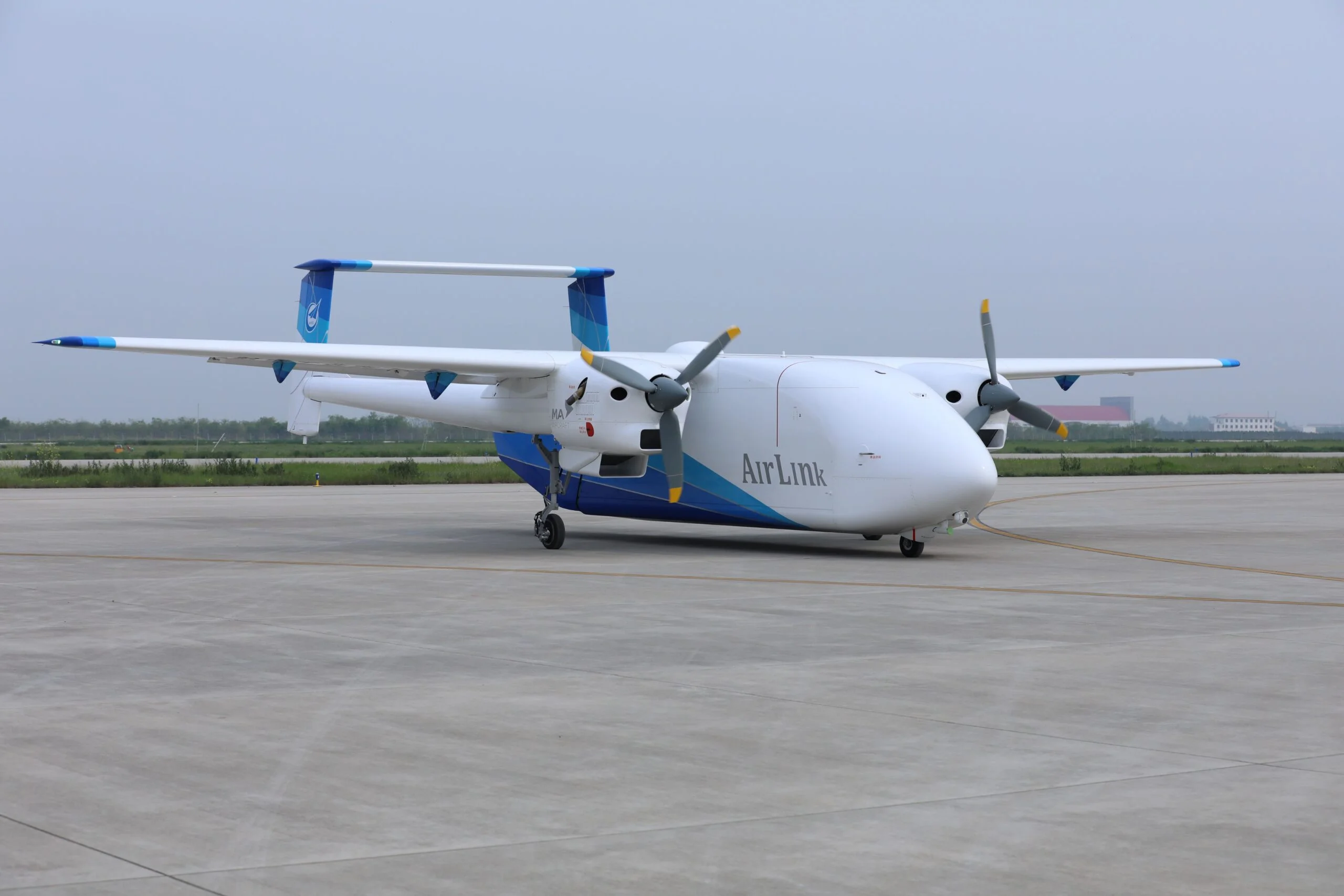

China’s HH-200 unmanned cargo aircraft, developed by AVIC, has completed its maiden flight, marking a new milestone in large-scale autonomous air freight and low-altitude logistics development.
The HH-200, a commercial unmanned aerial transport system, completed its maiden flight on the morning of April 15 at the Aviation Industry Corporation of China (AVIC) Civil Aircraft Flight Test Centre in Weinan, marking new progress for China in the development of large-scale unmanned cargo aircraft, CNS reported.
All aircraft systems worked normally. The flight remained stable throughout and completed its planned test profile smoothly.
Aircraft Configuration and Performance
AVIC independently developed the HH-200. It features a square, straight-through fuselage layout, a twin-engine high-wing configuration, and a twin-boom tail design.
It has a standard cargo volume of 12 cubic meters, expandable to 18 cubic meters, and a maximum payload of 1.5 tonnes. The aircraft cruises at 310 km/h and has a range of 2,360 km.
Engineering Design and System Capability
Meng Fantao, technical director of the Xinzhou Honghu HH-series unmanned transport system, said the team used advanced structural design and manufacturing methods, with extensive use of composite materials. This reduced overall weight by about 20% and also helped lower production costs.
He added that the HH-200 is built to civil aviation standards. It supports fully autonomous flight and AI-based obstacle avoidance. Its service life reaches 50,000 flight hours and 15,000 takeoff and landing cycles.
Operational Performance and Application Scenarios
The HH-200 shows strong adaptability in complex environments. It can operate from runways as short as 500 meters and from high-altitude airports above 4,200 meters. It also performs reliably in extreme temperatures from minus 40°C to 50°C and in complex weather conditions.
These capabilities support low-altitude logistics in mountainous regions, islands, snowy areas, and plateaus. They help reduce transport barriers and support emerging unmanned freight networks.
The HH-200 is expected to serve multiple logistics markets, including border and coastal transport, inland point-to-point cargo routes, and cross-island freight in Southeast Asia. It may also support air cargo networks across Belt and Road partner countries.
In the future, operators will adapt the platform for multiple roles, including emergency rescue, forest firefighting, weather modification, aerial remote sensing, and agricultural and forestry applications.
If you liked this article, why not read: China’s Saucer-Shaped eVTOL Aircraft Advances Urban Mobility


