
China tests a saucer-shaped eVTOL aircraft in Wuhan, designed for urban transport, emergency rescue, and low-altitude mobility.
A silver, saucer-shaped aircraft lifts straight into the air, hovers, moves sideways, and lands smoothly. This scene looks like science fiction. However, it is real. Reporters recently witnessed the test at a training site in Wuhan’s Optics Valley Low-altitude Economy Park.
What is the E-HAWK?
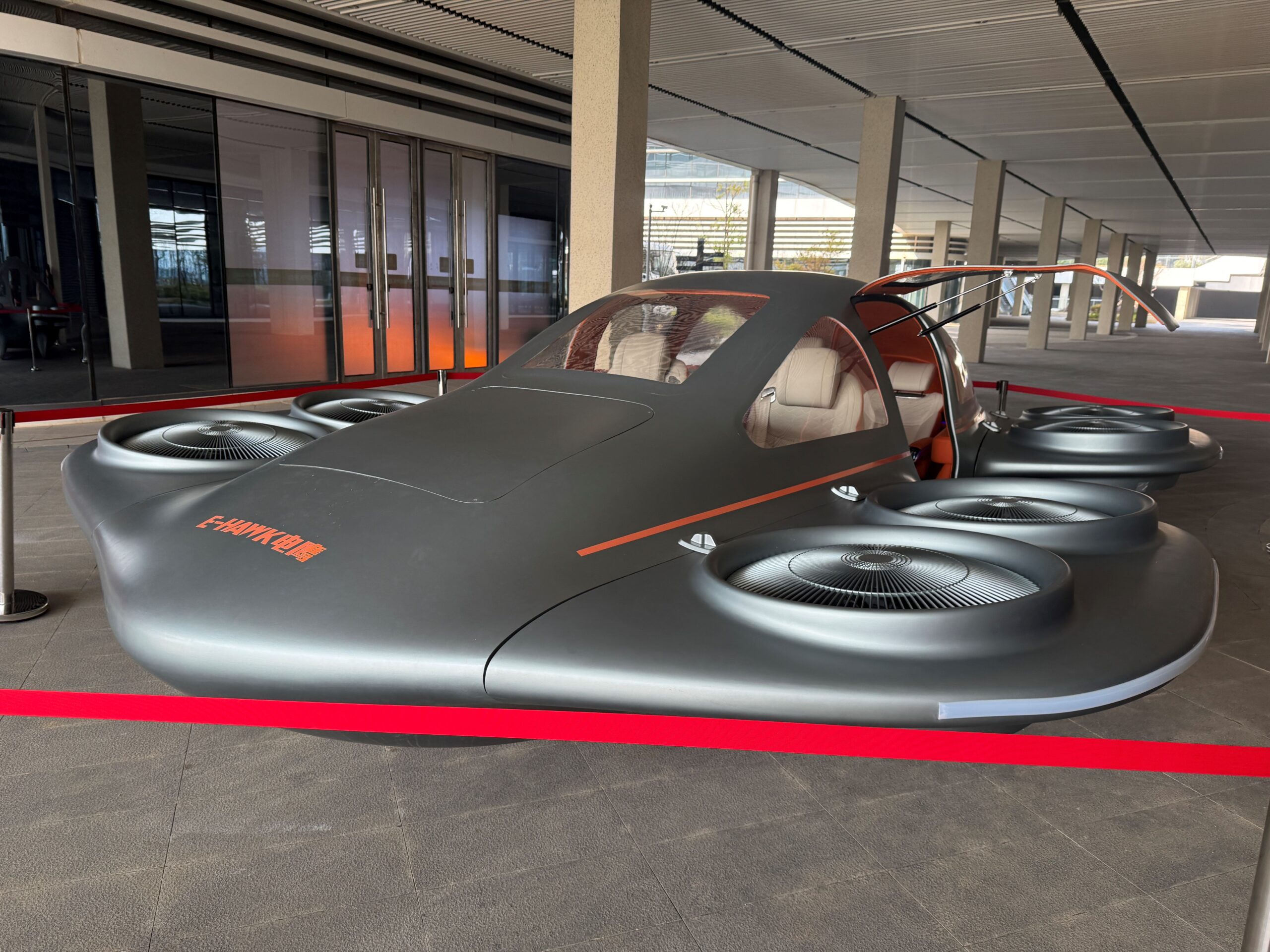
The aircraft, named E-HAWK, is a fully ducted, electric vertical takeoff and landing (eVTOL) vehicle. A Wuhan-based research team independently designed and developed it. It is the first ton-class aircraft of its kind with a fully enclosed ducted system.
The body is compact and rounded. It measures less than six meters across and takes up about the space of four parking spots. It can take off and land vertically, so it does not require a runway.
In terms of performance, the E-HAWK has a maximum takeoff weight of 1.2 tons and can carry up to 450 kilograms. It can travel up to 150 kilometres on a full charge, with a charging time of around two hours.
Inside the cabin, the design is minimal and futuristic. There is no steering wheel or traditional dashboard. Instead, a one-meter touchscreen controls the system and offers entertainment functions. Four leather seats offer enough space even for taller passengers.

Key Technology and Development
The idea was inspired by the film Avatar. Founder Cai Xiaodong said he was inspired by aircraft that can move freely through dense forests. He began to explore whether such a vehicle could enter everyday life.
At that time, there was little domestic experience to follow. The team had to develop key systems from scratch, including the ducted structure, flight control, and power configuration. Over seven years, they produced nearly ten iterations. In July 2025, the aircraft completed its first successful flight.
One breakthrough lies in its eight ducted “hidden wings.” The team achieved millimetre-level precision to fully enclose the rotors. As a result, the design reduces the risk of collision and lowers noise. It also allows the aircraft to operate close to buildings or in narrow urban spaces.
The team has completed more than 140 test flights, including extreme scenarios. For example, during simulated high-rise fire rescues, the aircraft can approach windows or balconies at close range. It can even stabilise a building to allow direct access for rescue personnel.
Future Applications
For now, the E-HAWK will mainly serve logistics and emergency rescue. Meanwhile, its role in urban transport is under development.
Cai estimates that, within five years, low-altitude networks could support passenger services. At that stage, users may book an air taxi through a mobile app. A 20-kilometre trip could take about 15 minutes, helping avoid road congestion.
The project has already received strong market interest. Potential clients come from regions including Southeast Asia and the Middle East. Planned uses include island transport and low-altitude tourism.
Additional reporting by Wu Yili.
If you liked this article, why not read: Sky Dragon V5000: China Pushes eVTOL Limits with 5-Ton Aircraft