
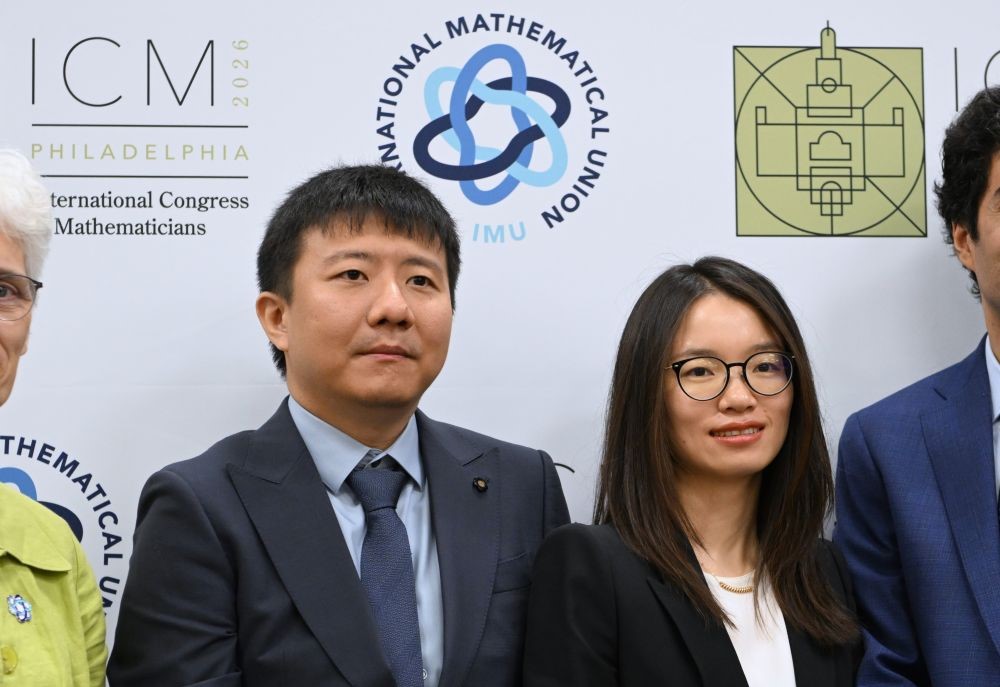

Yu Deng and Hong Wang become the first mathematicians of Chinese nationality to win the Fields Medal, marking a milestone for Chinese mathematics.
The two Peking University alumni become the first mathematicians of Chinese nationality to receive the award, widely regarded as the highest honour in mathematics.
Chinese mathematicians Yu Deng and Hong Wang were awarded the 2026 Fields Medal on July 24 at the opening ceremony of the International Congress of Mathematicians (ICM) in Philadelphia. They became the first mathematicians of Chinese nationality to receive the prize.
The Fields Medal, presented every four years by the International Mathematical Union (IMU), is widely regarded as the highest honour in mathematics. First awarded in 1936, it recognises outstanding mathematical achievement and future promise, and is awarded to mathematicians under the age of 40. This year, four mathematicians received the medal. The other winners were Jacob Tsimerman of Canada and John Pardon of the United States.
While mathematicians of Chinese descent, including Shing-Tung Yau and Terence Tao, have previously received the Fields Medal, Deng and Wang are the first recipients of Chinese nationality.
Recognised for Groundbreaking Research
Deng, a professor at the University of Chicago, was recognised for his work in partial differential equations. According to the IMU, his contributions include the rigorous derivation of the Boltzmann equation from hard-sphere dynamics for rarefied gases, the derivation of wave kinetic equations from nonlinear dispersive systems, and probabilistic approaches to nonlinear Schrödinger dynamics.
Wang, a permanent professor at the Institut des Hautes Études Scientifiques (IHÉS) in France and a professor at New York University’s Courant Institute of Mathematical Sciences, was recognised for her work in harmonic analysis and geometric measure theory. Her achievements include major advances in the local smoothing conjecture, Fourier restriction, Falconer distance sets, Furstenberg sets in the plane, and the century-old three-dimensional Kakeya problem.
Both mathematicians entered Peking University in 2007 and studied as undergraduates before continuing their academic careers overseas. Deng later transferred to the Massachusetts Institute of Technology, while Wang completed her undergraduate degree at Peking University before pursuing graduate studies abroad.
Speaking after the ceremony, Deng said it was “a tremendous honour” to have his name listed alongside mathematicians he had long admired. He added that the award recognised not only his own work but also the contributions of his collaborators and the broader field of probability theory.
Wang said the medal held special meaning for both her and her collaborators. She recalled learning about Terence Tao’s Fields Medal while she was in high school and said she felt the same excitement when receiving the honour herself.
International Collaboration and Talent Development
The awards have drawn attention to China’s mathematics education, as both winners completed their early education in China before building their research careers overseas.
Chinese mathematicians said the achievement reflects decades of progress in mathematics education while highlighting the importance of international academic collaboration. They also noted that both scholars completed their graduate training and the research recognised by the Fields Medal outside China, suggesting there is still room to strengthen the country’s cultivation of top-level mathematical talent.
“China’s education system has laid a solid foundation for nurturing mathematical talent,” said Tian Gang, an academician of the Chinese Academy of Sciences and director of the Beijing International Centre for Mathematical Research. He added that greater international academic exchange would help cultivate more world-class mathematicians in the future.
Yuan Yaxiang, another academician of the Chinese Academy of Sciences, described the awards as both recognition and encouragement for China’s mathematics community. He said the breakthrough also underscored the need to deepen international cooperation and academic exchanges.
The awards have been widely seen as a milestone for China’s mathematics community. They also highlight the increasingly international nature of mathematical research, where talent is cultivated across borders and breakthroughs often emerge through global collaboration.
Additional reporting by Xinhua, CNS.
If you liked this article, why not read: Why Are World Leaders Visiting Chinese Universities?


