
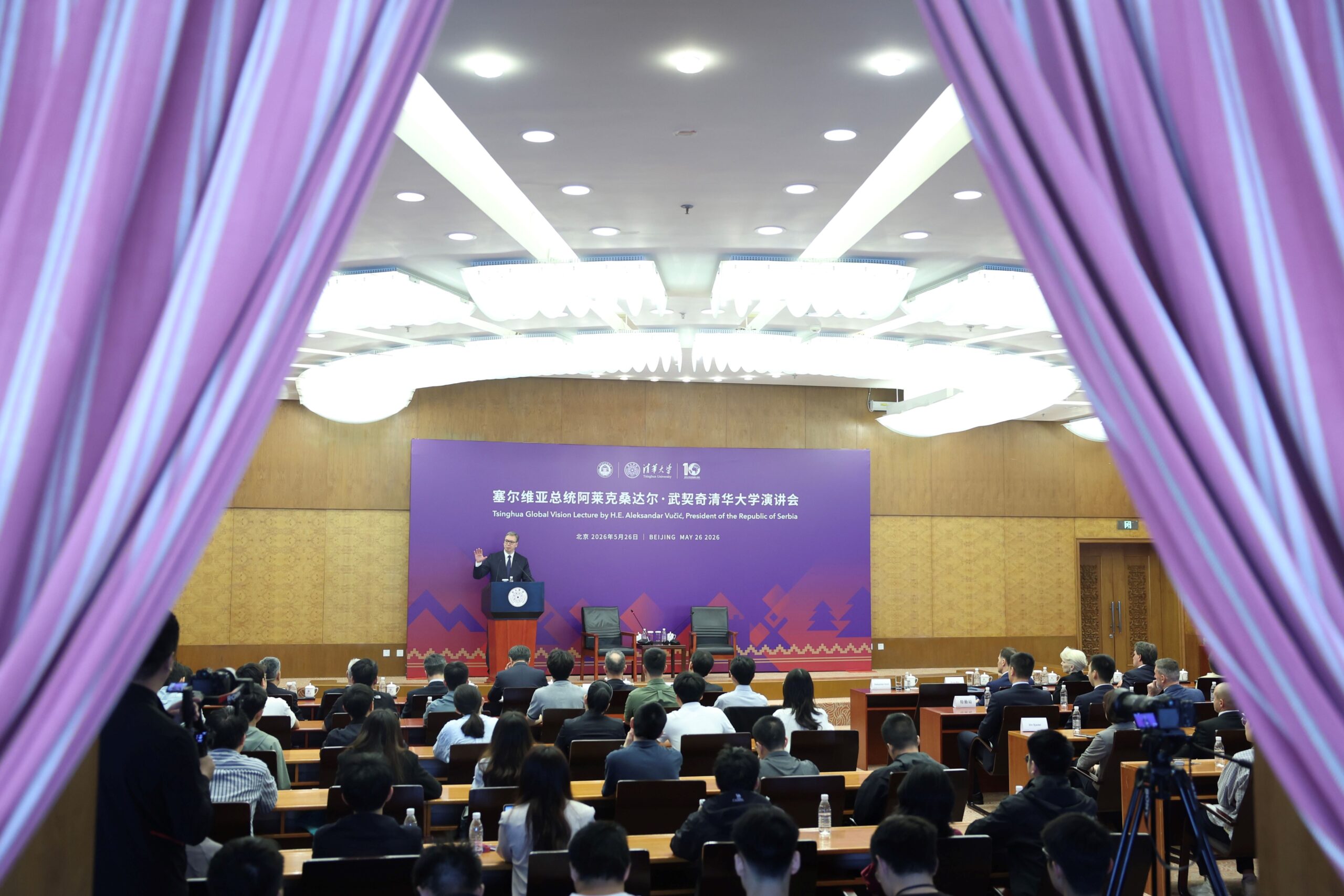

Why are more foreign leaders visiting Chinese universities? From AI labs to student exchanges, campuses are becoming new spaces for diplomacy and for understanding China’s future.
“Go alone if you want to go fast. Go together if you want to go far.”
When Serbian President Aleksandar Vučić visited Tsinghua University on May 26th, he quoted the proverb while discussing trust, cooperation and dialogue in a divided world.
However, it was not only his speech that drew attention.
After spending nearly an hour talking with Chinese students, Vučić shared what impressed him most. He said he saw what he described as a “tiger spirit” among many students — a mix of determination, discipline and ambition.
“This is crucial for China’s future,” he said.
Vučić is not the only foreign leader to recently appear on a Chinese campus.
Earlier, Spanish Prime Minister Pedro Sánchez visited Tsinghua University and reflected on a world map that was brought to China centuries ago by the Italian missionary Matteo Ricci. Although the map was advanced for its time, it placed Europe at the centre of the world. Sánchez used the example to discuss how perspective shapes the way people understand global affairs.
In recent years, similar scenes have become increasingly common.
Foreign diplomats, university presidents and political leaders now regularly visit Chinese campuses. These trips involve far more than ceremonial tours. Most include speeches, student discussions and laboratory visits, often centred on artificial intelligence, green development and scientific cooperation.
So why are so many world leaders going to Chinese universities?

A Closer Look at China’s Technology Push
Part of the answer lies inside university laboratories.
Chinese universities have become major research hubs in fields such as semiconductors, robotics and artificial intelligence.
This year, researchers from Tsinghua University and Peking University published a flexible computing chip in the journal Nature. The chip can bend and stretch while using very little power. Researchers believe it could support wearable medical devices and future brain-computer interfaces.
Meanwhile, a research team at Tsinghua developed an ultra-high-precision spectral imaging chip. The technology could help improve machine intelligence, remote sensing and astronomical observation.
The university has also expanded research in humanoid robotics. One open-source framework developed by Tsinghua-affiliated teams allows robots to move across grass, rocks and other uneven terrain while coordinating movement and perception in real time.
For visiting leaders, campuses like Tsinghua offer something increasingly valuable: a close-up look at how China is trying to position itself in emerging technologies.

Beyond Technology, A Focus on Young People
Still, laboratories tell only part of the story.
For many visiting leaders, students matter just as much as scientific breakthroughs.
Today, foreign leaders often spend time speaking directly with students, researchers and young scholars. These conversations offer a more personal view of China than formal diplomatic meetings usually provide.
During Sánchez’s visit, one student reflected on the metaphor of the world map mentioned in the speech. Everyone, the student said, carries a different “map of the world,” shaped by culture and personal experience. More dialogue, he added, may help people better understand how others see the world.
Vučić focused on something different. He spoke about the determination he saw among Chinese students. What impressed him most, he said, was their willingness to fully commit themselves to their goals.
That growing focus on youth has become an important part of international exchanges involving Chinese universities.
For example, Chinese and European universities have expanded cooperation in energy systems, electrical engineering and scientific research. Partnerships with Portuguese universities focus heavily on academic exchange and talent development.
At the same time, many political leaders now discuss education as part of long-term diplomacy. In their view, educational cooperation is not only cultural exchange. It is also an investment in future relations.

Campuses as a New Diplomatic Space
Chinese universities are now playing a larger role in international diplomacy.
During his visit to China, French President Emmanuel Macron visited Sichuan University and spoke with students about youth development, artificial intelligence and cultural exchange.
Earlier this year, British Prime Minister Keir Starmer visited an innovation and design institute in Shanghai. There, he discussed education cooperation and people-to-people ties with students.
These visits reflect a broader change in diplomacy.
In the past, diplomacy mostly unfolded inside conference rooms and government buildings. Today, more conversations are taking place in classrooms, laboratories and university forums.
For many foreign visitors, Chinese campuses offer more than prepared presentations. They provide a chance to observe the country’s priorities firsthand. Those priorities include technological innovation, investment in education and confidence in a younger generation.
As more world leaders step onto Chinese campuses, universities are becoming places where outsiders try to understand not only China’s technological ambitions, but also the people who may shape its future.
If you liked this article, why not read: Why is the Temple of Heaven a Key Stop for Global Leaders?


