
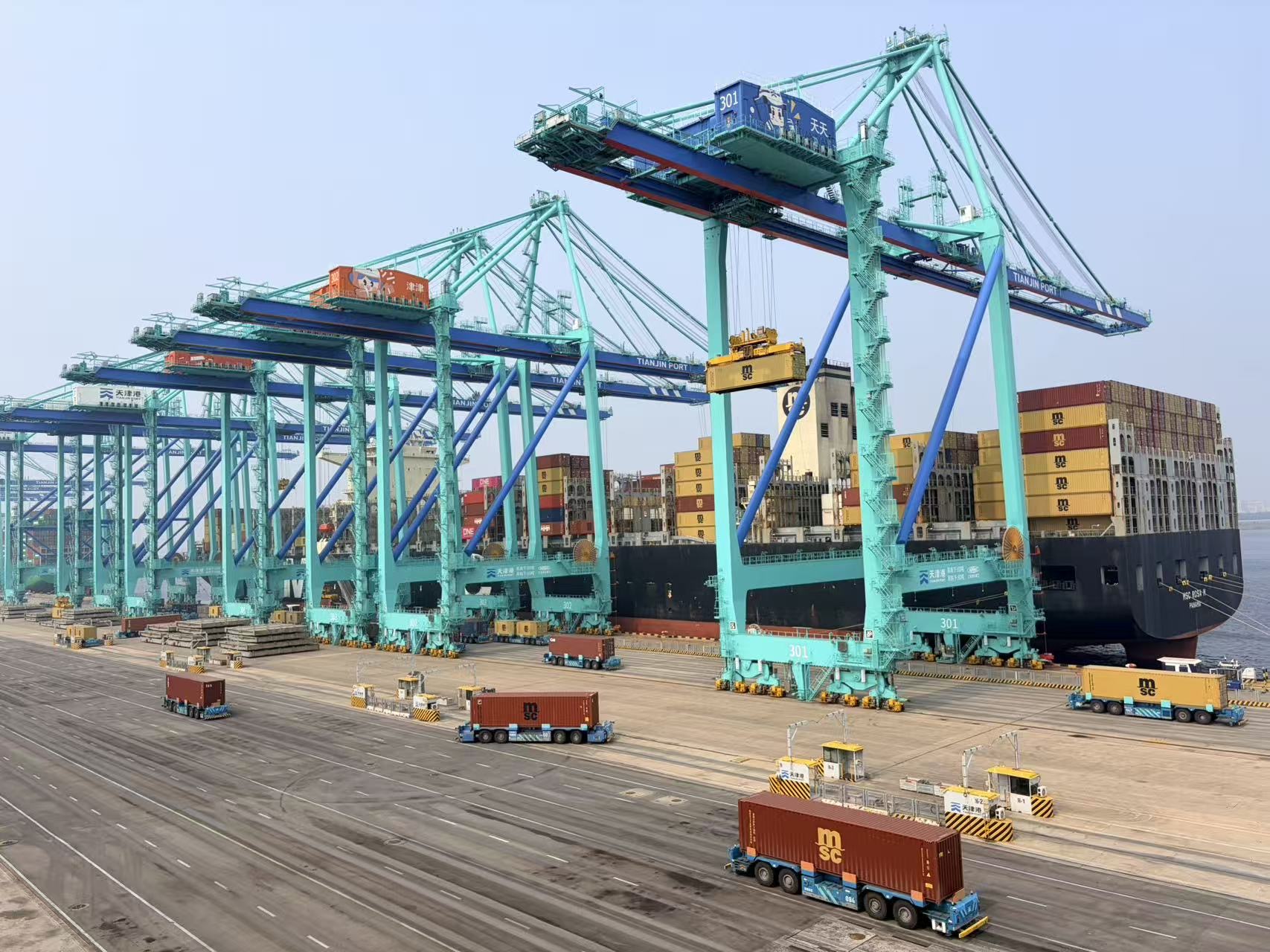

At China’s Tianjin Port, autonomous transport vehicles, AI systems and real-time data help run one of the country’s busiest shipping hubs with remarkable efficiency.
At Tianjin Port in northern China, cargo ships connect the country with more than 500 ports across over 180 countries and regions. Yet visitors to one of its busiest terminals often notice something unexpected: there are very few workers on the dock.
The scene is especially striking at the Smart Zero-Carbon Terminal in the port’s Beijiang area. As giant container ships unload cargo, driverless transport vehicles move steadily between cranes and container yards. Most of the work takes place with little direct human involvement.
The terminal combines technologies such as 5G networks, China’s BeiDou navigation satellite system and artificial intelligence. More than 100,000 sensors support daily operations, allowing containers to move through the terminal in a highly automated process.
Among the most visible technologies are Autonomous Rail-mounted Transporters, or ARTs. These intelligent vehicles carry containers across the terminal and serve as the main transportation force on the dock.
Unlike traditional automated vehicles that follow fixed routes, the ARTs can respond to changing conditions. Equipped with lidar, cameras and millimetre-wave radar, they can identify obstacles, adjust their routes and coordinate with other vehicles in real time.
According to port staff, the vehicles have become increasingly capable over the years.
Teaching Robots How to Drive
Cheng Weidong, a veteran port worker at Tianjin Port No. 1 Stevedoring Co., Ltd., has worked closely with the ART fleet since its introduction. “When they first arrived, they were much less efficient,” Cheng said. “They were like new drivers and moved very cautiously.”
Today, the vehicles operate far more smoothly. Sometimes they pause before moving forward. However, those brief waits are often part of a larger traffic-management strategy.
For example, if one vehicle passes through a work area before another has completed its task, congestion can occur around the cranes. Waiting a little longer can help keep traffic flowing and improve overall efficiency.
Cheng said much of that operational logic comes from the experience of human workers. “For years, I have focused on turning nearly 30 years of work experience, operating methods and driving skills into data that the robots can understand,” he said.
The Port’s Digital Brain
Behind the terminal’s automated operations is a centralised command system. Information from across the terminal is transmitted through a 5G network to a control centre, where operators monitor equipment and coordinate activities in real time.
Meanwhile, Tianjin Port has developed its own intelligent transportation system and terminal operating platform. These systems connect key equipment, including quay cranes and yard cranes, allowing them to exchange information continuously and work together more efficiently.
Based on real-time data, the system generates loading and unloading plans and directs equipment to carry out tasks in a coordinated manner. According to Tianjin Port, operating efficiency at the terminal is about 20 per cent higher than at conventional container terminals.
Feng Miao, operations manager at Tianjin Port’s Second Container Terminal Co., Ltd, described the command system as the terminal’s “brain.” “It combines workers’ experience, customer requirements and operating standards,” Feng said. “As more operational data becomes available, the system continues to improve and optimise the workflow.”
A Different Kind of Busy Port
Looking ahead, Tianjin Port plans to integrate advanced technologies further and expand the use of digital-twin systems and connected infrastructure.
For many visitors, however, the most memorable part of the terminal is not the technology itself. It is the sight of one of China’s busiest ports running around the clock with surprisingly few people in view, as ships, cranes and intelligent vehicles work together across the dock.
Written by Mengyao Wang, Enbo Wang, translated by Ronnie Yu.
If you liked this article, why not read: Life-Saving Drones Take Off in Tianjin, Changing Medical Deliveries


