
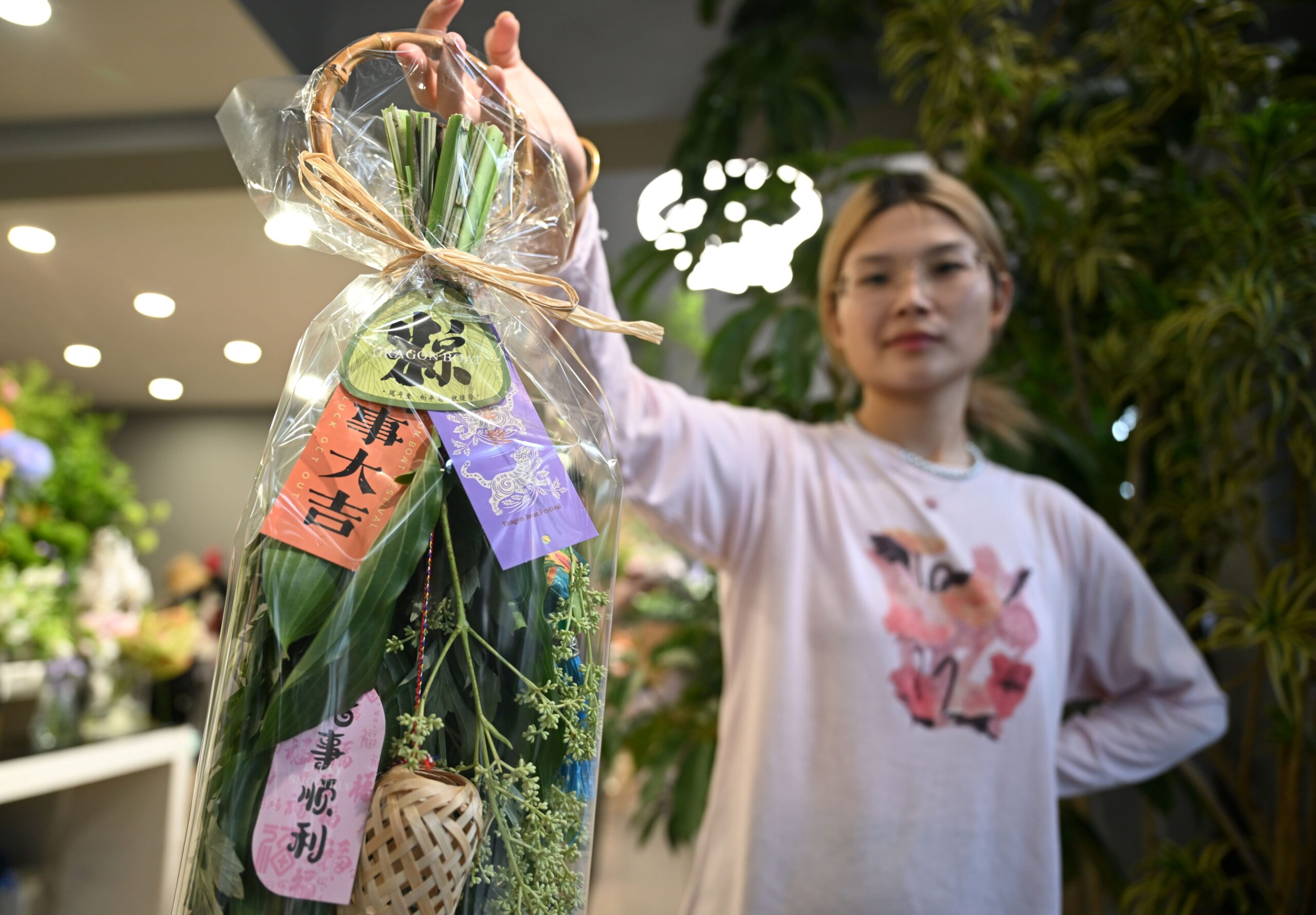

Traditional mugwort decorations are gaining popularity in China as the Dragon Boat Festival approaches, blending ancient customs with modern lifestyles.
As the Dragon Boat Festival approaches, traditional mugwort decorations are becoming increasingly popular across China. Once viewed mainly as a folk custom, hanging mugwort is now attracting new interest through modern designs, DIY projects and social media sharing.
In Beijing, resident Zhang Zhen recently bought a mugwort wreath from a local store. For years, hanging mugwort at home has been part of her Dragon Boat Festival routine. Like many Chinese families, she sees it as a meaningful way to welcome the holiday and the arrival of summer.
The Dragon Boat Festival has a history of more than 2,500 years. In 2009, it was inscribed on UNESCO’s Representative List of the Intangible Cultural Heritage of Humanity. Traditional customs such as eating zongzi, hanging mugwort and displaying calamus continue to be observed across the country.

Today, however, these traditions are taking on new forms.
Ahead of the festival, decorative mugwort door hangings have appeared prominently on major e-commerce platforms. At the same time, many social media users are sharing DIY tutorials on how to create their own mugwort bouquets and wreaths, adding a personal touch to the celebration.
At Miss Huajian, a flower shop in Beijing’s Xidan commercial district, Dragon Boat Festival-themed arrangements greet customers at the entrance. The designs combine traditional plants such as mugwort and calamus with flowers and decorative materials, offering customers a fresh interpretation of a long-standing custom.
Tian Wenning, a partner at the shop, told CNS that the store introduces special festival-themed products every year. This year, in addition to hanging bouquets, the shop launched flat floral baskets that can be placed indoors or hung on doors, giving customers more options for festive decoration.
According to Gao Shu, the popularity of mugwort floral arrangements reflects how traditional customs are adapting to modern lifestyles. Compared with gathering plants in the wild, ready-made floral products make it easier for urban residents to participate in the tradition. At the same time, they serve decorative, ceremonial and social-sharing purposes.
Beyond floral arrangements, mugwort-inspired products are also attracting consumers. At Baita Temple Pharmacy in Beijing, customers can find scented sachets, bracelets and other items featuring mugwort as a key element.
Fan Qian, head of innovation development at the pharmacy, said the store introduced a tiger-shaped sachet for this year’s Dragon Boat Festival. Filled with mugwort and other herbal ingredients, the product combines traditional festival culture with contemporary design.

The trend extends beyond Beijing. Across China, traditional Chinese medicine culture is inspiring a growing range of creative products. Some institutions in Beijing have transformed ancient herbal formulas into wearable accessories. Meanwhile, pharmaceutical companies in Shanghai are developing scented bead products based on traditional techniques. Elsewhere, Qichun County in Hubei Province has developed hundreds of mugwort-based products, helping drive local economic growth.
By Ronnie Yu.
If you liked this article, why not read: China’s 594-Year-Old Yanbu Old Dragon Sets Sail Again


