
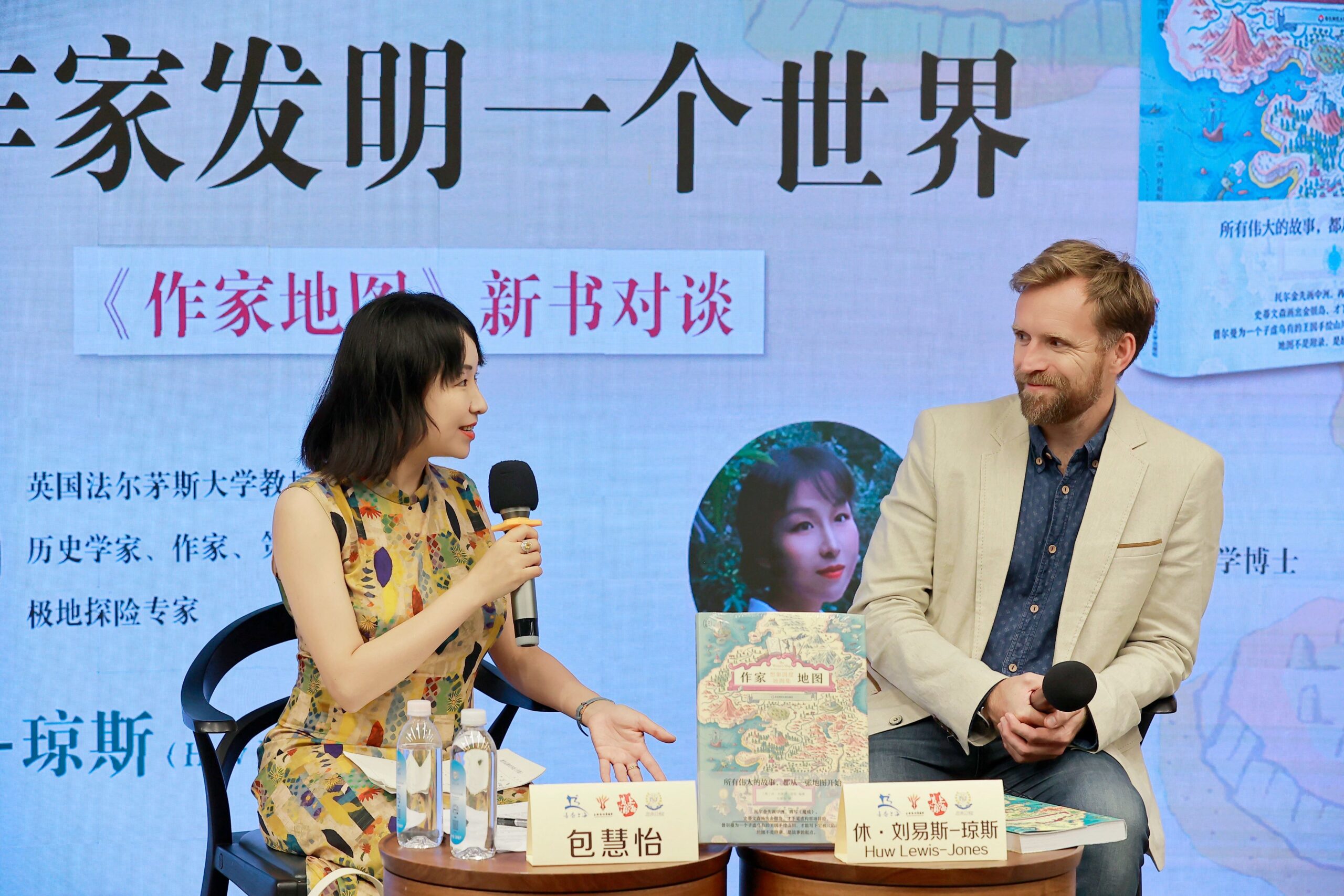

Huw Lewis-Jones explores how maps have shaped fantasy literature, from Treasure Island to Middle-earth, and how maps can reveal cultural perspectives.
Huw Lewis-Jones was born on a small island, where drawing maps of the island was part of everyday life.
His connection with fantasy literature also began with a famous map: the map of Treasure Island by Robert Louis Stevenson. The map features a treasure marked with an “X”, along with crossed bones and other symbols, forests and landmarks. Jones was fascinated by it as a child and collected different editions of Treasure Island.
In 1881, Stevenson was staying in Braemar, Scotland, when he drew a map of an imaginary island for his stepson, Lloyd Osbourne. The map showed a rugged coastline, forests, swamps and other features. It soon became the starting point for Treasure Island. Stevenson later described the map as a key source of inspiration for the novel.
The map also helped shape the story itself. In fact, Stevenson developed the novel around the geography he had drawn, rather than creating the map after completing the story. The map became an important part of the book and helped popularise the idea of the treasure map in adventure fiction.
For Jones, this offers a useful way to think about fantasy writing. A story does not always have to begin with a character or a plot. It can start with the place where the story will happen.
He sees a similar process in the work of J.R.R. Tolkien. The maps of Middle-earth helped Tolkien develop the geography and structure of his fictional world. They also gave readers a way to navigate the complex settings of The Lord of the Rings and other works.
When Jones taught creative writing at university, he sometimes asked students to put down their screens and draw maps of the worlds they imagined. For him, the exercise was a simple way to encourage students to build a fictional world from the ground up.
Maps can take on another meaning when they come from a different culture.
Jones has also looked at fantasy maps in Chinese literature. He admits that he cannot always fully understand what they represent. Yet that is part of their appeal.
A map can contain knowledge that is not immediately accessible to an outsider. Its place names, symbols and visual conventions may reflect a particular language, culture or way of thinking. To understand them fully, readers need to know more than what is shown on the page.
At the same time, Jones sees value in not understanding everything at once. Getting temporarily lost in a map can itself become part of the reading experience. Some of the meanings hidden in its folds may remain difficult to uncover.
Jones is also interested in how maps can document the way cultures see one another.
He hopes to publish a book exploring maps of England created by Chinese people over the past century. By looking at these maps across different periods, he wants to trace how Chinese perceptions of England have changed over time.
For Jones, maps provide a particularly direct way to examine cultural perceptions. They show not only where places are, but also what people choose to include, emphasise or leave out.
That makes the map more than a tool for navigating an imaginary world. It can also offer a way to look at how different cultures understand distant places and, ultimately, each other.
Additional reporting by Wang Ji.
If you liked this article, why not read: 【China in Pages】July Picks: Reading China Through Different Voices


