
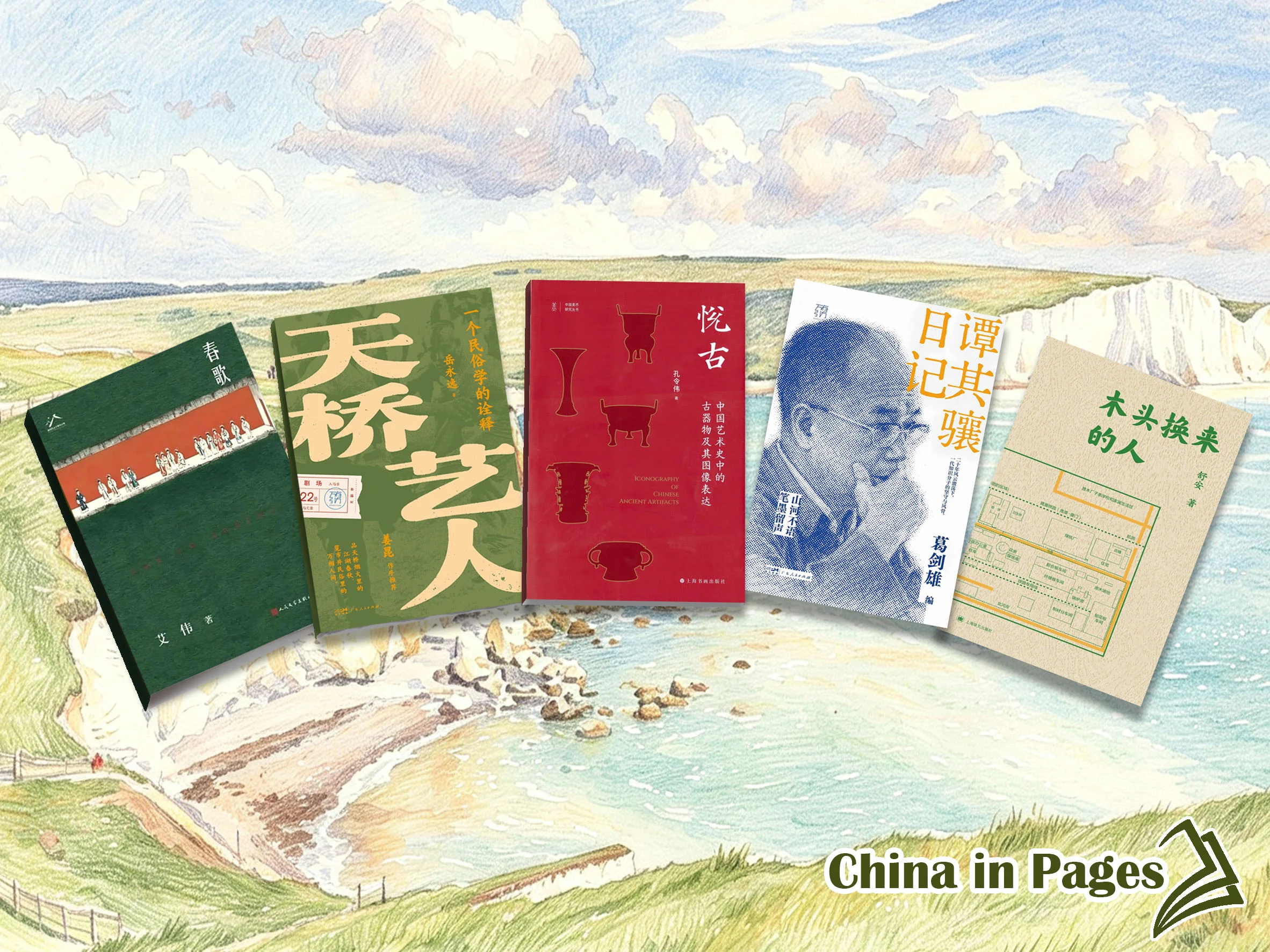

This month’s book picks offer a diverse range of perspectives on China, featuring voices from scholars, artists, factory workers, and street performers.
July’s new releases highlight the richness of contemporary Chinese publishing. This selection includes fiction, history, art history and narrative nonfiction. Together, these books explore family, memory, traditional culture and social change. They also introduce readers to influential scholars, overlooked communities and new ways of looking at China’s past and present.

Street Performers of Old Beijing 《天桥艺人》
For more than a century, Beijing’s Tianqiao district was home to storytellers, acrobats, wrestlers and other street performers. In this book, folklorist Yue Yongyi draws on fieldwork, oral history and archival research to trace their lives, their craft and the community they built.
The book follows performers from apprenticeship to life on the street stage. It also explores the customs, language and traditions that shaped their world. More than a study of folk culture, it demonstrates how ordinary people adapted to social change and passed their skills down across generations. It is an important work for readers interested in Beijing’s urban history, Chinese folklore and traditional performing arts.

The People Traded for Timber 《木头换来的人》
Shu An spent 12 years returning to her hometown to record the stories of the people who built their lives around a timber factory in southern China. Drawing on family memories and years of fieldwork, she follows three generations as they face changing industries, changing communities and changing ideas about work and identity.
Blending memoir with ethnographic research, the book gives a voice to ordinary factory workers whose lives rarely appear in official histories. It is both a family story and a record of China’s modernisation, told through the experiences of people who lived through it.

The Diaries of Tan Qixiang《谭其骧日记》
Tan Qixiang was one of China’s leading historians and a pioneer of Chinese historical geography. Best known for leading the compilation of the Historical Atlas of China, he kept these diaries between 1951 and 1972. They record his research, his conversations with fellow scholars and his observations of everyday life during a period of profound change.
More than a personal diary, the book offers a firsthand account of modern Chinese intellectual life. It also shows how one scholar continued his work through changing political and social conditions. With diary pages, manuscript images and a chronology, it is a valuable resource for readers interested in modern Chinese history and the people who shaped it.

Iconography of Chinese Ancient Artifacts 《悦古》
Bronze vessels, jade ritual objects and ancient paintings are more than museum pieces. They carry stories, beliefs and memories that have shaped Chinese culture for thousands of years. In this richly illustrated book, art historian Kong Lingwei explores how ancient objects were recorded, copied and reimagined in Chinese art.
Rather than treating artefacts as silent relics, Kong shows how they became part of a shared cultural memory. He follows their journey from sacred ritual objects to admired works of art and sources of creative inspiration. Blending art history, archaeology and visual culture, this book offers a fresh way to understand China’s past through the objects it has chosen to remember.

Spring Song《春歌》
Set in Hangzhou, Spring Song follows the lives of six families across three generations, from the 1980s to the present day. As the city changes, so do the people who call it home. Their lives are shaped by love, loss, family ties and the choices they make.
Rather than focusing on dramatic events, Ai Wei pays close attention to everyday life and the quiet changes brought by time. Traditional culture, local landscapes and Kun Qu opera are woven naturally into the story. The result is a thoughtful novel about ordinary people living through decades of social change in contemporary China.
Written by Estelle Tang, illustrated by Yuma Zhao.
If you liked this article, why not read: June Picks: China Seen Through Individual Eyes


