
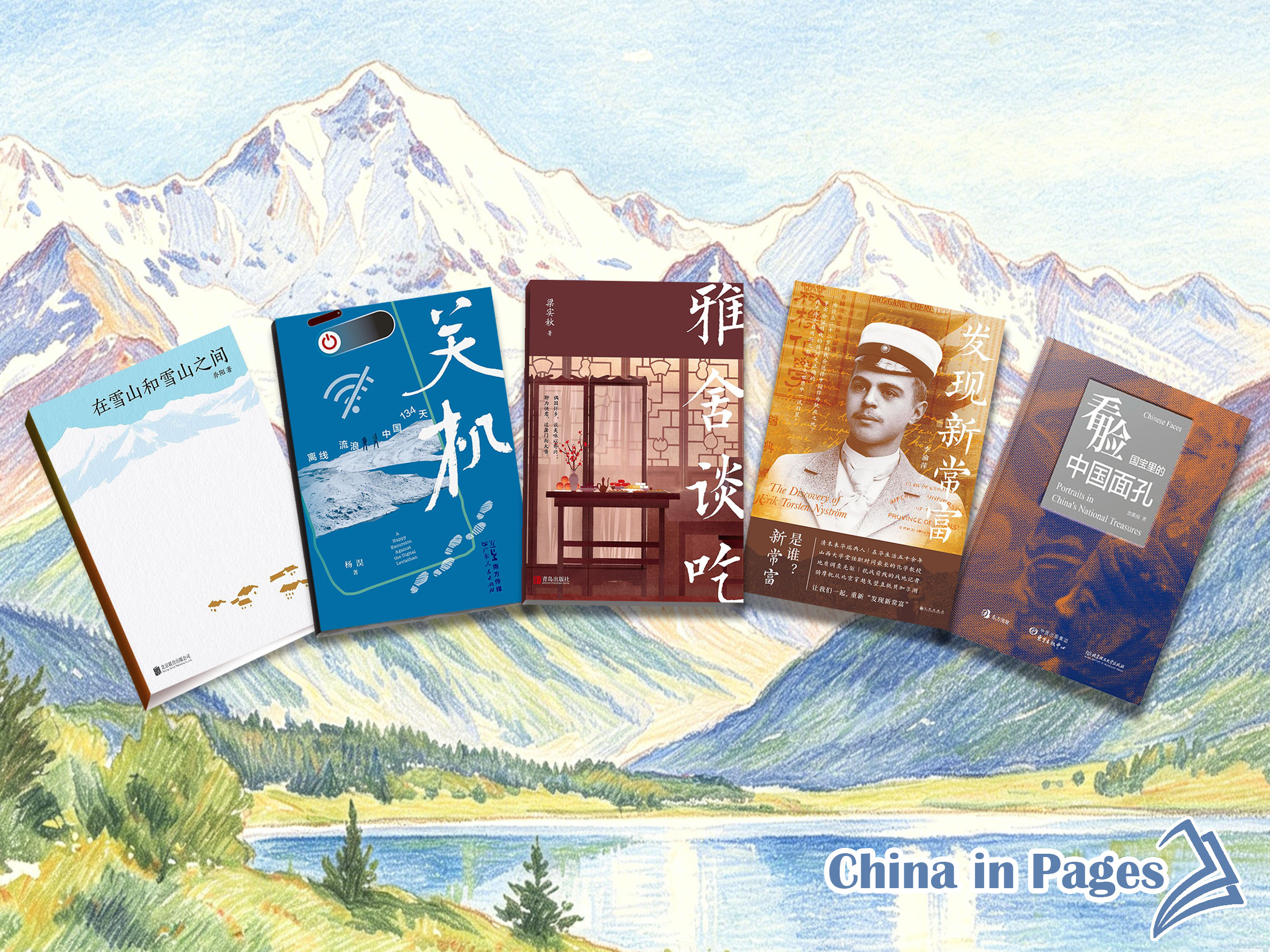

Discover our June picks of books about China that explore digital life, mountain living, history, cultural heritage and food.
The five books selected this month all begin small — one man’s unplugged journey, one woman’s mountain life, one scholar’s table — and open outward into questions about civilisation, belonging and what it means to be human.

Essays on Food《雅舍谈吃》
Liang Shiqiu spent more than thirty years translating Shakespeare into Chinese and produced a vast body of literary criticism amounting to over twenty million words. Alongside this scholarly work, Essays on Food reveals another side of his writing: reflections on food and everyday eating culture.
He writes about ham, vinegar-soaked fish, roast lamb, pickled vegetables, soup dumplings and fried meatballs—dishes found in both restaurants and home kitchens. With quiet self-deprecating humour, he notes that he had no formal training in food studies, only that he had “eaten continuously for over eighty years”. Through these essays, Liang captures ordinary life with clarity and wit.

Portraits in China’s National Treasures《看脸——国宝里的中国面孔》
This book explores Chinese material culture through a single, accessible idea: the human face. By looking at faces, the author argues, one can understand where people come from and how they relate to the world around them.
Weng Huainan, head of the library and documentation department at the National Museum of China, selects over a hundred ‘faces’ from objects spanning the full arc of Chinese civilisation — pottery, bronze, jade, ceramics, murals, sculpture, painting and calligraphy. His focus is not form or inscription but expression: calmness, joy, humour, anger, grief. These emotions give ancient objects a human presence, allowing them to speak across time.

The Discovery of Erik Torsten Nyström《发现新常富》
Swedish academic Erik Torsten Nyström went to China in the final years of the Qing dynasty, where he adopted the Chinese name Xin Changfu (新常富). He lived and worked there from 1902 to 1954, teaching, excavating archaeological sites, serving in armed conflict, rescuing lives, and reporting on wartime events. Chinese society was something he studied at close range, and he came to admire elements of its traditional ways of life. Although he intended to remain in China, he eventually returned to Sweden.
Li Yuping, a historian and Swedish-language translator based in Sweden for over a decade, reconstructs Nyström’s life through previously unseen family archives: photographs, letters, diaries, hand-drawn maps and teaching notes. The book traces Nyström’s movements and, through them, sketches a changing China.

A Happy Excursion Against the Digital Leviathan《关机:离线流浪中国134天》
In an age when almost every aspect of daily life depends on a smartphone, what would happen if you simply switched it off? Trained at the Royal College of Art, Yang Hao set himself an extraordinary challenge: to spend 134 days travelling across China without a mobile phone or internet access.
Covering 68 cities and counties in 24 provincial-level regions, Yang discovers both the practical difficulties and unexpected freedoms of life beyond the digital world. By the time he reconnects, every missed message has disappeared, having expired after the platforms’ 72-hour delivery window. It is an oddly unsettling reminder of how fragile our digital connections really are. Part travelogue, part social experiment, this book invites readers to reconsider what it means to be connected in an always-online age.

Between the Snow Mountains《在雪山和雪山之间》
Twenty years ago, Qiao Yang left her home in Sichuan for the mountains of north-west Yunnan, where she gradually built a life among glaciers, alpine meadows and Tibetan communities. Walking alongside botanists and wildlife photographers, she learned to read the landscape through its flowers and forests; living with local people, she came to see the mountains not simply as scenery but as home. Blending memoir, travel writing and reflections on the natural world, Between the Snow Mountains is a quietly lyrical meditation on belonging, humility and humanity’s place within nature.
She questions the modern tendency to place humanity at the centre of the natural world. As she writes, “Human writings seem rather insignificant beside the great book of nature.”
Written by Estelle Tang, illustrated by Yuma Zhao.
If you liked this article, why not read: May Picks: Visible Life and Invisible Experience


