
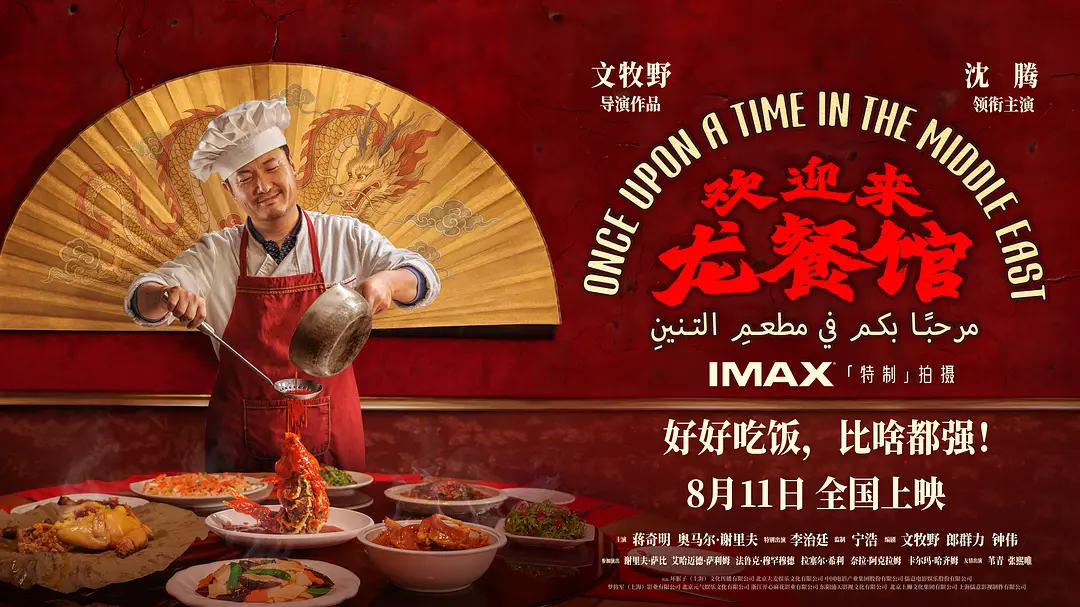

Chinese film Once Upon A Time in the Middle East turns food, war and a restaurant into a moving story of survival, human dignity and the pursuit of peace.
Chinese film Once Upon A Time in the Middle East has struck a chord with audiences in China with a simple but powerful idea: in times of war, being able to sit down and have a good meal can itself be a form of happiness.
The film tells the story of Xu Fu, a Chinese chef who travels to the Middle East to pay off his debts. He ends up caught in a war and runs a restaurant called Chinese Restaurant. As the conflict worsens, cooking becomes more than a way for him to make a living. It becomes a means of survival and protection for a group of children orphaned by war.
The film opened in Chinese mainland cinemas on August 11th. By August 16th, it had grossed more than 800 million yuan (about £87 million), according to Chinese online ticketing platforms.
Yet beyond the box office, much of the discussion has focused on the film’s unusual combination of food and war.
Food, War And Ordinary Lives
At a cinema in Beijing, many viewers stayed in their seats after the credits rolled. Some watched the screen in silence. Others quietly discussed the ending.
Zhang Yuan, a viewer, said she could not stop crying after the film. “The one thing I will remember most, and can actually put into practice right away, is to have a good meal,” she said.
That simple idea runs through the film.
Director Wen Muye said in a recent interview with CNS that the restaurant and its chef naturally brought food into a story about war. “Chinese Restaurant is a place where people eat, and our protagonist is a chef,” Wen said.
For him, the contrast was essential. Food represents everyday life and human dignity, while war represents destruction and death. Putting the two together makes both sides of the contrast more visible.
The film uses small details to show how war changes ordinary things. A chilli pepper, normally just a seasoning, becomes a tool of torture. Potatoes that would usually be thrown away after sprouting instead become part of an act of kindness.
And the children at the centre of the story are no longer simply children. War turns them into victims and, at times, tools in a violent conflict.
As the story unfolds, the words “have a good meal” take on a much heavier meaning.
For Beijing office worker Gao Yu, the film’s message lies in the way war affects people who might otherwise have nothing to do with each other. “The film made me think about the question Xu Fu is asked: ‘Do you really think war has nothing to do with you?’” Gao said.
Without war, people of different nationalities and ages could live together and pursue ordinary goals, he said. Once war begins, however, no one can completely escape its consequences.
A Story Rooted In Real Experiences
The story draws on the experiences of Chinese people who ran restaurants in Baghdad during the 2003 Iraq War. That real-life background gives the film another layer. Xu Fu is fictional, but the idea of a Chinese restaurant continuing to serve food in a war zone came from real experiences.
Among those connected to the film is Ameen Muneer Mohammed Al-Obaidi, an Iraqi-born journalist based in China who is better known by his Chinese name, Fang Haoming. He experienced war as a child and appears in the movie.
After watching the film, Fang wrote on social media that the children in the story reminded him of his own childhood. “I had no childhood,” he wrote. “It was only after I came to China that I understood that having a good meal with your family is real happiness.”
His experience gives a personal meaning to one of the film’s simplest ideas.
For Xu Fu, cooking begins as a job. He wants to make money and repay his debts. Later, his priorities change. He wants to look after the people around him.
Wen said the film does not seek to provide an easy answer to war. People cannot always choose the circumstances into which they are born or the conflicts they encounter. But they can still choose to hold on to ordinary life. “Perhaps there are many things about war that have no solution,” Wen said. “But there is one thing you can choose to do — have a good meal.”
The film’s ending also avoids an easy resolution. Twenty years later, Xu Fu returns to the Chinese Restaurant. One of the children he once saved is working in the kitchen. Before the two can recognise each other, the film ends.
Zhang said she had been waiting for an extra scene and even hoped for a more conventional happy ending. Instead, the restrained ending leaves the audience with the lives of the characters rather than a neat conclusion.
Building The World Behind The Story
The film’s story takes place in the Middle East, but much of its world was built in China.
Wen and the production team initially considered shooting overseas. However, as fighting broke out abroad, the team decided that filming in an actual war-affected area was not feasible.
They then chose to build the setting at home. About 70 per cent of the film was shot at Oriental Movie Metropolis in Qingdao, Shandong Province, where the production team built more than 100,000 square metres of sets. Another 25 per cent was filmed in Shitanjing, Ningxia Hui Autonomous Region. A small number of desert scenes were shot in Egypt.
At Oriental Movie Metropolis alone, the production used 14 sound stages, nine set-building workshops and a large outdoor filming area.
The same attention went into the food on screen. Nearly 40 dishes appear in the film. According to Wen, every dish had to fit the story, look appetising and make sense in the setting.
More importantly, the food had to be real. “Every dish in the film can actually be eaten, and it is actually good,” Wen said.
That may be why the film’s most understated message has resonated so strongly: when everything around you is falling apart, sitting down for a meal can still mean choosing life.
Written by Ronnie Yu.
If you liked this article, why not read: The Teochew Chive Dumpling Winning Hearts After a Hit Film


