
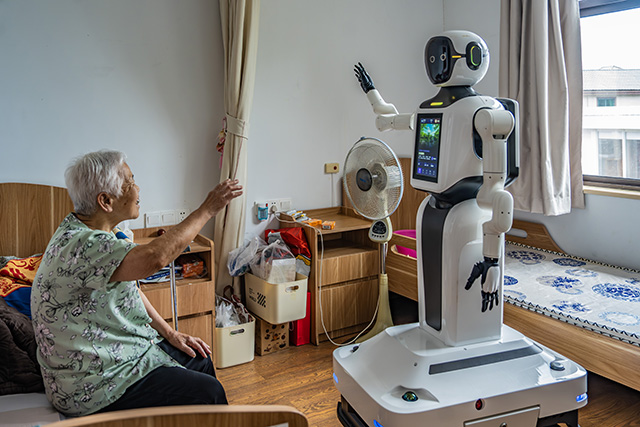

AI is transforming elderly care in China, from smart therapy beds and health monitoring to care robots, while human carers remain essential.
Robotic-arm moxibustion devices can now target treatment points with precision. Smart therapy beds use AI to create personalised wellness plans. Meanwhile, smart care robots can monitor older people’s health in communities. Across China, technology is now entering almost every aspect of elderly care. More older people are also trying AI-powered interactive products. As a result, “AI + elderly care” is becoming part of everyday life.

The era of AI-powered elderly care may now be drawing closer. According to a report by Guangming Daily, China’s recently released Official Bulletin on the Development of National Undertakings for the Aged, 2025 shows that the country had 323.38 million people aged 60 and above by the end of 2025, accounting for 23% of the total population. Meanwhile, life expectancy reached 79.25 years.
Digital technology and smart devices have also become deeply embedded in daily life. They make everyday activities easier while changing how older people live and receive care.

At the Shuiguohu Comprehensive Elderly Care Centre in Wuchang District, Wuhan, staff have divided the daytime activity area into exercise spaces and open activity rooms. Activity schedules cover the walls. Older residents walk around, chat and relax.
The centre also has an exhibition area for therapy equipment. Smart therapy beds stand neatly in rows. A robotic-arm moxibustion device catches visitors’ attention.
Xinhua News Agency reported that an older resident, Zhang Huimin, was trying out a smart therapy bed. Zhang has mild cognitive impairment and takes medication regularly. Care worker Lv Fang helped Zhang lie down and secured her feet to the device. She then switched on several functions, including vibration massage, airbag pressure therapy and infrared treatment.
“The smart therapy bed uses built-in AI analysis,” Lv said. “After we enter basic health information, the system creates a personalised therapy plan.”
Zhang has recently suffered from back and leg pain, insomnia and constipation. The centre set her treatment cycle at 15 days. Regular sessions may help ease pain, stimulate the intestines and improve sleep.
Smart wellness equipment now appears throughout the centre. For example, residents can wear heart-rate monitors. Their families can then check their heart-rate data in real time on their phones. A smart anti-snoring pillow can also detect snoring and automatically adjust support for the head and lower back.

However, robots still serve as assistants. They cannot replace human carers yet.
Yao Wei, a nursing department director at a Wuhan elderly care centre, gave an example. She described an older person with heart disease who cannot leave their bed. Before a carer helps the person take a bath, the carer must first carry out a full health assessment. The water must also be kept at around 40°C. The bath should normally finish within 15 minutes. During the bath, the carer checks the person’s skin and joints and talks to them throughout the process.
Human carers can therefore provide more detailed and personalised attention in these situations. Ge Jian, head of Hubei Qianjia Yikang Elderly Care Services Co., Ltd., said AI should not simply replace people at this stage.
“AI-powered elderly care currently means cooperation between artificial intelligence and human carers,” Ge said.
Smart devices can handle standard tasks, such as home safety monitoring and basic health alerts. However, more personalised services still need human contact. For example, older people who need someone to visit and keep them company still rely on carers for face-to-face and hands-on support. Therefore, AI is changing elderly care in China. But for now, technology works best alongside people rather than instead of them.
Written by Yi Shen.
If you liked this article, why not read: How Robots Are Assisting Elderly Residents in Beijing


