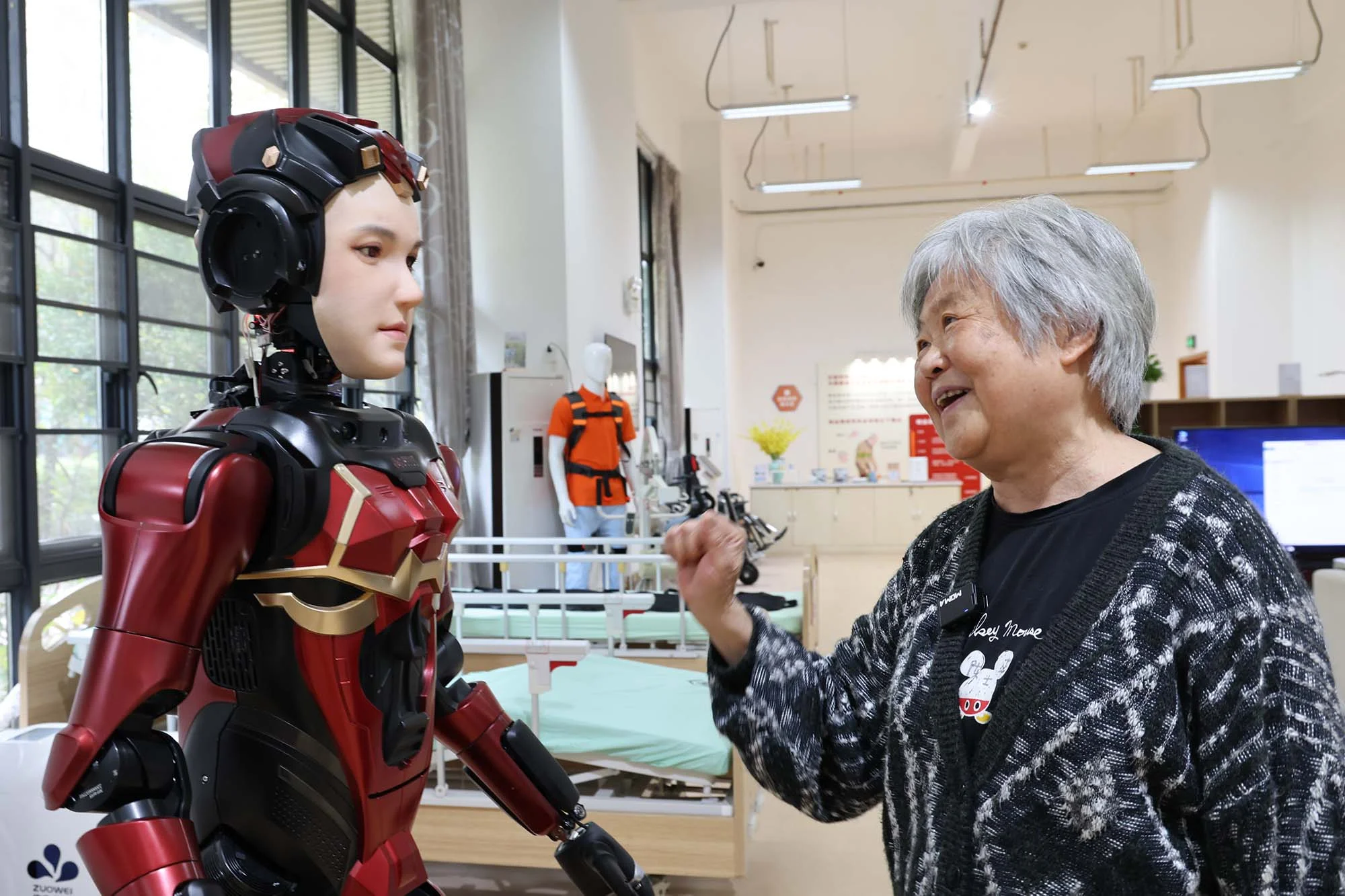

While humanoid robotics companies continue to refine their prototypes in laboratory settings, several elderly care communities in Beijing have moved beyond testing to integrate robots into daily life.
On March 12th, a care centre in Beijing’s Yizhuang district opened what is described as the world’s first facility focused on robotic elderly care. The facility serves as a live demonstration hub, deploying over 40 types of robots from 24 manufacturers.
Robots Enter Daily Elderly Care in Beijing
The centre covers about 1,100 square metres and is divided into four areas.
On the ground floor, robots prepare food and deliver dishes to diners. A pancake-making robot can complete an order in three minutes, while serving robots move between tables.
Upstairs, one floor is set up as an activity space for children, with robots designed for drawing, simple games and interaction. Another floor combines rehabilitation and day care. There are machines for massage and heat therapy, devices for basic health checks, and wearable robotic equipment to support movement during physical training. Residents can also play board games with a chess-playing robot.

On the top floor, rooms are fitted with smart systems, including intelligent wheelchairs and monitoring systems designed to detect health emergencies.
‘I used to think robots were far away from us,’ said Ms Zhang, a 72-year-old resident, after trying one of the therapy machines. ‘It feels quite different when you actually use one.’
Finding Companionship in A Digital Friend
Other care homes in Beijing have been experimenting with similar ideas. In one community facility, a service robot named Xiaoli has become a fixture for residents such as 86-year-old Wu Weiguo. Mr Wu, who lives with Alzheimer’s disease, often struggles with memory loss and physical mobility. Before the robot’s arrival, he was frequently withdrawn or distressed, often insisting on travelling to a distant railway station to revisit memories of his former career as a biophysicist.
Staff report that since Mr Wu began daily interactions with Xiaoli six months ago, he has become more settled. The robot, which features a screen with large animated eyes, is designed to simulate attentive listening. Mr Wu now spends significant time each day chatting with the machine, often smiling as they exchange remarks.

Huang Jinli, an industry professional who tested the robot with her 80-year-old mother, observed that the machine often acts as a ‘key’ to memories that elderly people feel hesitant to share with relatives. Her mother, who rarely spoke of her youthful passion for the arts, eventually opened up to the robot, even moved to tears when it played her favourite traditional song.
Technical and Social Hurdles
Despite these successes, the technology faces a communication gap. Early versions of the robot Xiaoli struggled with natural language. It could only respond to specific commands like ‘I want to listen to music,’ failing to understand variations such as ‘Can you sing a song?’
Li Yang, a product director involved in refining the software, explained that most large language models are trained on data from younger users. ‘We need to accumulate more data from actual elderly care scenarios to understand their specific speaking habits and vocabulary,’ Mr Li said.
Cost remains a barrier. Companion robots can cost tens of thousands of yuan, while more advanced machines for rehabilitation or lifting support are significantly more expensive.

A Supplement, Not A Replacement
Industry experts and social workers say elder care robots are designed to support human staff, not replace them. Lei Yibo, a social worker, uses the companion robot Xiaoli as an assistant during painting and music classes. He said the robot helps create a more active atmosphere, but it cannot handle the complex emotional needs of elderly users on its own.
However, demand for such technology is growing. Chen Wei, an official at Zhejiang Chinese Medical University, said more than 40 million older people in China live with some level of disability. This is increasing pressure on care services and families. ‘It is not about machines replacing people,’ Mr Chen said. ‘It is about using technology to support carers and families, and to offer older people a more dignified life.’
Written by Estelle Tang, additional reporting by Beijing Daily, The Beijing News and CCTV.com.
If you liked this article, why not read: China Releases First National Standard for Humanoid Robotics