
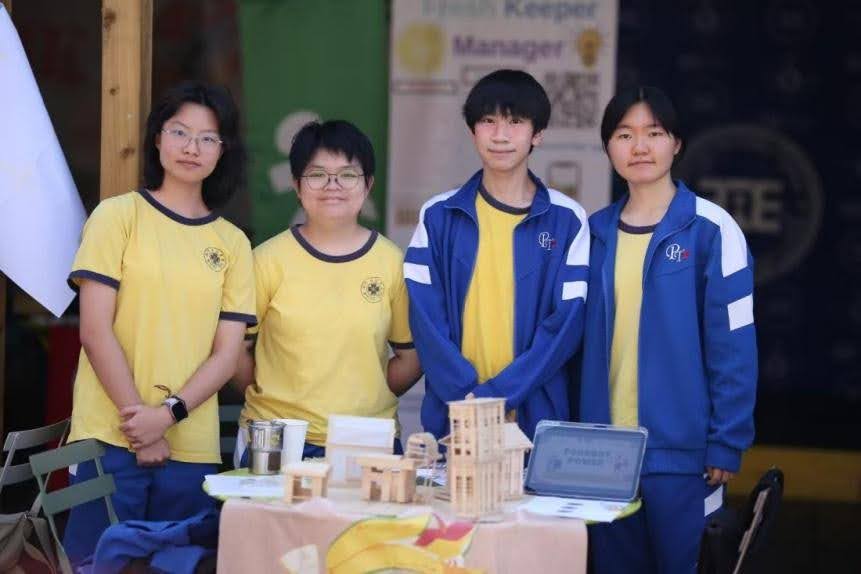

On July 7th, the 2026 BIEA International Youth STEM Competition Final and Showcase took place at Mercato Metropolitano in Elephant & Castle, London.
Now in its ninth year, the competition has built a track record of tackling real-world challenges, from deploying drones to protect endangered species and cleaning up coastlines, to combating the plastic crisis and reimagining urban design.
This year’s theme, “Reducing Food Waste”, drew 50 teams from 15 countries and regions, with participants aged between 6 and 18 presenting solutions they had spent months developing and refining.

Dr Alex Holmes, the competition’s organiser, told reporters that this year saw a marked increase in experimental projects, with many teams exploring novel preservation methods using food waste itself as raw material. “We saw children making antimicrobial bags from citrus peel. The thinking is very much aligned with circular economy principles,” she said. Among the entries, China’s teams left a particularly strong impression. “There was a lot of Python code, various sensors. The designs were clever and well thought-through,” she added.
Macao sent 12 teams to the final, all selected through a local qualifying process. Zhao Qichao, a teacher from Pui Wah Middle School who accompanied the delegation, said the competition offers students an end-to-end experience, from selection and preparation through to the final showcase, that few other platforms can match. “It’s a significant leap forward for the students,” he said. In his view, the real value of STEM education lies not in finding answers, but in learning to ask the right questions. “Identifying a problem is more important than solving one. STEM education cultivates students’ ability to notice what’s wrong around them, articulate it, and then use their knowledge to address it, forming a complete loop.”
At one of the Macao exhibition stands, a miniature residential building constructed from ice lolly sticks drew a steady stream of curious visitors. The model belonged to Team Save Savour Savants, and was built to demonstrate how their robot system would navigate between apartment blocks and restaurants to collect food waste. Team member Du Wanlin explained that the project was born out of an observation: people simply don’t bother recycling kitchen scraps. “Our survey found the main reason was that it felt like too much effort, and some neighbourhoods don’t even have the right bins.” The team’s solution automates the collection entirely. Kitchen waste is processed into fertiliser and biogas, which in turn powers the robots, a self-sustaining cycle requiring no external energy source.
Also from Macao, team Piggie Broccoli tackled the problem at an earlier stage: the moment food enters the home. Their smart device uses a camera to identify what’s in the fridge, predict expiry dates and suggest recipes, with an automatic composting function that activates once items spoil. The casing is made from bamboo and powered by solar or wind energy. “We wanted to complete the full cycle, from buying food to when it can no longer be eaten,” said team member Charles Chu. “The prototype actually works right now, though we’ll keep improving it.”

The team from Shanghai Children’s Palace Low-Carbon Club traced their inspiration back to a work of science fiction. Liu Enze said the spark came from watching truckloads of leftover food being hauled away from the school canteen each day. “It was painful to see.” The idea crystallised when the team recalled a detail from the novel The Wandering Earth, in which a character builds a miniature ecosystem. Drawing on that concept, they investigated whether food waste could be fed into a biofloc cultivation system to raise fish, turning refuse into a resource. Their experimental setup, equipped with turbidity sensors and temperature monitors, has already been piloted at a neighbourhood committee level, with plans to scale to school canteens and small farms. Wang Han ran the numbers: a school currently spending around £180 a year on food waste disposal could, with this system, generate approximately £7,000 in additional income instead.


Sun Chongtai, from the Beijing Song Qingling Youth Science and Technology Cultural Exchange Centre, presented ZeroWaste, a three-module smart canteen system integrating facial recognition for ordering, a cooking robot, and a composting power generator for post-meal waste, forming an end-to-end loop from meal selection to kitchen scraps. He noted that the proposal aligns with Beijing’s current push to equip more primary and secondary schools with on-site canteens. “Many schools still have food delivered in from outside. Our project could help more schools set up their own kitchens.”


Among the international field, South Korea’s EcoShield and Turkey’s CitraSense approached the same underlying problem from different angles: food that spoils before it ever reaches the table.
EcoShield developed a natural, edible coating made from chitosan, tea polyphenols, glycerin and acetic acid. The thin, semi-permeable film slows moisture loss, limits gas exchange and inhibits microbial growth. In trials, coated strawberries showed 28% less moisture loss at room temperature, and 65% less under refrigeration.

CitraSense focused on meat. The Turkish team developed a biopolymer coating derived from mandarin peel extract and thyme oil, combining antimicrobial properties with smart sensor capability. As meat begins to spoil, the coating shifts colour, from yellow to orange to dark brown, giving consumers an at-a-glance freshness indicator. “We wanted to use food waste itself to solve the problem of food waste,” a team member said. The material is biodegradable and compostable, with potential applications in smart food packaging and retail supply chains.


Faced with the same question, young people from 15 countries arrived at 15 different answers. Some were inspired by daily household waste, others by science fiction; some focused on community infrastructure, others on materials science. After speaking with teams from around the world, Shanghai’s Liu Enze reflected: “Everyone had a different starting point, completely different thinking, but we were all solving the same thing.”
It is precisely this that Dr Alex Holmes values most about the competition. STEM classrooms, she observed, tend to deal in established knowledge. This kind of contest asks students to apply what they know to problems that are real and unresolved. “What they learn isn’t just science. It’s leadership, teamwork, and the ability to think outside the box. Those are things AI still can’t replace.” BIEA’s belief, she added, is a simple one: we all share the same planet. “Letting children see that peers on the other side of the world are tackling the same question in completely different ways. That matters.”
The BIEA International Youth STEM Competition is the association’s annual flagship event, designed to inspire scientific curiosity and cross-cultural collaboration among young people aged 6 to 18 through engagement with real-world challenges. On 8 July, BIEA also hosted the Youth Voice Forum at UCL Bloomsbury, bringing together young participants from across the globe to exchange perspectives on artificial intelligence, sustainable development and international cooperation.
Reported by Tianai Lu and intern reporter Xiaoxiao Hu.
If you like this article, why not read: How Overseas Chinese Youth Explored China This Summer


