

April’s book selection moves between code and aesthetics, history and everyday life.
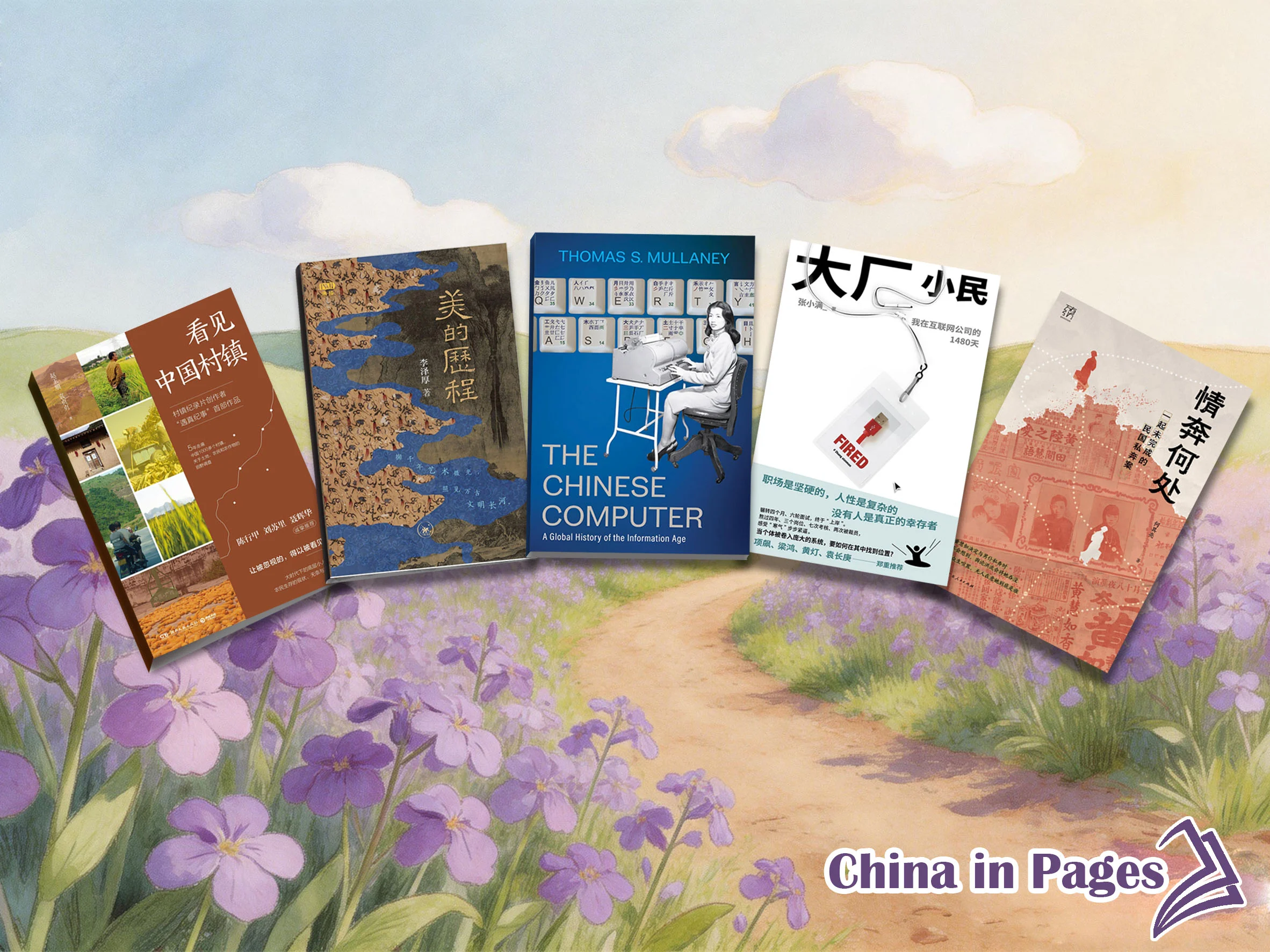
Our April reading list starts with the clever ways Chinese characters were squeezed into the digital age, and moves on to a sweeping history of Chinese art and ideas of beauty. It also includes a late 1920s elopement story, life inside China’s internet giants, and the often unseen world of villages and small towns.

The Chinese Computer: A Global History of the Information Age《中文计算机》
Chinese people living or studying abroad often share a curious experience: locals watch them type Chinese characters on a standard keyboard or smartphone and are intrigued. Some ask how Chinese characters are input; others assume there must be a separate keyboard designed just for Chinese.
In fact, like most people around the world, Chinese users type on standard QWERTY keyboards. So how does it actually work? How were Chinese input methods invented? In this book, Thomas S. Mullaney explores how Chinese characters entered the digital age after the Second World War. He also looks at the forgotten history of Chinese keyboard designs, a subject unfamiliar to many Chinese readers today. The book offers a fresh perspective on both the history of Chinese characters and the development of Chinese computing.

The Path of Beauty《美的历程》
A landmark work on Chinese aesthetics, The Path of Beauty traces the evolution of Chinese art through the ages. The philosopher and aesthetician Li Zehou explores changing ideas of beauty, from the raw vitality of ancient bronzeware, to the refined elegance of the Wei-Jin period, and on to the grandeur of Tang grottoes and the quiet lyricism of Song and Yuan landscapes.
Rather than a conventional art history, the book offers a broader synthesis of painting, sculpture and literature. Li goes beyond formal description, linking artistic change to the wider currents of Chinese history. Drawing on philosophical and anthropological perspectives, he shows how a distinctively Chinese aesthetic sensibility developed over thousands of years.

A Passionate Escape《情奔何处》
In 1928, Huang Huiru, the daughter of a wealthy Shanghai family, fell in love with her family’s male servant, Lu Genrong, and eloped with him to Suzhou. After the case was reported, Lu was arrested and imprisoned, while Huang died after giving birth. The story was widely reported in newspapers in Shanghai and Suzhou.
The author He Qiliang reconstructs this case through newspapers, theatre, film and fiction of the time, offering a portrait of a ‘New Woman’ in late 1920s China. Moving beyond elite women, the book focuses on a more ordinary ‘Nora-like’ figure caught between tradition and modern independence. It explores how early twentieth-century reformist ideas in China shaped women’s everyday lives and understandings of modernity.

Ordinary Souls in Big Tech《大厂小民》
‘I was someone who disliked competition, yet I stepped into a highly competitive, rational and tightly engineered system.’ Zhang Xiaoman, a former investigative journalist, spent 1,480 days working for a major Chinese tech company.
In the public eye, China’s tech giants are often seen as symbols of progress or profit-driven attention machines. Zhang offers a more nuanced perspective. In what she describes as ‘typical non-technical roles’, Zhang dealt with all kinds of people across the company but stayed on the edge of the system. This gave her a special view: observing how the industry operates from within.

Voices from Rural China《看见中国村镇》
In China, the cities are never short of the spotlight. Whether it is a new skyscraper, a railway stations, or a suburban development, the media is always there. Villages and small towns, however, are far less visible. Zhao Yushun and Yuan Zhenzhen decided to take the microphone to the fields.
As documentary filmmakers and creators of a popular Bilibili channel, they have built a following of over 500,000 and attract millions of views. Over the past five years, the pair have travelled across the country, visiting more than 1,000 villages and small towns. Through direct conversations with local residents, they strip away idealised images of the countryside and present a more grounded reality of rural China.
Written by Estelle Tang, illustrated by Yuma Zhao.
If you liked this article, why not read: March Picks: Books Portraying China Through Personal Stories


