
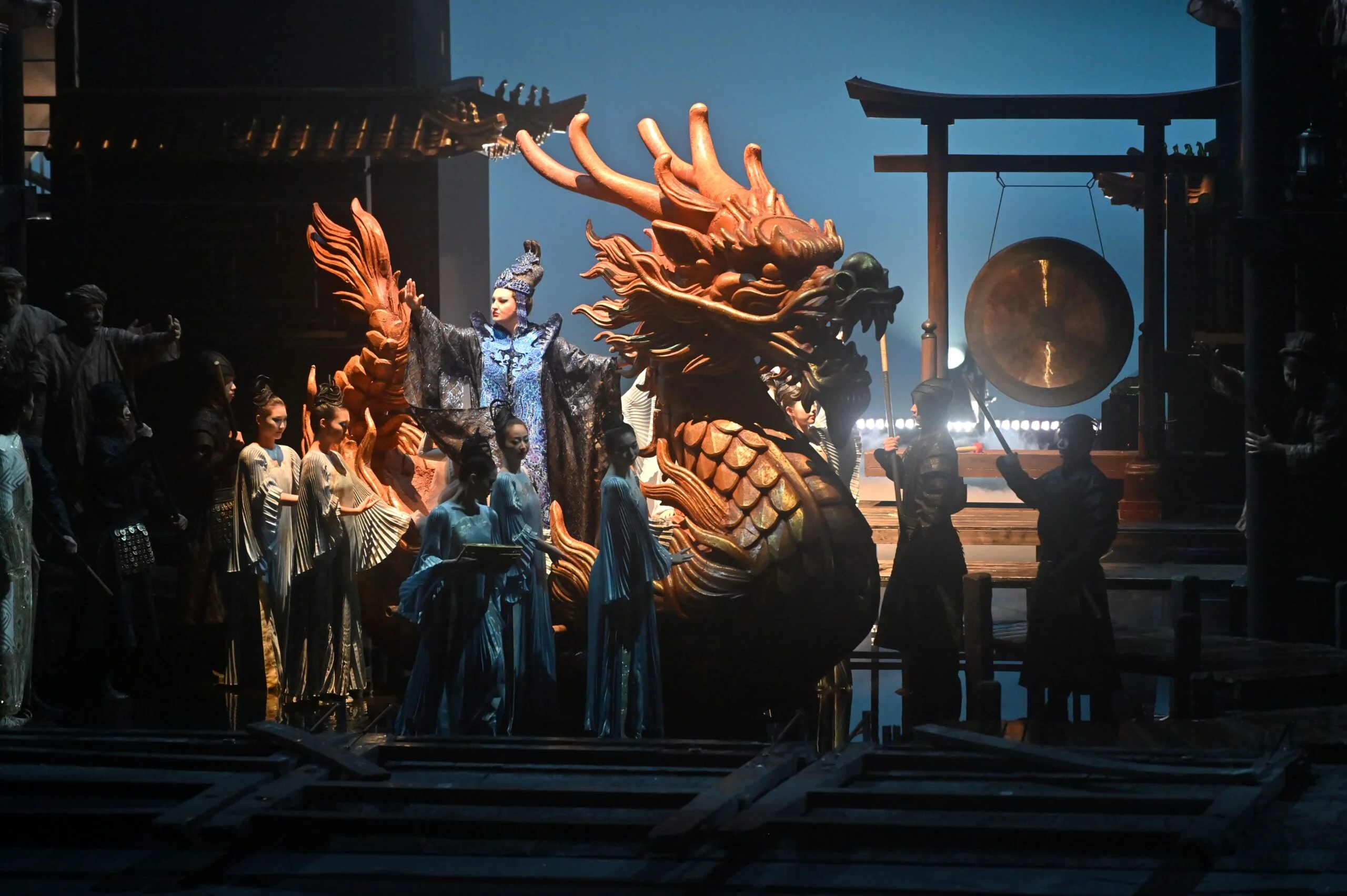

A new centenary production of Puccini’s Turandot reimagines the opera’s Oriental fantasy through martial arts and East–West collaboration on stage.
In 1926, when conductor Arturo Toscanini lowered his baton at La Scala and declared that the composer had laid down his pen forever, Giacomo Puccini’s unfinished Turandot entered history as both an artistic fragment and a myth. A century later, the opera returns not as a fixed masterpiece, but as a living text that continues to shift with cultural interpretation.
In 2026, to mark the centenary of its premiere, a new production of Turandot—co-directed by Jackie Chan in his first foray into opera direction—opened at the Guangzhou Opera House before travelling to the Xiamen Minnan Grand Theatre. Later this year, it will also serve as the opening production of the 72nd Puccini Festival in Italy. As the production crosses continents, it raises a larger question: how does a century-old Western opera reimagine its idea of “the East” in today’s global cultural landscape?
From “Jasmine Melody” to Oriental Fantasy: How Turandot Was Shaped
Puccini’s Turandot tells the story of an emotionally distant princess in a mythical version of imperial China who challenges her suitors with riddles, sentencing those who fail to answer them to death. When Prince Calaf succeeds, he not only solves the riddles but also attempts to win her emotional transformation through persistence and love.
According to a long-circulating anecdote in opera history, Puccini encountered a melody resembling “Jasmine Flower” (Mo Li Hua) in a music box during the summer of 1920. That brief encounter reportedly inspired him to weave an “Eastern” musical atmosphere into the opera. Over time, the melody became one of the most recognisable musical symbols associated with Turandot.
However, scholars increasingly emphasise that the opera reflects a Western construction of the East rather than an authentic representation of it. Claudio Toscani, a professor of opera history at the University of Milan, notes that Turandot “emerged from a Western gaze that imagined the East, yet it also opened a century-long dialogue between musical traditions.”
Early productions often relied on stylised visual codes—dragons, lanterns, imperial palaces—designed to signal “Chineseness” to European audiences. In this context, cultural elements functioned less as narrative substance and more as aesthetic decoration shaped by exoticism.
As cultural exchange between China and the West deepened, reinterpretations gradually emerged. In 1998, Zhang Yimou staged a monumental version at Beijing’s Forbidden City, transforming the opera into a spectacle of red walls, golden roofs, and ritualised court imagery. Later, in 2008, the National Centre for the Performing Arts in China introduced a new ending composed by He Wei, reinforcing themes of forgiveness while integrating ink-painting aesthetics and spatial minimalism.
Even so, each adaptation exposed a persistent tension. Western operatic traditions prioritise dramatic vocal expression, while Chinese audiences often expect clearer narrative logic and historical grounding. Consequently, the character of Turandot has remained fluid, constantly reshaped by differing cultural expectations.

Martial Arts on Stage: Rewriting Opera Through Physical Language
The 2026 centenary production takes this reinterpretation further by integrating Chinese martial arts directly into the dramaturgical structure of the opera. Rather than treating martial arts as decorative choreography, the production embeds movement into character psychology and narrative development.
Each principal character receives a physical “double” that expresses their internal state. Turandot, for instance, is paired with a “dragon” embodiment that uses Tai Chi-inspired motion to reflect restraint and authority. Calaf’s counterpart appears as a “horse,” drawing on Changquan techniques to externalise tension, urgency, and emotional instability. Through this structure, martial arts no longer sit outside the opera as spectacle; instead, they become a language of emotional articulation.
Producer Tian Hui explains that the creative team aimed to move martial arts “into the core of operatic storytelling rather than leaving it as surface decoration.” In the same spirit, co-producer Guo Liqun describes the choreography as a system that translates desire, repression, and transformation into visible physical expression. As he puts it, this approach allows Eastern aesthetics to operate within the internal logic of the work rather than hovering around it.
At the same time, performers trained in Western operatic tradition have had to adapt to this hybrid form. During rehearsals in Xiamen, bass singer Vyacheslav Strelkov described the experience as unlike anything in his career, noting that the integration of opera and martial arts created a new physical awareness on stage. Tenor Ivan Gyngazov highlighted the challenge of maintaining vocal control while executing choreographed movement sequences. Meanwhile, soprano Courtney Ann Mills emphasised that the production reshaped her understanding of both the character and the cultural context behind it.

From Cultural Distance to Creative Collaboration: Rethinking East and West
Over the past century, Turandot has moved through distinct phases of interpretation—from Western fantasy to Chinese reinterpretation, and now toward collaborative co-creation. Each stage reflects not only artistic evolution but also shifting cultural power dynamics between East and West.
Guo Liqun recalls that in the 1980s, Chinese artists often approached Western classics from a position of admiration and distance. Today, however, he sees a different relationship emerging. Chinese and European artists now collaborate as equals, engaging in shared creative decision-making rather than hierarchical adaptation.
This shift does not eliminate cultural differences. Instead, it reframes it. Rather than treating difference as a barrier, the centenary production treats it as material for artistic construction. As a result, Turandot becomes less a fixed Western opera about the East and more a transnational work continuously rewritten through performance.
Ultimately, when the melody of “Jasmine Flower” returns on stage, it no longer functions as a simple exotic motif. Instead, it resonates as a century-long echo of interpretation, negotiation, and creative exchange. In that sense, the enduring appeal of Turandot lies not in its resolution, but in its openness—its ability to remain unfinished, and therefore permanently open to reinterpretation.
Written by Ronnie Yu.
If you like this article, why not read: Ming-Dynasty Opera to Debut at Brighton Fringe 2026


