

Discover how Chinese families seal their wishes in Huangjiu, a traditional rice wine, preserving life’s milestones and emotions for years to come.
In Shaoxing, a historic city in eastern China, some families mark life’s most important moments in an unusual yet deeply meaningful way: they seal a jar of freshly brewed Huangjiu and set it aside for years—sometimes decades—before opening it again. In doing so, they are not simply preserving a drink but capturing a moment in time.
Sealing Time, Sealing Wishes
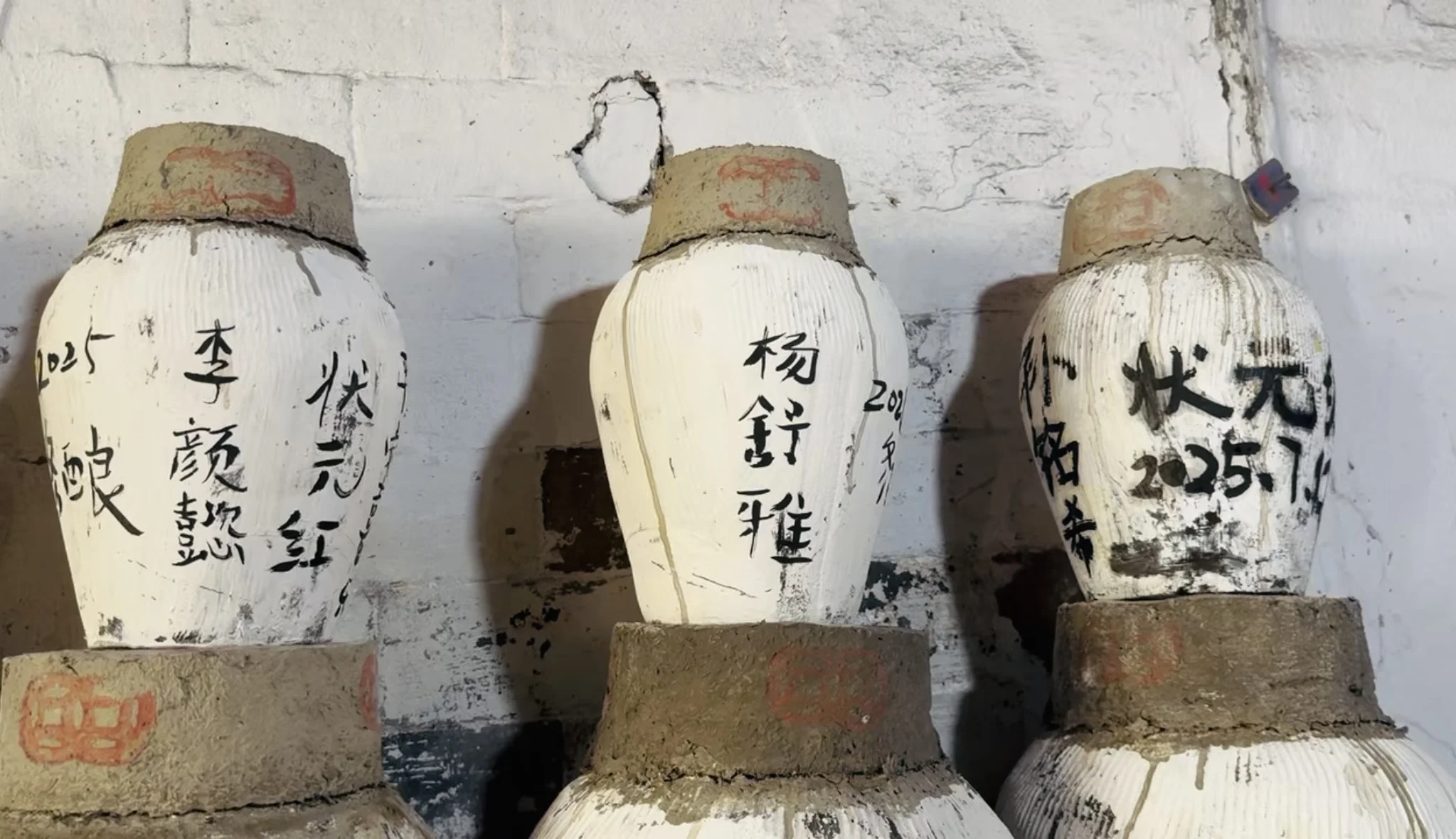
Known as “sealing a jar” (fengtan), the practice involves pouring newly brewed Huangjiu into a clay vessel, wrapping the mouth with red cloth, securing it with rope, and sealing it with mud. The jar is then stored away, often untouched until a future milestone. In this sense, it works much like a time capsule—except that what is preserved is not objects, but emotion, memory, and anticipation.
Each spring, following a traditional brewing cycle that begins in winter, families travel to Shaoxing to take part in this ritual. The timing is no coincidence. By long-standing practice, Huangjiu is brewed in the colder months and sealed in spring, when conditions are considered ideal for ageing. As such, the act of sealing becomes part of a larger rhythm shaped by both craft and season.

A Promise for the Future
For many, the ritual is closely tied to family life. Luo Caiya, a visitor from Lishui in Zhejiang province, recently sealed a jar for her newborn nephew. Under the guidance of a local brewer, she and her family carried out each step by hand. Afterwards, she used a calligraphy brush to write the child’s name, birth date, and a short message of hope on the jar.
They plan to open it 18 years later, when the child reaches adulthood.
Such intentions are common. Across Shaoxing, jars are marked with phrases like “wedding anniversary,” “peace and joy,” or simply a future year. Some are prepared by newlyweds to mark their marriage, while others are sealed by parents for their children, or even by individuals planning ahead for milestone birthdays. Although the occasions differ, the idea behind them remains the same: to connect the present with the future through a shared ritual.
At the same time, the tradition is quietly evolving. One local brewer recalls a Chinese-French couple who sealed a jar for their newborn daughter. Alongside her Chinese name, they inscribed a French one on the vessel. They also made a promise—to return years later and open the jar together. In that moment, the practice extended beyond family memory, becoming a subtle bridge between cultures.

Tradition in Continuity
Huangjiu itself has a long history. As one of China’s oldest forms of brewed alcohol, it follows a seasonal process that reflects a close relationship with nature: preparing fermentation starters in summer, crafting wheat-based qu in autumn, brewing in early winter, pressing the wine in spring, and finally sealing it for ageing. Each stage depends on timing, environment, and accumulated experience.
Over time, the tradition has adapted to modern conditions. While the core techniques remain intact, producers are also exploring new methods to better understand fermentation and improve consistency. Even so, these changes do not diminish the ritual significance of sealing a jar. Instead, they exist alongside it.
Ultimately, for those who take part, Huangjiu is more than a beverage. It becomes a vessel for memory—one that matures quietly alongside the lives it is meant to accompany. When the seal is finally broken years later, what emerges is not only aroma, but a moment long preserved.

Additional reporting by Xiang Jing.
If you like this article, why not read: “Wine Olympics” Returns to Ningxia, Rising Global Influence


