

From tactile replicas to audio guides, museums across China are creating more accessible and multi-sensory ways for visitors to experience history and culture.
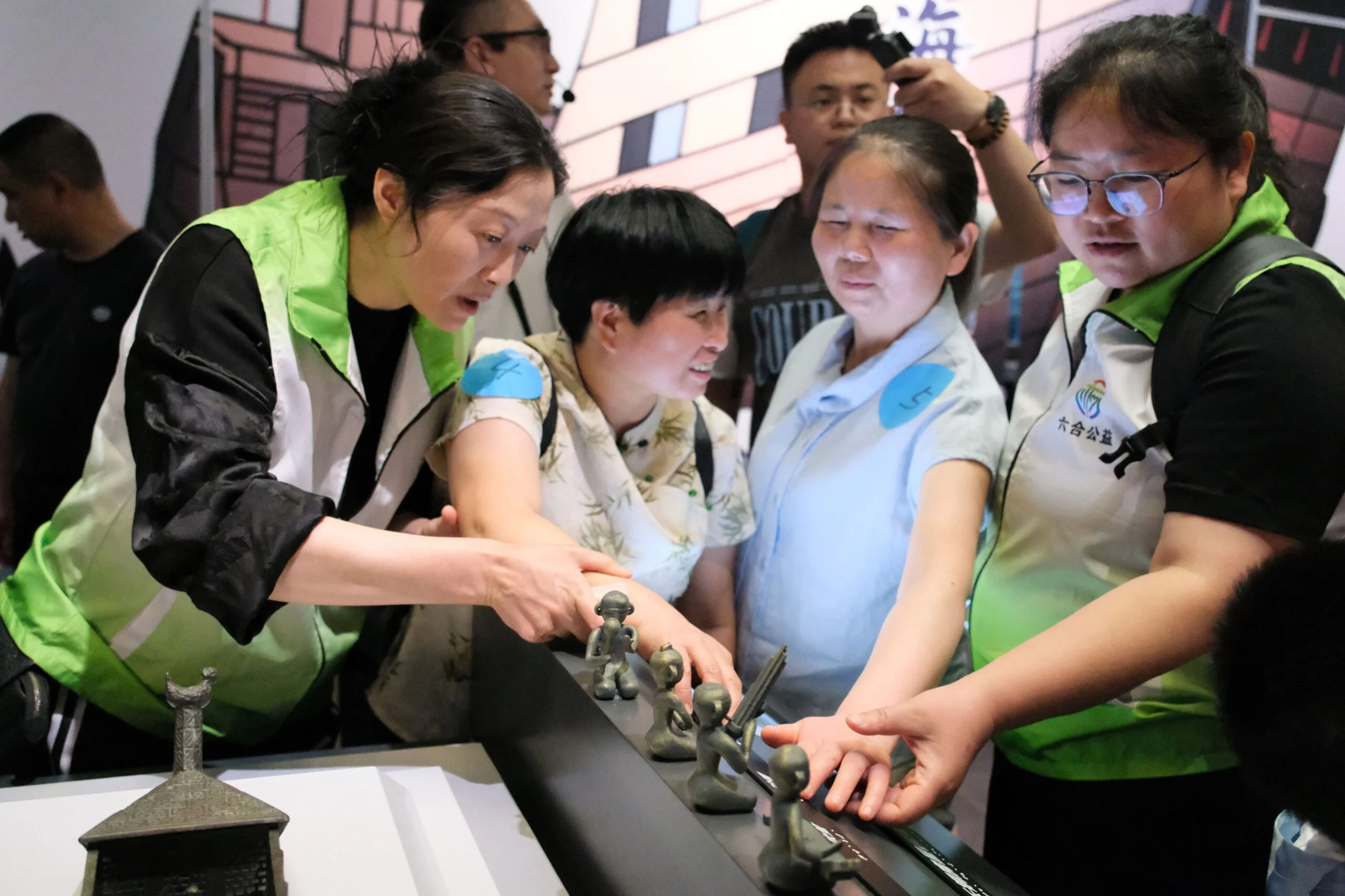
Fingers slowly moved across the cool surface of a jade artefact from China’s Liangzhu civilisation. Then they paused inside a narrow circular hole carved into the centre of the piece more than 4,000 years ago.
There, visitors with visual impairments and other participants discovered a small, uneven ridge left behind by ancient craftsmen as they drilled the jade by hand.
“It’s an imperfection you can only notice through touch,” volunteer guide Dong Zhen said during a museum activity in Hangzhou, east China’s Zhejiang Province.
Around her, participants continued exploring the artefact with their hands. Some traced the carved patterns along its outer edges. Others leaned closer to listen as guides described how the jade cong was once used in ancient rituals.
For many participants, the experience offered a different way to connect with history — not through glass cases or written labels, but through touch, sound and imagination.
The activity took place at Zhejiang Provincial Museum ahead of International Museum Day on May 18th. Inside the museum’s exploration gallery, visitors interacted with tactile replicas of nine cultural treasures from the museum’s collection.
Meanwhile, educators used vivid descriptions to explain the stories behind the objects. Participants touched the miniature instruments held by musicians in a bronze house model from the Warring States period. Others followed the flowing outlines of a relief version of the famous Chinese painting Dwelling in the Fuchun Mountains.
Nearby, a replica of the Tang-era qin, or seven-string zither, drew repeated attention. Several visitors ran their fingers along its curved edges again and again, quietly exploring the shape of the ancient instrument.
Museums Beyond Visual Experience
The gallery is part of the museum’s broader effort to create a more accessible and inclusive museum experience.
The space includes braille labels, audio devices, tactile displays and interactive screens with sign-language videos. Instead of relying only on visual presentation, the museum encourages visitors to engage through multiple senses.
Across China, more museums are moving in a similar direction.
At Guangdong Museum in southern China, monthly programs now offer long-term services for visitors with different accessibility needs. The museum has developed audio-based experiences as well as sign-language guided activities.
In Shijiazhuang, north China’s Hebei Province, visitors can touch replicas of famous cultural relics, including the Changxin Palace Lantern and bronze animal heads inspired by those once displayed at Beijing’s Old Summer Palace.
Meanwhile, Tianjin Natural History Museum recently opened a multi-sensory exhibition area featuring tactile animal models, textured surfaces and plant scent installations. Audio guides and large-print explanations are also available throughout the space.
Rather than centring only on what can be seen, these museums are experimenting with new ways for people to experience culture and nature.
A Growing Focus on Cultural Access
The changes reflect a broader push for barrier-free public spaces in China.
In 2023, China introduced its Law on Building Accessible Environments, aimed at improving public access and social participation. Meanwhile, UNESCO and the Chinese Association of Museums launched work on guidelines for museum accessibility, which were released in 2025.
Yet inside the museums, the changes often appear in quieter moments.
Back in Hangzhou, several visitors with visual impairments remained beside the jade cong long after the explanation ended. Their hands moved slowly along the inner ridge left by craftsmen thousands of years ago.
Additional reporting by Xinhua, CNS.
If you liked this article, why not read: New Year’s Eve at the Museum: A Growing Cultural Trend in China


