
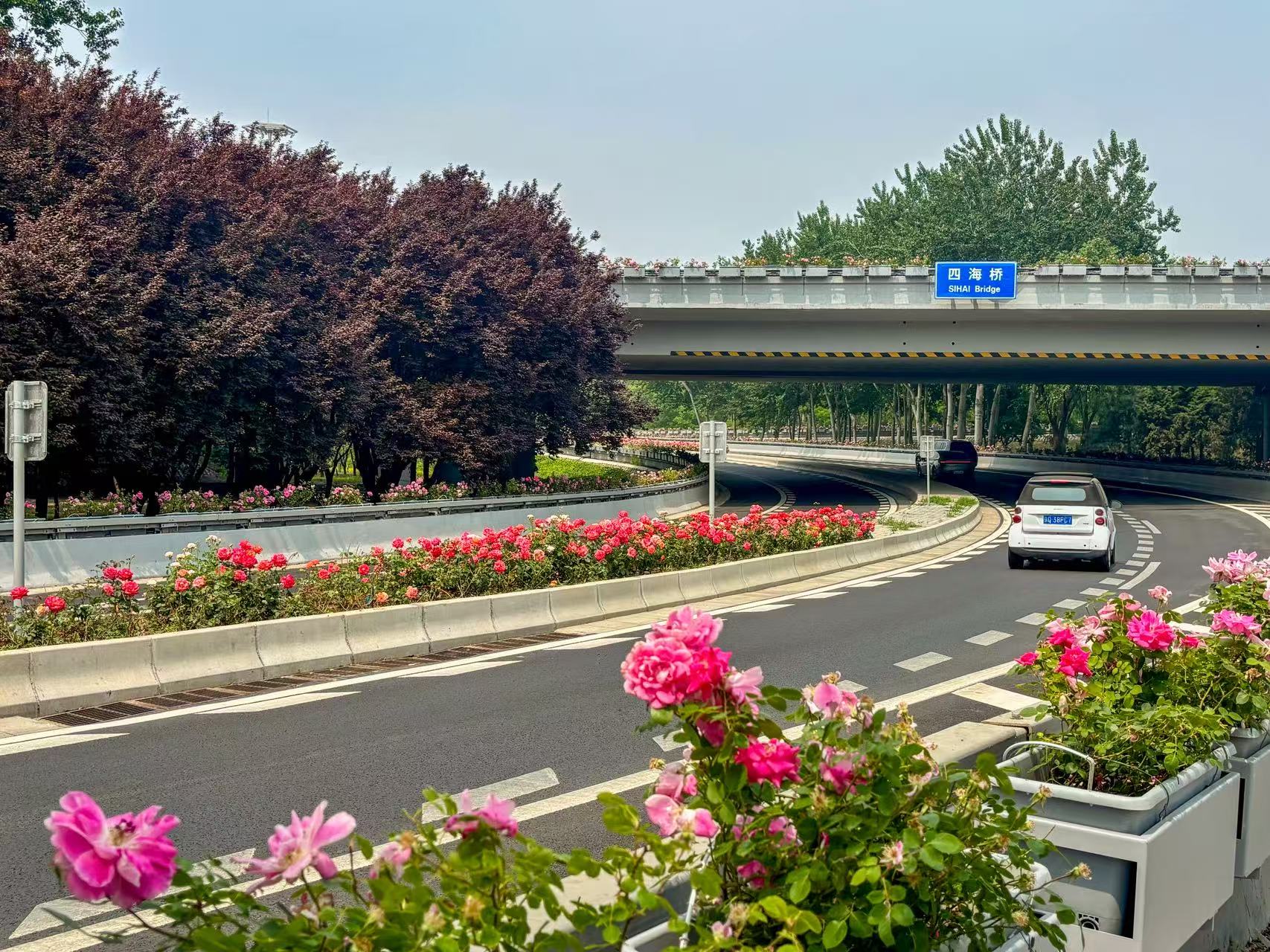

Beijing is turning its 65-km 4th Ring Road into a continuous rose corridor that combines urban infrastructure, sustainability, and public green space.
Beijing is transforming its 65.3-kilometre 4th Ring Road into a continuous rose corridor, a project city officials say will create the world’s first urban “rose ring” when completed in November.
The project forms part of a broader effort to expand green infrastructure across the Chinese capital. Beijing has already built nearly 1,000 kilometres of rose landscape corridors, and the completed 4th Ring Road project will include more than 710,000 rose plants.
Rather than serving as a simple roadside decoration, the initiative aims to integrate ecological design into one of the city’s busiest transport routes. The result is a new type of urban space where infrastructure and nature coexist.

Roses Reshape Daily Life in the City
May marks the peak blooming season for roses in Beijing. During these weeks, roads, bridges, parks, residential neighbourhoods and historic alleyways are filled with colourful blossoms.
The transformation has attracted widespread attention online. In recent weeks, topics related to Beijing’s roses have trended on several social media platforms as residents shared photos and videos of flower-lined roads and elevated highways.
Many commuters say the flowers have changed how they experience daily travel. Some describe traffic jams as feeling less stressful when surrounded by blooming roses, while others compare their journeys to travelling through a garden.
Photographers have also captured aerial views of elevated roads wrapped in what many online users call “rose necklaces.” The images have gained thousands of likes and helped turn the flowers into one of the city’s most popular seasonal attractions.
Visitors have noticed the change as well. Pina, an Italian tourist visiting Beijing, said the city’s streets looked beautiful and that the flowers made her want to spend more time exploring the capital.
Elsewhere in the city, places such as Chaoyang Park Road feature long stretches of roses and flowering plants along sidewalks and fences. Meanwhile, the rose garden at the National Botanical Garden showcases thousands of varieties across seven hectares and holds the title of “Garden of Excellence” awarded by the World Federation of Rose Societies.

Building a Sustainable Green Corridor
Creating a continuous floral landscape along a major ring road requires more than planting flowers.
City planners adapted their approach to different conditions along the route. Climbing roses were planted directly in areas with suitable soil, while hardened surfaces in other sections were removed and restored to support vegetation. In shaded areas beneath bridges, designers selected rose varieties that can tolerate lower light levels and installed flower boxes.
Safety also played a key role. New flower installations along elevated sections help reduce glare while enhancing the visual landscape.
At the same time, Beijing introduced a smart irrigation system designed to improve efficiency. Around 500,000 metres of irrigation pipelines now support drip and spray watering methods. According to city officials, the system can reduce water consumption by more than 50 per cent and cut manual watering work by about 60 per cent.
The rose itself has a long connection with China. Historical records trace its cultivation back more than two thousand years. Chinese roses later reached Europe through maritime trade routes and contributed to the development of many modern rose varieties grown around the world today.
In recent decades, Beijing has moved from relying heavily on imported varieties to developing its own. The city now has more than 220 rose varieties with independent intellectual property rights.
Today, roses have become more than a seasonal attraction. As Beijing expands its network of floral corridors, they are helping redefine how residents interact with urban space. Roads designed primarily for movement are increasingly becoming places that people stop to notice, photograph and enjoy.
Written by Ronnie Yu, additional reporting by CNS, CCTV.com
If you liked this article, why not read: Flowers Without Borders: Beijing International Flower Show Opens


