
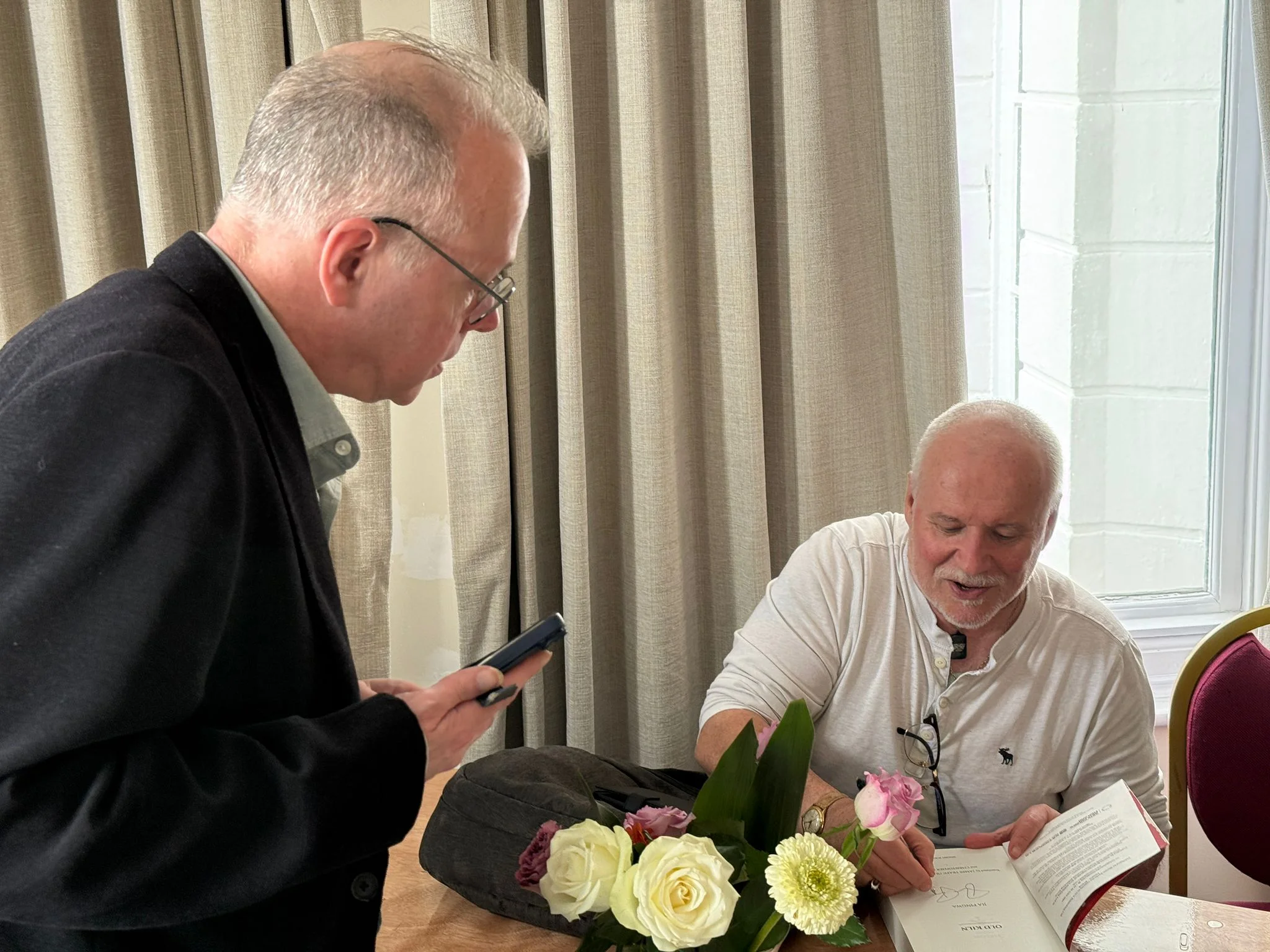

Jia Pingwa reflects on his book The Old Kiln, memory, trauma, and translation at a Hastings book club event organised by Sinoist Books in May.
The book club was held on May 4th in Hastings, organised by Sinoist Books, which published the English translation of Jia Pingwa’s The Old Kiln. The club aims to bring together those from all walks of life with an interest in Chinese literature.
The session opened with Sinoist representative Wang Ying asking Jia about his motivation for writing The Old Kiln. Jia explained that he sought to explore how hardship reveals human nature, observing that difficult conditions often expose harsher aspects of human behaviour.
He also identified a gap in Chinese literary production: while “scar literature” emerged after the Cultural Revolution, relatively few long-form novels have fully documented that historical period. Having experienced the era himself as a teenager, and recognising that those who lived through it are now ageing, Jia emphasised a strong sense of responsibility to record these histories before they fade from collective memory.
When discussing the relationship between fiction and reality, Jia noted that although the novel’s setting is fictional, its events and characters are largely based on real experiences. During the Cultural Revolution, his father, a schoolteacher, was persecuted, schools were shut down, and he returned to his home village, where he witnessed social upheaval firsthand. Many characters in the novel are drawn from people he personally knew.
Jia also reflected on the novel’s scale. Although he usually begins writing with a structured plan, he did not anticipate The Old Kiln becoming so extensive. However, the richness of material and detail led it to expand organically to over 500,000 Chinese characters.
In terms of reception, he highlighted the novel’s strong impact in China, particularly its role in prompting reflection on the origins and lingering social consequences of the Cultural Revolution. He noted that he was especially struck when readers began referencing his fictional characters in real-life contexts, indicating deep narrative resonance.
Jia also discussed his wider literary output, including the forthcoming English translation of Bean Paste, translated by Nicky Harman. Jia described his work as broadly centred on two major themes: urban intellectual life, represented by The Abandoned Capital, and rural historical experience, represented by The Old Kiln. Compared with the latter, Bean Paste is shorter and may offer a more accessible entry point for international readers.
Also speaking at the event was translator James Trapp. He described taking on the project unexpectedly during the COVID-19 pandemic. He initially found the text challenging due to its heavy use of the Shaanxi dialect. With support from dialect dictionaries, native speakers, and co-translators, the team worked through these linguistic complexities.
The translation process involved extensive collaboration among three translators, along with input from professional staff within the publishing group, including the creation of detailed character lists and relationship maps to manage the novel’s large cast. Regular discussions were held to ensure consistency in terminology and interpretation.
Emphasing the importance of translation, there was a live bilingual reading at the event. A passage was first read by Jia in the Shaanxi dialect of Chinese, followed by Trapp’s English translation, vividly demonstrating the interplay between original text and translated version.
If you like this article, why not read: Sinoist Books Win Big at London Book Fair


