Floral Masterpieces from Austria Bloom in Beijing

Picture of Yi Shen

Yi Shen

Work Link

Floral Masterpieces from Austria Bloom in Beijing

To celebrate the 55th anniversary of China-Austria diplomatic ties, a premium Austrian floral art exhibition debuted in Beijing.

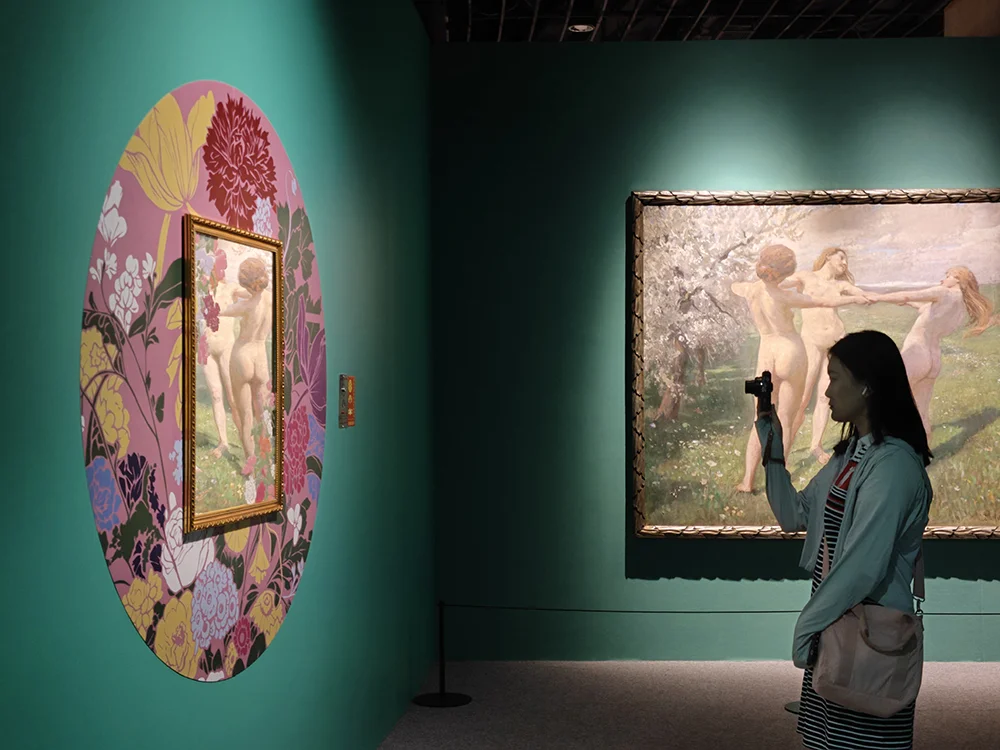
In June 2026, the exhibition “Blooming Hearts Through Centuries – From Waldmüller to Klimt: Floral Masterpieces from the Belvedere in Vienna” opened at the China Millennium Monument Art Museum in Beijing. Guided by the Austrian Embassy in China and co-organised by the Belvedere Museum Vienna and the China Millennium Monument, the exhibition brings together 60 Austrian floral masterpieces valued at more than €58 million. Visitors photograph a painting by Ferdinand Georg Waldmüller.
A gallery view of the exhibition.
Ferdinand Georg Waldmüller’s Still Life with Fruit, Flowers, and a Silver Cup (1839). Silverware, flowers and fruit stand out vividly against a dark background.
“Decorative Bouquet of Flowers” (1884) by Hans Makart (1840–1884). Makart uses bold brushstrokes and a dynamic composition to emphasise overall visual impact rather than botanical accuracy.
The exhibition spans more than two centuries of artistic development, from 18th-century Baroque to 20th-century Expressionism. As 2026 marks the 55th anniversary of diplomatic relations between Austria and China, the exhibition serves as a major cultural exchange project between the two countries. A visitor admires Waldmüller’s Still Life with Fruit, Flowers, and a Silver Cup (1839).
Visitors leave messages at the exhibition’s message wall.
Ferdinand Georg Waldmüller’s Still Life with Fruit, Flowers, and a Silver Cup (1839). Silverware, flowers and fruit stand out vividly against a dark background.
“After the Rain” (c.1898) by Gustav Klimt (1862–1918). Created before his celebrated Golden Period, this early landscape depicts a flower-filled meadow in the Austrian countryside and hints at the distinctive style that would later define the artist.
Visitors explore the exhibition. Sound and scent are incorporated to create a multi-sensory experience beyond visual appreciation.
Exhibition merchandise on display.
“Alpine Flowers” (1876) by Joseph Schuster (1812–1890). The painting depicts a valley in the Swiss Alps with soft colours and flowing brushwork, celebrating nature through the Romantic tradition.
“Flora” (1830), a marble sculpture by Josef Klieber (1773–1850), depicts the Roman goddess of flowers and spring. The work reflects the influence of Classicism on Austrian sculpture during the Biedermeier period.

Photos by Di Wang.

If you like this article, why not read: Gordon Cheung Exhibition Opens at Close Gallery, Somerset

Related Posts

Huw Lewis-Jones
How Maps Lead Readers Into Imaginary Worlds
Once Upon A Time in the Middle East
How a Chinese Film Turns Food into a Story of Survival and Peace
IMG_9006 (1)
Cecilia Chuan Jiang’s Debut Solo Exhibition Where Light is Stored Opens in London
Shoton Festival in Lhasa
Giant Buddha Thangka Unveiled as Shoton Festival Opens in Lhasa
Chinese lacquer
Why Are Young People Returning to a Chinese Village for Lacquer?
Zhongshu
Why a Christopher Nolan Interview with Chinese Podcaster Zhong Shu Went Viral
Inner Mongolian rock band SongS Band
How an Inner Mongolian Rock Band Is Reimagining the Sound of the Grasslands
July Books
【China in Pages】July Picks: Reading China Through Different Voices
Teochew chive dumpling
The Teochew Chive Dumpling Winning Hearts After a Hit Film
Women Naadam Festival
From Archery to Horse Riding: Women Bring New Energy to Naadam Festival
Scroll to Top