
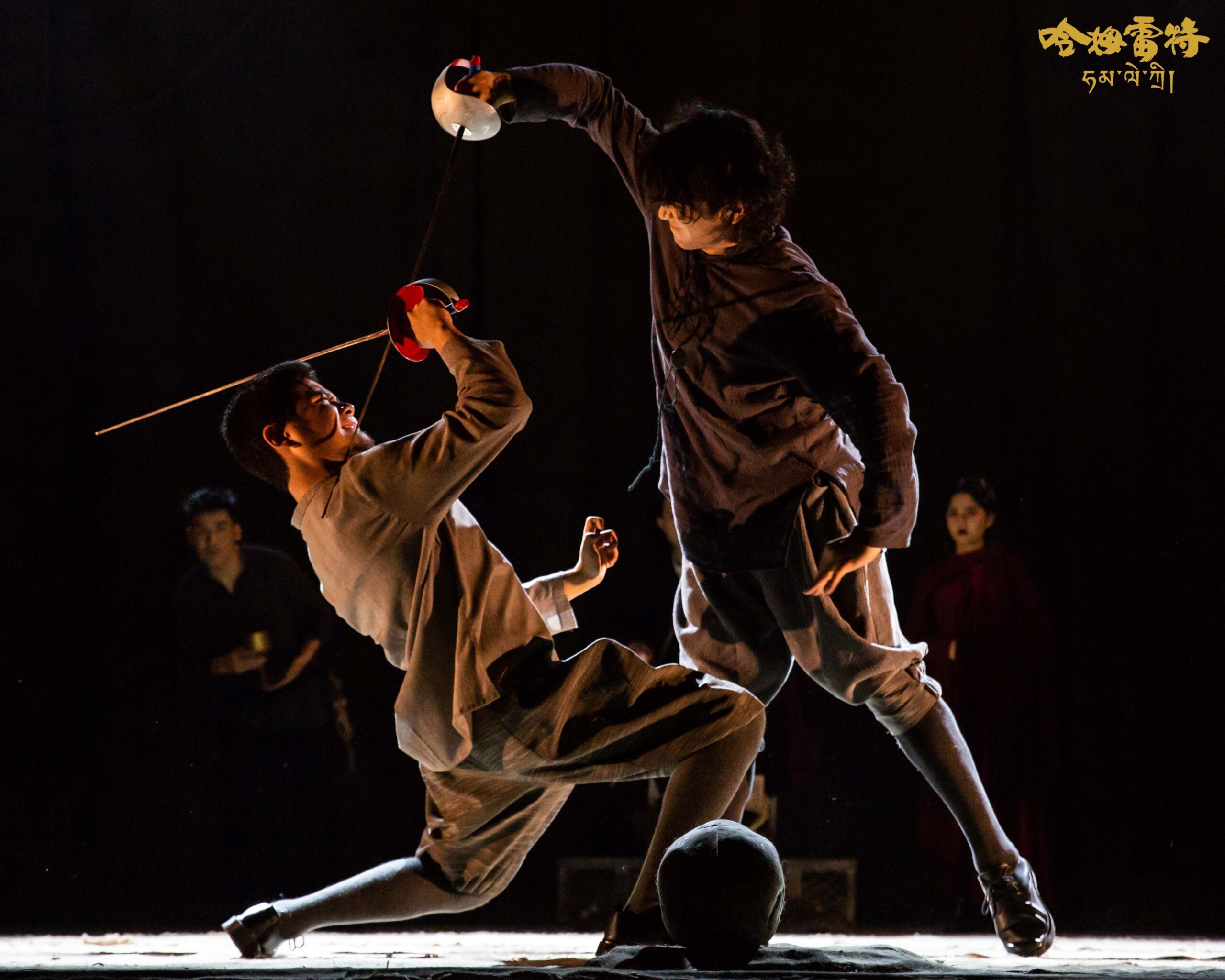

A Tibetan-language adaptation of Shakespeare’s Hamlet is drawing global attention as it heads to Hong Kong, raising questions about live theatre, culture and human connection in the AI era.
As Ophelia descends into madness, she begins to sing a Tibetan folk song.
“Lend me your wings so I can fly,” the lyrics say. “I will not go far. I will circle back to my homeland.”
The moment feels both intimate and universal. Shakespeare’s Hamlet has appeared in countless languages across the world. Yet this version, performed entirely in Tibetan by actors from the Tibet Autonomous Region Drama Troupe, carries a different emotional rhythm. Tibetan dance, music and folk traditions flow naturally through the performance.
The Tibetan-language Hamlet, directed by renowned Chinese actor and theatre director Pu Cunxin, will be staged at the 2nd Hong Kong International Shakespeare Festival in June this year. Previously, the production was also presented at the 35th Baltic House International Theatre Festival in St. Petersburg in October last year.
Still, the play is drawing attention for more than its cross-cultural journey. At a time when artificial intelligence can generate text, images and even performances, the production raises a deeper question: why does live theatre still matter?
For Pu, the answer is simple.
“AI can create things that look real,” he said in a recent interview. “But theatre is live. The performers and the audience are emotionally present together.”
Shakespeare in Tibetan
The production began in 2021 as a graduation project for 22 Tibetan students studying at the Shanghai Theatre Academy. Pu said he chose Hamlet because he believed the students had the emotional strength and imagination needed for Shakespeare.
At first, he did not plan to stage the play in Tibetan. However, the idea changed after translator Nima Dunzhu completed a Tibetan version of the script.
When Pu first heard the actors speak the lines in Tibetan, he was struck by the language’s musicality and poetic force.
“It felt as if we were watching a theatre troupe from anywhere in the world perform in its own deeply expressive language,” he said.
Since its premiere, the play has toured several Chinese cities and received strong responses from audiences. Some viewers even told Pu that the actors made it feel “as though Shakespeare had written Hamlet specifically for them.”
A Different Hamlet
This version does more than translate Shakespeare into another language. It also reshapes the structure of the play.
For example, the famous graveyard scene no longer appears as one continuous sequence. Instead, conversations between Hamlet and the gravedigger are split into four separate interludes throughout the production. As a result, the story gains a stronger sense of memory and reflection.
The ending also changes. Before dying, Hamlet searches for his manuscript and repeats the line “To be, or not to be” one final time.
“Hamlet’s hesitation, resistance and questioning of fate are questions every person faces,” Pu said. “Our version does not try to provide answers. Instead, it invites audiences to reflect together.”
Meanwhile, Tibetan cultural elements appear throughout the play in subtle and organic ways.
In one scene, Hamlet reunites with old friends and joins them in a Guozhuang dance, a traditional Tibetan folk dance. Pu said the moment was never designed as a staged “ethnic symbol.” Rather, it came naturally from the actors themselves.
The same approach shapes Ophelia’s character. During her descent into madness, she sings the Tibetan folk song White Crane. Her performance expresses not only sorrow, but also a longing for peace and freedom.
“These are not cultural elements we intentionally added,” Pu said. “The actors naturally sing and dance. It is part of who they are.”
At the same time, the production keeps its visual design simple. Pu has reduced lighting changes and stage effects for international performances. Consequently, the audience focuses more closely on the actors’ emotions and physical presence.
He compared the style to traditional Chinese opera, where minimal stage design can still create a powerful, dramatic world.
What AI Cannot Replace
The production’s journey reflects a broader cultural dialogue. After its staging in Russia last year, it continues its path to Hong Kong this June. Each stop places the work in a different cultural context, yet the core question remains the same.
For Pu, the journey is not about cultural display. Instead, he sees it as an artistic dialogue.
“When Tibetan actors perform Shakespeare in Tibetan, it is not simply a language change,” he said. “It becomes another cultural interpretation of a story about humanity.”
That idea also explains why the production resonates in the AI era.
Today, artificial intelligence can imitate voices, generate images and reproduce artistic styles with increasing accuracy. However, theatre still offers something technology cannot fully recreate: shared human presence.
A live performance unfolds in real time. Actors respond to the audience, and the audience responds in return. Emotions shift from moment to moment. Silence, movement and even imperfection become part of the experience.
As a result, audiences do not need to understand Tibetan to connect with the play. The emotional force still comes through in the rhythm of the language, the movement of the actors and the atmosphere inside the theatre itself.
Written by Ronnie Yu, Additional reporting by HKCNA, CNS.
If you liked this article, why not read: Love Across Cultures: Youth Dialogue Revives Tang and Shakespeare


