
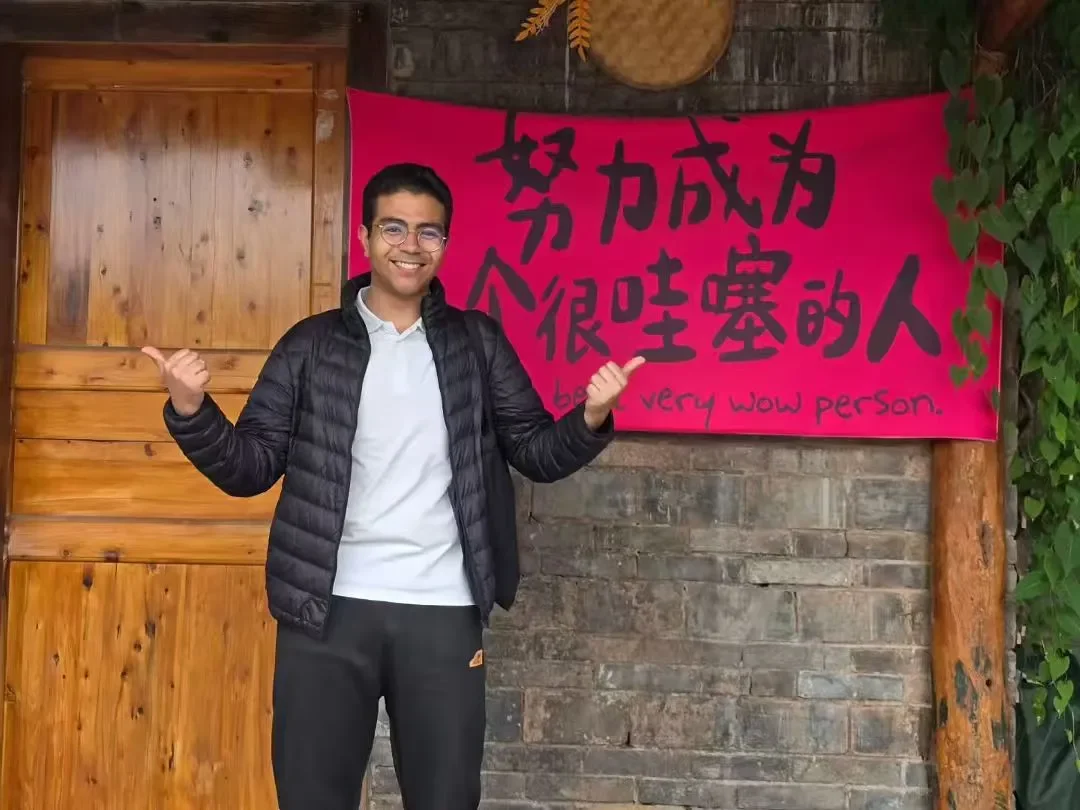

China travel transformed one Egyptian student’s understanding of Chinese culture through journeys in this country.
On 19 May 1613, Xu Xiake, one of China’s best-known early travellers, set off from Ninghai. He opened his travel journal with the line: “The clouds disperse, the sun shines bright; both men and mountains brim with joy.” He probably never imagined that, more than 400 years later, so many young people from around the world would be exploring the same land.
Ahmed Saad Shaheen, known as Haizhe, is one of them. The 25-year-old Egyptian is currently pursuing a master’s degree at the School of Chinese Studies and Cultural Exchange, Renmin University of China. During his three years in China, he has journeyed from Sanxingdui to the statue of Confucius in Qufu, and from Beijing’s hutongs to the foot of the Tianshan Mountains.
“You can only truly understand Chinese culture by being there in person,” Haizhe says.

The Start of a Journey
Haizhe’s travels in China began with simple everyday experiences.
When he first arrived in Beijing three years ago, he wandered the hutongs, strolled along Qianmen in the evening and bought green tea ice cream, watching historic buildings stand quietly beneath the neon lights. At the National Botanic Garden, surrounded by fresh spring greenery, he exclaimed: “Spring in Beijing is my favourite season.”
Visiting the Cao Xueqin Memorial Museum and standing before the writer’s modest former residence, he felt, for the first time, the life behind a great literary work.
These first impressions were soon surpassed by his trip to Xinjiang.
“The taste of pilaf and lamb still lingers on my tongue,” he recalls. At a bonfire party in Yueliangdi Village in Changji, he danced alongside residents, describing the night as “one of a kind”. In Jiangbulake, he rode horses with friends across the grasslands, with the Tianshan Mountains stretching into the distance.
A local guide told him: “You cannot grasp how vast China is until you visit Xinjiang.”
Haizhe reflects: “There’s a Chinese saying: seeing once is better than hearing a hundred times. Real cultural understanding comes from experiencing it for yourself.”

A Journey Through Civilisation
In the winter of 2024, Haizhe visited the Nishan Sacred Land in Qufu. Standing before the 72-metre-tall statue of Confucius, set against mountains and overlooking a lake, he remarked: “‘When three people walk together, one may be able to teach me something.’ Confucius’s wisdom not only inspires individuals but also offers guidance for building a harmonious society.”
Months later, he joined a study tour to Sichuan, where his understanding of China deepened even further.
At Sanxingdui, the bronze sacred tree and bronze masks left him astonished. He noticed visitors from different countries and backgrounds pausing to discuss the relics together.
“This cross-cultural exchange made me feel how inclusive culture can be.”
He compared museums in Egypt and China. Egyptian artefacts are displayed in solemn, original settings, while Chinese museums make extensive use of VR and AR technologies to bring history alive.
“It’s like having a knowledgeable guide beside you, ready to answer your questions at any time.”
Yet nothing moved him quite like Dujiangyan.
Standing at the Fish Mouth Levee and watching the Min River split into two channels, he learned that this water conservancy project dating back to the 3rd century BCE still irrigates the Chengdu Plain today. It reminded him of the Nile back home.
Haizhe explains that ancient Egyptians relied on the Nile’s natural floods for farming, whereas the Chinese learned long ago to channel rivers and work in harmony with nature — a system that has continued to function for more than 2,000 years.
“This is far more than an engineering feat; it reflects a way of understanding civilisation — working with nature rather than simply exploiting it.”
At the 2025 Beijing International Tea Trade Expo, Haizhe developed a passion for Chinese tea. It reminded him of customs at home.
“Egyptians drink tea with lots of sugar, while Chinese tea invites you to savour its natural flavours and subtle layers. Tea acts as a cultural language, revealing richness in the smallest details.”
He is compiling notes about Chinese tea in Arabic, adding: “I hope to bring this warm experience back to Egypt.”
Growth on the Road
In April 2026, weighed down by academic pressures, Haizhe joined a school trip to the confluence of three rivers in Yibin. Standing by the rivers, he gradually found a sense of calm again.
He later posted on social media:
“There is no noise here, only a quiet, profound beauty. This way of life—not rushing onward, but taking time to experience the world—is the life I long for.”
After three years of travelling, Haizhe says what has impressed him most is the sense of participation. Instead of observing a civilisation from the outside, he has stepped into it and allowed it to change the way he sees the world.
More than 400 years ago, Xu Xiake traversed China on foot and wrote over 600,000 Chinese characters about his journeys. Today, young people like Haizhe are continuing that journey in their own way, adding new chapters to a story that is still being written.
Written by Chenhui Sun.
If you liked this article, why not read: Agnès Belotel-Grenié: Translation is a Bridge to Understanding


