
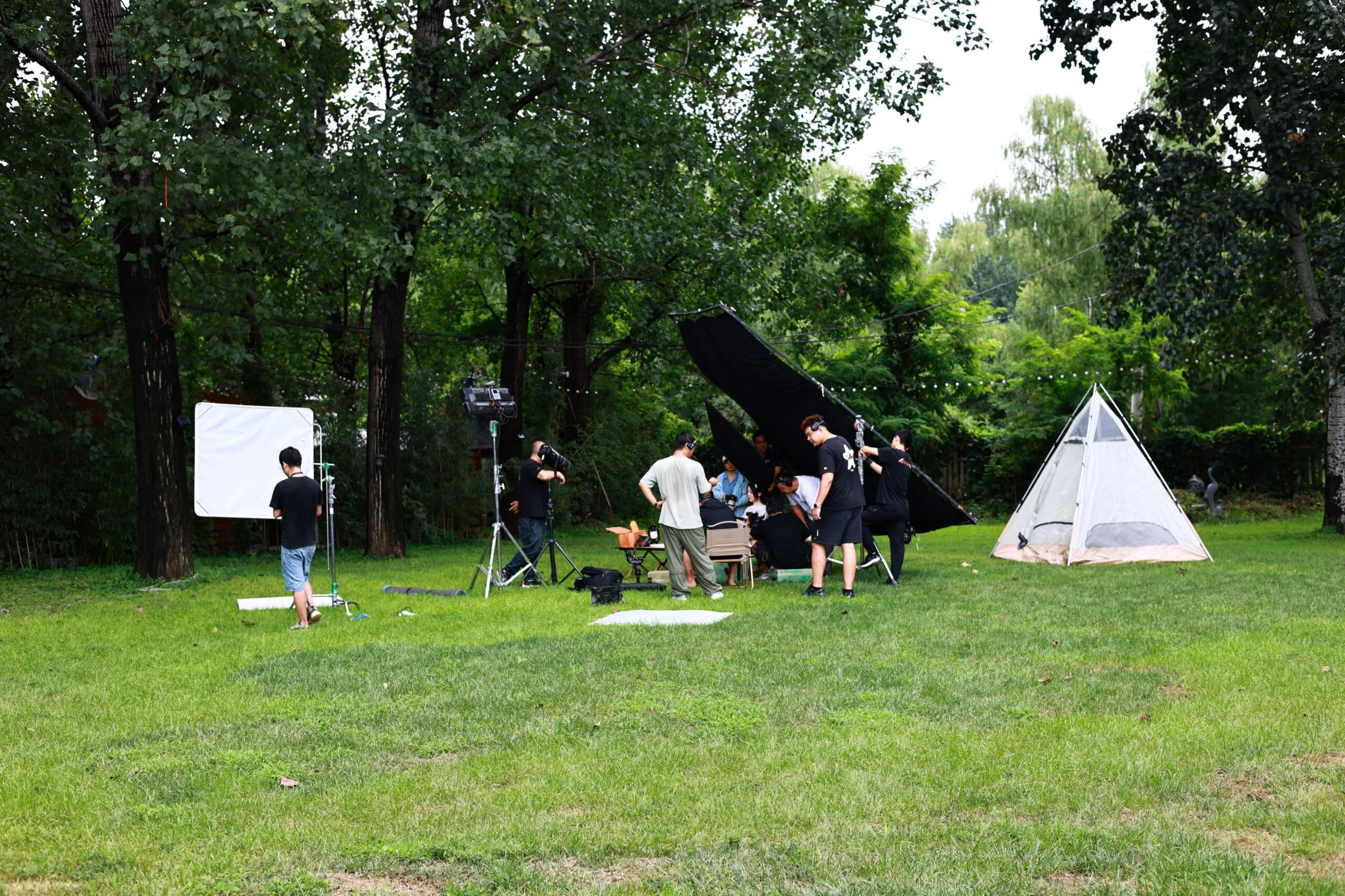

As AI reshapes China’s short-drama industry, live-action producers are adapting through new production models, overseas markets and stories from ordinary people.
“Are people still making live-action short dramas?”
The question came up as generative artificial intelligence (AI) began to reshape China’s video market.
After the Spring Festival in 2026, the short-drama industry felt the chill. AI-generated video tools were improving fast, while some major platforms tightened their support for short dramas. Live-action productions, once a booming part of the market, began to lose momentum.
“Objectively speaking, the volume of live-action dramas has indeed fallen sharply,” said Gui Yaohua, general manager of Zuiku Short-form Drama and Film Production Base (hereinafter Zuiku) in Beijing.
A year ago, the base looked different. More than 20 major companies had moved in around the time it received its official designation. Its cooperation with leading platforms was expected to generate around 70 productions a year. For a while, production teams filled the site, and occupancy rates rose.
Today, the question is no longer how quickly the “vertical drama base” can grow.
Turning a Culture & Creative Park Into a Film Set
Zuiku International Culture and Creative Park sits in Beijing’s Chaoyang District. The site was once an old industrial area and has operated as a cultural and creative park for more than a decade.
In late 2024, Gui noticed that many creative parks were becoming increasingly similar. He began looking for a new direction.
The answer was “space plus industry”.
Unlike Hengdian, China’s best-known film and television production base, Zuiku does not rely on large-scale, purpose-built sets. Instead, it has taken a lighter approach.
The team worked with several institutions, including film, aviation and railway museums, and brought together more than 200 real-life locations within about 31 square kilometres of Cuigezhuang. The locations were then organised into a searchable database and made available for booking through a mini-program.
“If Hengdian is a film town built up over one or two decades across 33 square kilometres, we want to create a film town without walls,” Gui said.
The idea is simple: make use of spaces that already exist rather than building everything from scratch.
That approach has become increasingly important as production costs come under pressure.
At Zuiku, the old warehouse has been divided into a collection of different sets. A hospital room stands close to a luxury office. An interrogation room carries the words “Confess and receive leniency” on its wall. A modest rental room can be transformed into a completely different setting with a few changes to the furniture and props.
The spaces are compact because most short dramas are shot vertically. They rely heavily on medium shots and close-ups, rather than wide cinematic views.
In practice, that means one corner can serve as an entire scene.
The base is now building on that flexibility. It has formed an AI team and taken on interview programmes and micro-variety shows. It also provides training for students from art colleges.
And then there is another change: the doors are opening to ordinary people.

Putting Ordinary People in Front of the Camera
In 2026, Zuiku launched a programme that allows people with no professional acting experience to make their own short dramas from start to finish.
The slogan is simple: everyone has a story of their own.
The programme has already run four sessions. Many participants have been retired women who have long held an interest in the arts.
For some, the experience is about becoming an actor for a day. For others, it is about revisiting a moment they once missed.
“One person never had a wedding because of the circumstances of the time,” Gui said. “So she came here to make up for it. We helped turn it into a story and record it.”
For Gui, such projects are also an experiment in what he calls “new mass culture”.
The shift towards ordinary people goes beyond filming.
Guo Ertai, the base’s artistic director and a director himself, has set up immersive, location-based acting classes. Instead of practising only in a classroom, students train inside the actual sets.
A bedroom becomes a classroom. So does a living room or a hospital ward.
Students learn how emotions and scenes work in different spaces, Guo said.
He favours a training model inspired by Hong Kong’s TVB, where students spend several months in training and then move quickly into practical work.
“Actors need an outlet,” Guo said. “After you learn, you should be able to act in our own productions.”
He also sees the current turbulence in the industry as a process of adjustment.
Top stars, he said, do not necessarily guarantee commercial success. Audiences are becoming more segmented, and performers who focus on a particular field can still build their own following.
For a short-drama industry that grew rapidly around formulas and speed, that may mean looking for a more stable rhythm.

Looking Beyond China
There is another direction for Zuiku: overseas markets.
The base has launched its own labels on major Chinese short-drama platforms, including Hongguo and Douyin. At the same time, it has begun exploring overseas distribution.
Zuiku has signed a distribution agreement with a South Korean team, which has also moved into the park. Talks with a North American team are under way.
For now, overseas distribution often starts with a relatively simple model.
Existing Chinese productions can be translated and subtitled for overseas audiences without reshooting or recording new dialogue, keeping costs under control.
But Guo is cautious about describing overseas markets as an easy “blue ocean”.
The production requirements vary widely.
In Japan, short dramas entering the market may need local actors and locations, while producers also pay close attention to the script and story. Companies face the challenge of developing a paying audience in South Korea. In parts of Southeast Asia, viewers are more likely to watch through websites rather than dedicated short-drama apps.
These differences make it difficult to simply copy China’s high-speed production model overseas.
“China’s biggest advantage is efficiency,” Guo said.
At its most extreme, Chinese teams once produced 100 episodes in just three days. Production has since become more regulated and measured.
Yet the same efficiency can also make cooperation with overseas teams more complicated.
Guo believes Chinese producers need to look beyond simply exporting finished programmes.
“You shouldn’t make something overseas just for the sake of making something overseas,” he said. “It is more important to let overseas audiences see something that comes from China.”
For both Guo and Gui, that local content remains the most valuable part of China’s short-drama industry.

Staying Relevant After the Boom
A year ago, people were asking whether the “vertical drama base” would take off.
Now they are asking whether it can survive.
Gui still believes live-action dramas have a future. He does not see AI and live-action production as mutually exclusive.
“They should eventually become integrated,” he said.
For Zuiku, flexibility may be its biggest advantage. Unlike a purpose-built production base, the site grew out of a cultural and creative park. It can therefore adjust its business more easily as demand changes.
Guo takes a similar view of the people working in the industry.
“Stars are stars, and arts workers are arts workers. They are two different things,” he said.
The short-drama industry is going through a period of change. Some people who came for quick profits may leave. Others are trying to make it a long-term profession.
At Zuiku, that change is visible in the spaces themselves.
The sets are still there. The cameras are still rolling. But the people in front of them are changing.
Additional reporting by Morgan Lee.
If you like this article, why not read: China’s Short Drama Grows From Local Trend to Global Phenomenon


