
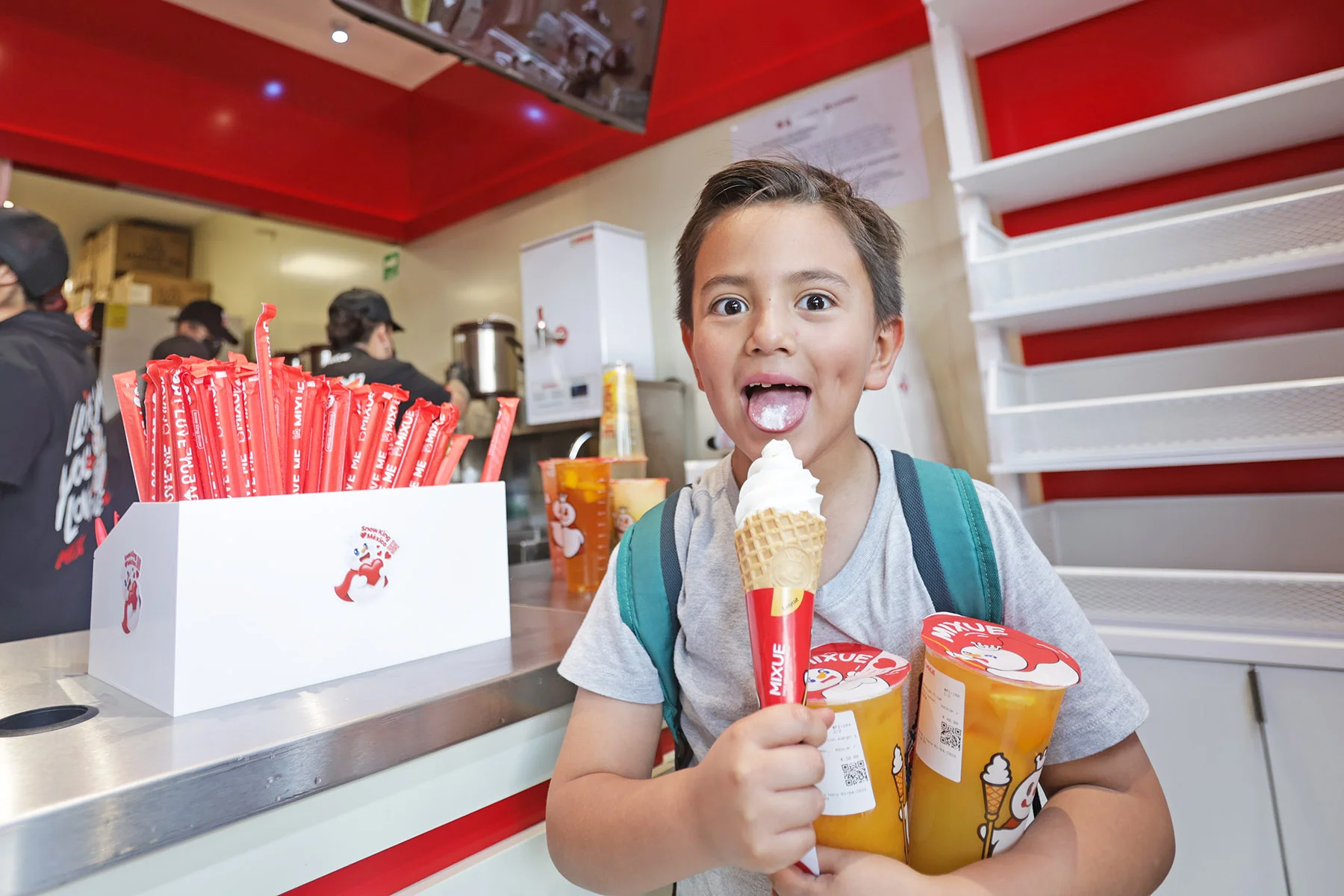

Chinese tea chain Mixue comes into the spotlight after Nvidia CEO Jensen Huang’s visit to Beijing, highlighting its rapid overseas expansion and low-price strategy across global markets.
During his recent visit to China with Donald Trump’s official delegation, Nvidia CEO Jensen Huang made a stop in Beijing’s historic Nanluoguxiang area on 15 May. Despite temperatures reaching 30 degrees Celsius, Huang walked around in his trademark black leather jacket.
He ate traditional noodles with fried bean sauce at a Michelin-recommended eatery and tried fermented mung bean milk, a pungent local speciality. To refresh his palate, Huang then ordered two cups of peach-flavoured iced tea at a branch of Chinese tea chain Mixue Group. After giving the drink a thumbs-up outside the shop, videos and photos spread rapidly across Chinese and international social media.
Mixue moved quickly. Within hours, its ordering app launched a CEO’s Choice promotion featuring the same drink for just 7 yuan (£0.70). The company later said sales of the product jumped by almost 140% in a single day.
Cheap Drinks, Fast Expansion
The moment brought fresh global attention to a brand that has quietly become one of the world’s largest food and beverage chains.
Founded in 1997 in Zhengzhou, central China, Mixue built its business on ultra-cheap drinks, ice cream and franchising. Its smiling snowman mascot, known as the Snow King, has become a familiar figure across Chinese social media through absurdist advertising campaigns and viral songs.
The company now runs around 60,000 outlets worldwide, overtaking both Starbucks and McDonald’s in store numbers. Most of its shops are in China and Southeast Asia, where low prices have helped it attract younger customers squeezed by rising living costs.

In Indonesia, for example, a cup of brown sugar milk tea can cost a little over $1, while ice cream sells for as little as around $0.50 in some markets.
That aggressive pricing strategy helped Mixue expand at a remarkable speed, especially in Indonesia and Vietnam. But rapid growth has also created problems. Analysts say oversaturation has reduced sales at individual stores, while the company closed more than 2,500 outlets globally last year, including several hundred overseas branches.
Turning towards the Americas
After years of focusing mainly on Asia, Mixue is now accelerating its expansion into the Americas.
The company opened its first US store in December 2025 and currently operates a small number of branches in New York and Los Angeles, targeting Chinese students and immigrant communities already familiar with bubble tea culture.
These US outlets offer more than three dozen drinks and ice cream products, priced between $1.19 and $4.99 — considerably below typical café prices.
This year, the brand has entered Latin American markets. In February, Mixue opened a store in Mexico City near the central Plaza de la Constitución, just 60 metres from a McDonald’s outlet. Lulu, a local Chinese resident, said she waited nearly an hour when she visited the store in its second week of opening.
The draw, she said, is simple: a freshly made bubble tea for less than half the price of a large Starbucks latte. ‘That’s about the same as a Coke here,’ she said.
In Brazil, the company’s first São Paulo branch also attracted large crowds, with some visitors travelling from nearby cities for the opening. Menu prices remained in line with Mixue’s wider strategy, including soft-serve ice cream selling for around $0.60 and lemonade for a little more than $1.

Europe: the Next Frontier?
Mixue has yet to enter the European market, but it has not gone unnoticed there.
The brand relies on a tightly controlled supply chain to keep costs down. More than 60% of its ingredients are produced in-house. However, its model also depends on cheap rents and low labour costs, factors that Le Figaro argues would be difficult to replicate in Europe.
Franchise consultancy Bittencourt Group noted that while Mixue’s affordable prices are a clear asset, the brand faces limits in appealing to wealthier, health-conscious consumers. Some critics have also pointed to the high sugar content of its products.
Nevertheless, the company continues to diversify its portfolio. Lucky Cup, its budget coffee chain, accounted for nearly half of the group’s 13,000 net new outlets in 2025. The brand also follows a low-price strategy, with most drinks retailing between 4 and 10 yuan. In April, Lucky Cup appointed award-winning actor Tony Leung Chiu-wai as its celebrity ambassador, signalling its ambition to expand international brand awareness.
Written by Estelle Tang, additional reporting by Le Figaro, ShineGlobal.
If you liked this article, why not read: Replace Human Actors with AI? Not Everyone Is Convinced


