
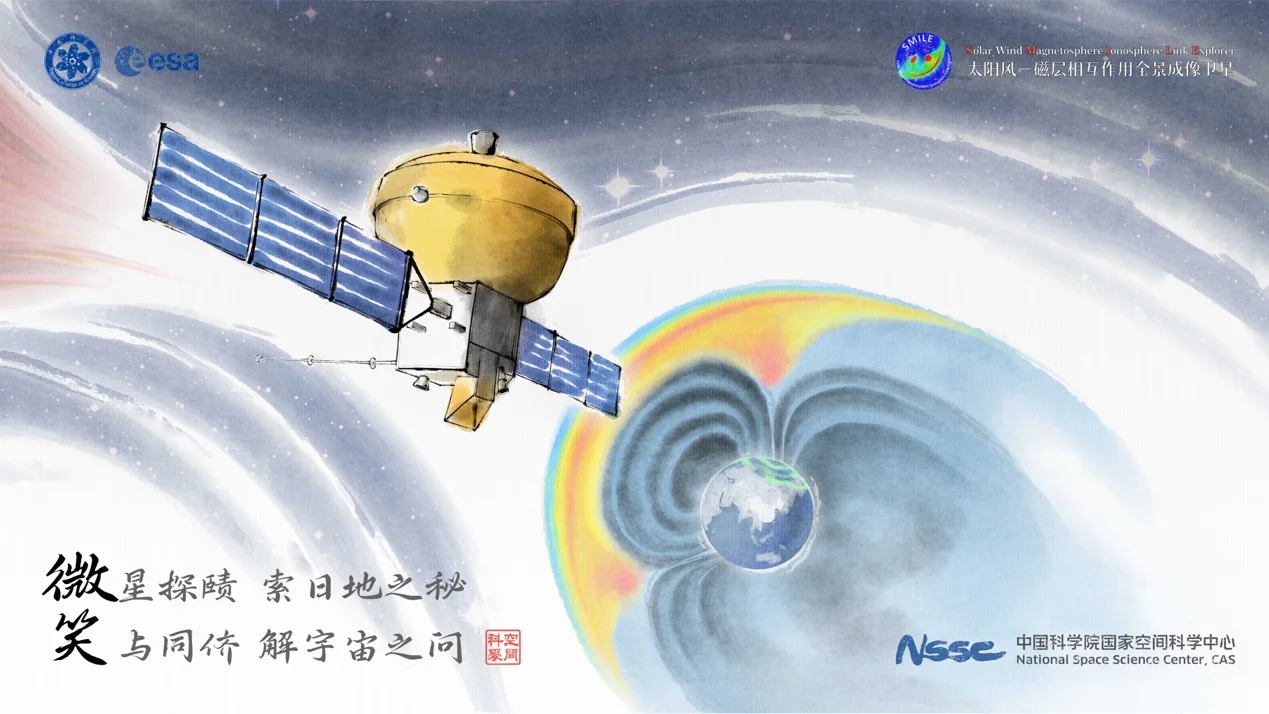

The China–Europe SMILE satellite has successfully launched, marking a new phase in space science cooperation and advancing research on solar wind and space weather.
The joint China–Europe solar wind–magnetosphere interaction satellite SMILE launched successfully on July 19th aboard a Vega-C rocket from the Guiana Space Centre in Kourou, French Guiana, entering its planned orbit shortly after liftoff.
This mission marks the first full, task-level deep cooperation between the Chinese Academy of Sciences (CAS) and the European Space Agency (ESA) in space science. It is also one of China’s most comprehensive international space engineering collaborations to date.
A Decade from Proposal to Launch
The SMILE mission was selected in 2015 through an international call for space science proposals jointly issued by CAS and ESA. CAS and ESA selected SMILE from several candidate missions, and it received formal development approval.
From approval to launch, the project took more than a decade. During this period, teams from both sides worked across continents to turn the concept into a fully operational scientific satellite.
The core scientific goal of SMILE is to achieve global imaging of the interaction between the solar wind and Earth’s magnetosphere. By doing so, it aims to reveal how space weather is formed and evolves.
As modern society becomes increasingly dependent on satellites, navigation systems, and power infrastructure, solar wind-driven geomagnetic storms have also become a factor that cannot be ignored.
According to Wang Chi, Director of the National Space Science Centre of CAS, the mission aims to capture a more complete picture of solar wind–magnetosphere interaction through global imaging.
The satellite uses soft X-ray and ultraviolet imaging techniques to reconstruct large-scale magnetospheric dynamics under solar wind influence — an approach scientists often compare to a “CT scan” of Earth’s magnetic environment. Long-term observations are expected to improve understanding of space weather and help protect satellites, navigation systems, and power infrastructure.
From Technical Differences to Close Coordination
SMILE carries jointly developed payloads from China and Europe. China is responsible for the satellite platform, mission control, ground support systems, and scientific application systems. It also leads the development of three key instruments: the ultraviolet auroral imager, the low-energy ion analyser, and the magnetometer.
ESA is responsible for the payload module and the world’s first spaceborne soft X-ray imager. It also provides the launch vehicle, launch site, and support during the ascent phase. Several leading European institutions, including the University of Leicester, contributed to instrument development and calibration.
Over the course of ten years, the two sides went through a long process of technical alignment. European teams tended to emphasise strict procedural control and long-term configuration stability, while Chinese teams often favoured parallel development and rapid iteration. These differences created coordination challenges during the early stages of the project.
However, as cooperation deepened, frequent meetings and detailed interface documentation helped both sides align expectations and technical workflows. Over time, European engineers came to recognise the efficiency of Chinese execution, while Chinese teams adopted earlier planning and more structured documentation practices.
The collaboration also built personal connections. In 2024, when the satellite was integrated at the European Space Research and Technology Centre (ESTEC), European colleagues arranged regular Chinese meals on Fridays for the visiting Chinese team. What began as a small gesture became a memorable part of the joint working experience.
According to Zhang Yonghe, Deputy Director of the Innovation Academy for Microsatellites, SMILE shows that deep China–Europe cooperation in space science is both feasible and productive. He said the project has become a model for cross-cultural engineering collaboration. It has also strengthened confidence in future large-scale international missions.
ESA Science Director Carole Mundell also said that the trust built between engineering and science teams has endured through global disruptions. She added that SMILE is expected to deliver important new scientific discoveries.
Open Science and the Next Phase of Exploration
After launch, SMILE will spend about 42 days adjusting its orbit before reaching its final scientific observation trajectory. It will then undergo approximately two months of in-orbit testing, followed by a planned three-year scientific observation phase.
During operations, Chinese and European teams will jointly process all scientific data and make it openly available to research institutions worldwide.
The mission comes at a time when international scientific cooperation is facing growing geopolitical and technological pressures in several fields. Against this backdrop, SMILE remains one of the few large-scale space science missions jointly developed by China and Europe.
Beyond SMILE, China plans to advance a new generation of space science missions over the next five years. These include the “Hongmeng Project,” “Kuafu-2,” an exoplanet survey mission, and an enhanced X-ray timing and polarimetry observatory. These missions aim to study topics ranging from the early universe to solar activity, Earth-like exoplanets, and extreme astrophysical environments.
According to Wang Chi, discussions on future cooperation with ESA are already underway in these areas.
For China and Europe, SMILE may be only the beginning of a longer era of space science cooperation.
If you liked this article, why not read: China Opens Space Station Program to Foreign Astronauts


