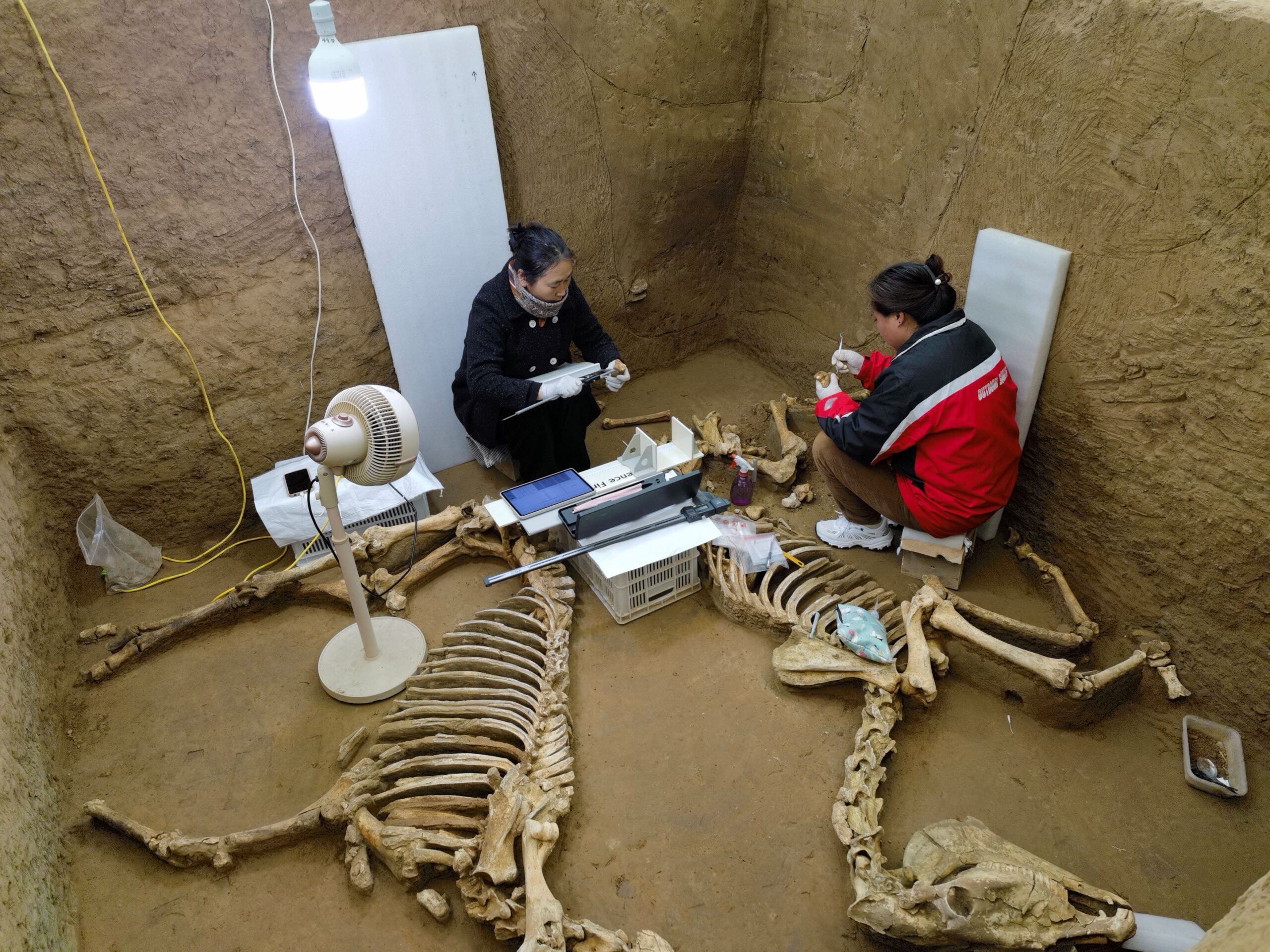

Archaeologists at China’s Yin Ruins have uncovered the earliest known evidence of wild animals kept by humans.
Recently, archaeologists at the Yin Ruins in Anyang, Henan Province, uncovered the earliest known collection of wild animals kept by humans, dating back over 3,300 years to the Shang Dynasty (c.1600–1046 BC).
A Royal Collection of Wild Animals
Excavations focused on the Imperial Tombs area, across the river from the palace and ancestral shrines. Researchers cleared 19 small and medium-sized sacrificial pits and discovered skeletal remains from a surprising variety of animals.
These included tigers, leopards, wolves, foxes, water buffalo, deer, and roe deer. Birds were also present, such as swans, cranes, geese, falcons, and eagles. Some animals still had bronze bells around their necks, suggesting they were raised and managed over time rather than simply hunted.
“This was not just hunting,” said Li Xiaomeng, assistant research fellow at the Institute of Archaeology, Chinese Academy of Social Sciences (CASS). “These were rare and exotic creatures, likely kept in the imperial gardens or enclosures of high-ranking Shang nobles.”
Bronze Bells Reveal Animal Management
A total of 29 bronze bells were found across 13 of the 19 pits. According to Zeng Yuli, an archaeological researcher specialising in ancient agriculture and animal husbandry, the bells were likely used to train and manage animals, offering insight into the Shang Dynasty’s sophisticated wildlife management.
“People at that time had already begun monitoring and categorising animal groups. Animals were deeply integrated into daily life,” Zeng explained.
Rituals and Social Organisation
The concentration of animals and their standardised treatment suggest that the Shang people had a comprehensive system for acquiring, raising, and managing wildlife, according to Niu Shishan, research fellow at the Institute of Archaeology of the CASS.
Large sacrificial pits also contained humans, elephants, and horses. Interestingly, horse numbers were consistently even, and some skulls showed depressions on top. Niu noted that these patterns reveal carefully planned ritual practices, shedding light on Shang ceremonial traditions.
“These findings not only show the scale of imperial rituals but also provide crucial evidence to study the religious beliefs and ceremonial systems of the Shang Dynasty,” Niu added.
A Window into Ancient Civilisation
The Yin Ruins are famous for oracle bone inscriptions, confirming it as the late Shang capital. Recent discoveries go beyond animal remains. Archaeologists also uncovered parts of the city’s road network, including a 1.6-kilometre main road, revealing advanced urban planning.
Together, these findings highlight the sophistication of Shang society. From wildlife management to city planning and ritual practice, they show a civilisation that organised people, animals, and resources with remarkable skill.
Additional reporting by CNS, Global Times.
If you liked this article, why not read: Liulihe Site: The Origins of Beijing