
China’s Ministry of Education has released new guidelines to strengthen science and technology education, promote global cooperation, and nurture young innovators by 2035.
China’s Ministry of Education (MOE) and six other government departments have jointly issued new guidelines on strengthening science and technology education in primary and secondary schools. The document outlines six key priorities, including promoting international exchanges and cooperation, aiming to support the high-quality development of education, science and technology, and talent, according to an MOE release on November 12th, CNS reported.
Expanding International Cooperation
The guidelines call for building a Belt and Road Science and Technology Education Community and establishing a multilateral cooperation network. China plans to sign new education cooperation agreements with partner countries and to build international city and school alliances through existing sister-province and sister-city partnerships.
The MOE also plans to host a Global Youth Science and Innovation Expo and release a Global Blue Book on Science and Technology Education, sharing China’s experience and supporting education innovation worldwide.
Strengthening Global Engagement
Moreover, China will actively cooperate with international organisations such as UNESCO, leveraging its national bases for innovation, research, and collaboration in science and technology education. China will build a global knowledge base and promote forward-looking research.
The plan encourages the development of interdisciplinary “AI + Science Education” curricula and multilingual teaching resources. A “Science and Technology Education Cloud Classroom” will also be developed to provide high-quality digital resources and technical support to developing countries, promoting balanced global education development.

A Vision for 2030 and 2035
According to the guidelines, by 2030, China aims to establish a foundational system for science and technology education in primary and secondary schools, with improved curricula, deepened teaching reforms, and strengthened evaluation and support mechanisms.
By 2035, a fully integrated science and technology education ecosystem is expected to take shape. Project-based, inquiry-driven, and interdisciplinary learning methods will be widely applied, enabling students to use scientific and technological knowledge to solve real-world problems creatively.
Supporting Practice and Teacher Development
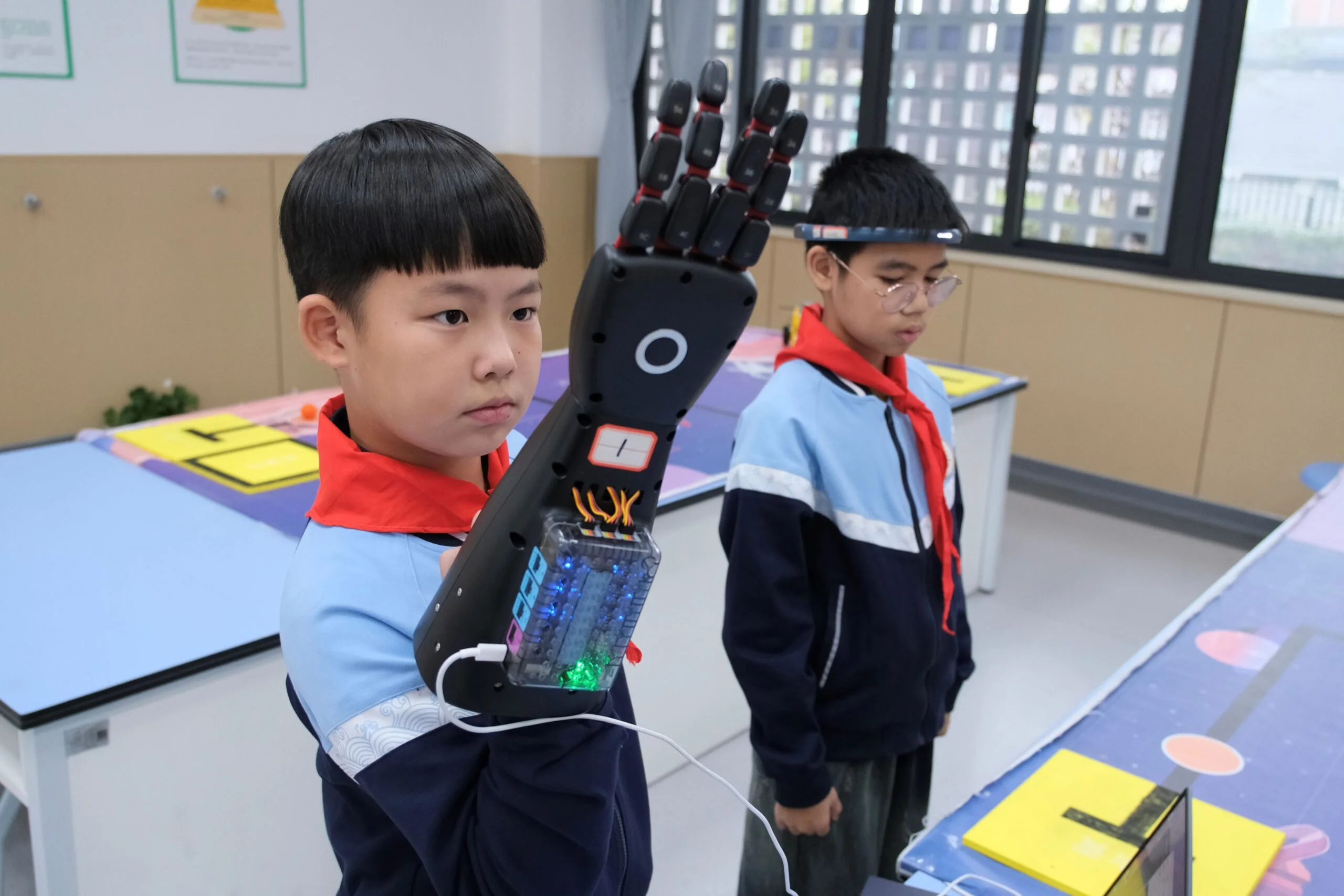
The guidelines state that relevant departments will integrate and utilise laboratories, innovation bases, and training centres. They will create hands-on learning spaces for students. These spaces will allow students to conduct experiments and engineering projects in real-life settings.
Departments will also promote international youth innovation exchanges. They will adopt dual-mentor models for project-based learning. Besides, Nobel laureates and international experts will provide online mentorship. This aims to enhance students’ global perspective and creativity.
In addition, the official will launch an overseas training program for science and technology teachers. Selected primary and secondary school teachers will visit foreign universities. The program will help broaden their international vision and professional skills.

Local Implementation
Many cities in China have already launched science and technology education initiatives. In Shanghai, the Municipal Education Commission told the Global Times that science education is now available to all primary and secondary school students. The city has built a coherent, progressive curriculum that spans the full nine-year compulsory education cycle.
Shanghai also encourages senior high schools to offer more inquiry-based elective courses in mathematics, physics, chemistry, and related fields. The city is also piloting STEM programs.
In Wenzhou, Zhejiang Province, Xie Shangzhi, vice principal of Wenzhou No. 22 Senior Middle School, said the school has developed a series of AI courses at basic, intermediate, and advanced levels. The chemistry laboratories were renovated last year. Physics labs are currently being upgraded.
Traditional project-based innovation activities, such as drone design and programming projects, are also being carried out.
Written by Chen Wang.
If you liked this article, why not read: Meet Xiao An: The Robot Teacher Redefining and Challenging Education