
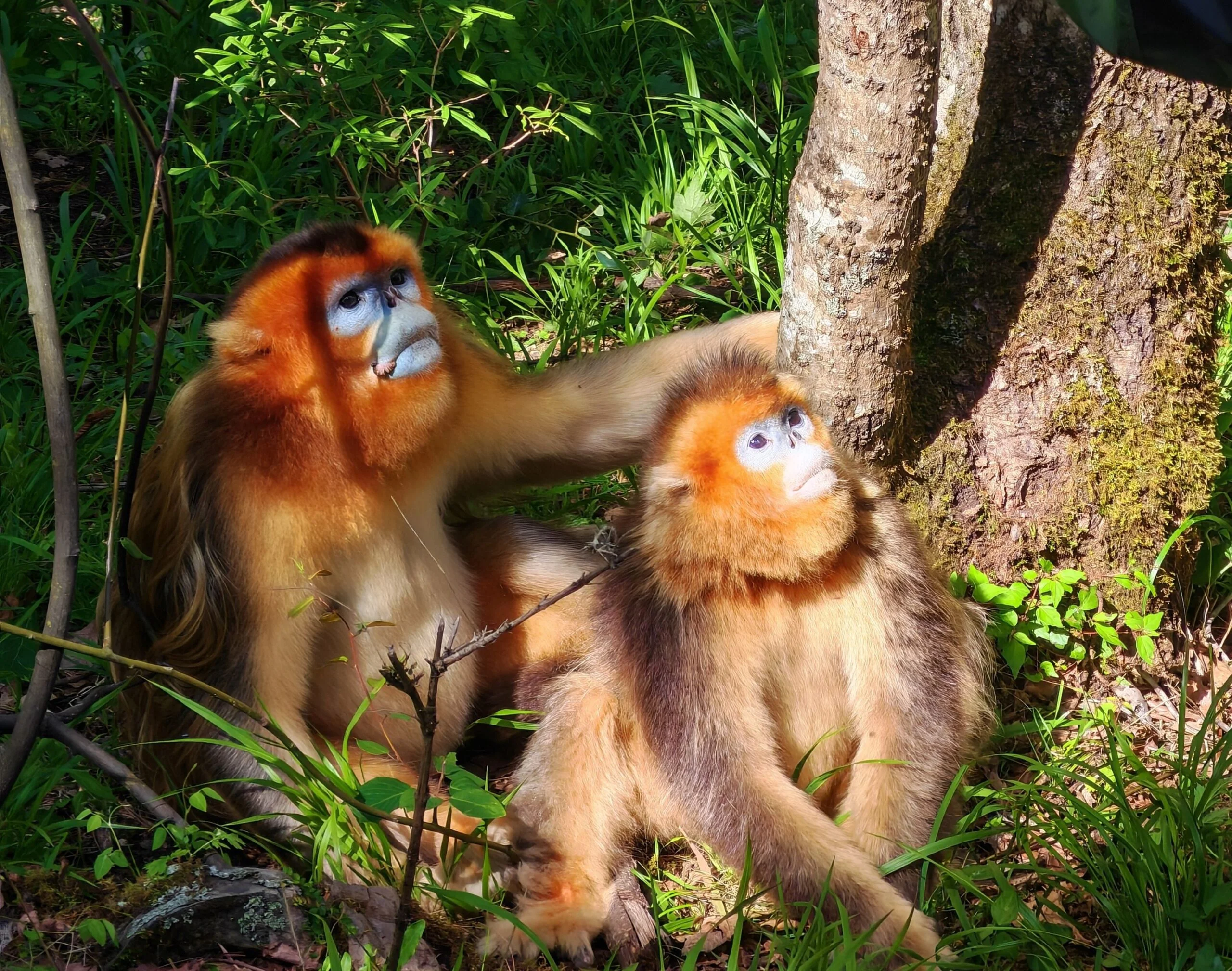

Golden snub-nosed monkeys in China’s Sichuan forests use unique calls to reunite lost babies with their parents, according to decades of observation.
When a young golden snub-nosed monkey gets separated from its family, it quickly calls for its parents.
Instead, it lets out a distinctive call — “ao-oo” — as if asking, “Where are you?”
The parents answer with the same sound. Hearing their voices, the youngster quickly finds its way back.
This is one of the many behaviours that Tang Yulin has observed during decades spent watching golden snub-nosed monkeys in the mountains of southwest China.
“Through long-term observation, we found that the call carries a message similar to ‘Where are you?'” Tang told CNS. “The parents respond with the same call, and the young monkey can soon reunite with its family.”
Tang is the head of the research centre at the Baihe Nature Reserve in Jiuzhaigou County, Sichuan Province. The reserve is home not only to giant pandas but also to one of China’s most iconic and endangered primates: the golden snub-nosed monkey.
On a forest boardwalk winding through dense woodland, groups of monkeys move among the trees. Their blue faces and golden fur stand out against the green mountains. High above, a dominant male keeps watch from the treetops. Nearby, mothers and youngsters climb through branches, feed on fresh leaves and groom one another.
Golden snub-nosed monkeys are naturally cautious around people. Yet Tang has spent more than 30 years earning their trust. According to him, more than 120 monkeys have become familiar with his presence over the years.
“If you crouch down, they feel less nervous,” he said.
As Tang walked into a monkey group and greeted them, several animals gathered around him. One reached out as if to shake his hand. A young monkey grabbed his trouser leg and appeared to search for insects in his clothing.
“That is the highest courtesy a monkey can offer,” Tang said with a smile.

Meanwhile, the monkey population in the reserve has continued to grow. In the past, golden snub-nosed monkeys were usually found at elevations above 1,950 metres. Today, they are often seen at around 1,800 metres as well. Their feeding range has expanded, and the variety of food available to them has increased.
The reserve now supports seven monkey groups with a total population of more than 1,700 individuals, making it one of the most important habitats for the species in China.
For Tang, however, protecting the monkeys is more than a job.
His family has been guarding these forests for over six decades. In 1990, at the age of 22, he became the third generation of his family to work as a forest ranger in the reserve, following his great-uncle and father.
For years, his routine rarely changed. He often left home at four or five in the morning and returned close to midnight. On average, he walks nearly 1,500 kilometres through the mountains every year. The work can be demanding. Sudden rainstorms soak his clothes and boots. Landslides and other dangers are part of life in the mountains.
“Only if you truly like the animals here can you avoid feeling tired,” he said.
Years of fieldwork have turned Tang into a walking guide to the reserve. Pointing to a tree behind him, he can explain where the species grows and how it changes with the seasons. He can identify animal tracks and droppings and name most plants and animals found in the area. He also knows the different monkey groups in remarkable detail.
Then, in 2019, another member of the family joined the effort. Influenced by Tang, his nephew became the fourth generation of a forest ranger in the reserve.
Tang hopes the work will continue for many years to come.
“My wish is that, through the efforts of generation after generation, we can protect the golden snub-nosed monkeys,” he said. “I want future generations to be able to see them too.”

If you liked this article, why not read: Square-faced Monkey has Become the Latest Celebrity in China


