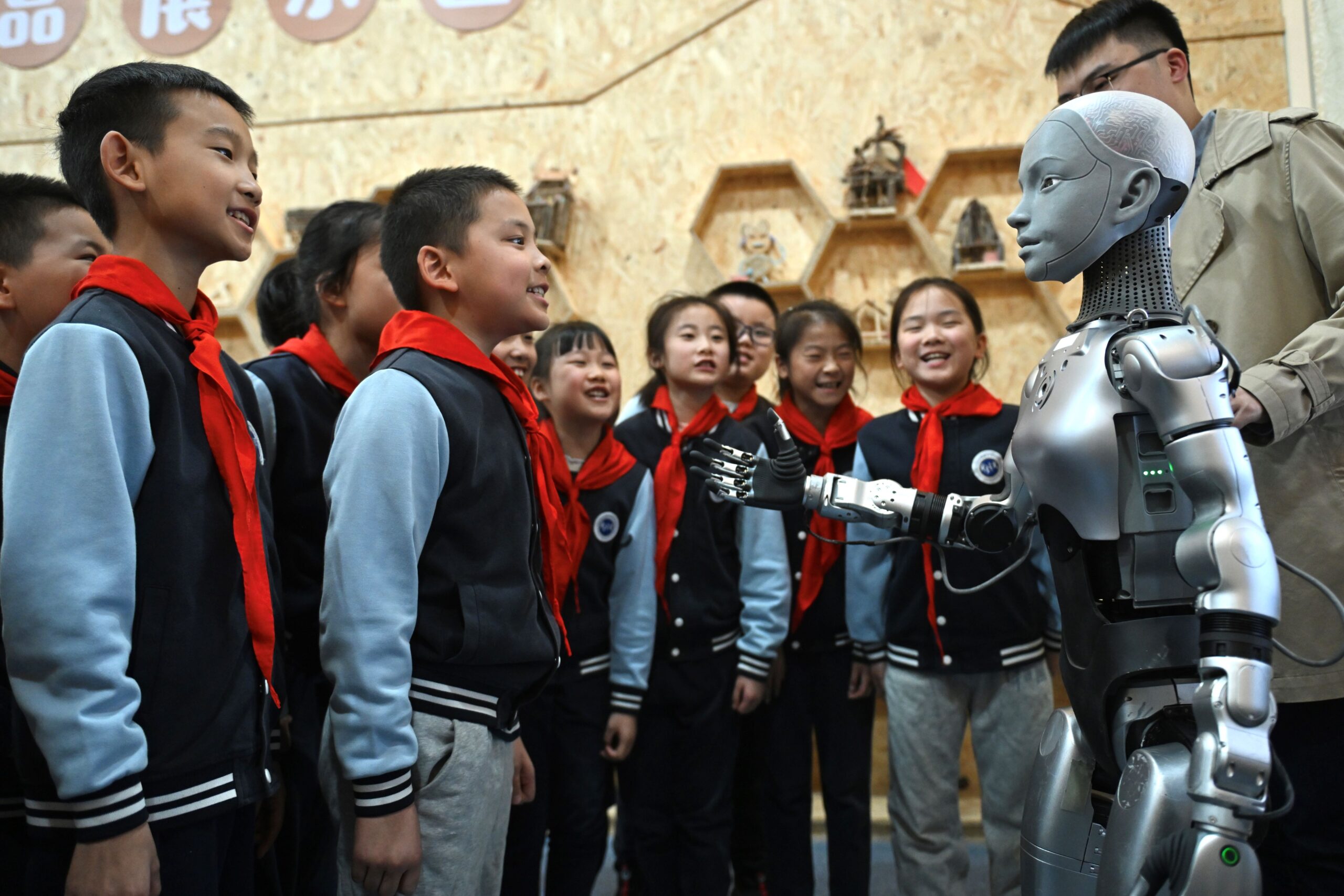

China unveils Xiao An, a full-size bionic robot teacher blending AI and empathy. Will it transform classrooms—or challenge what it means to be a teacher?
In a brightly lit classroom in Hefei, eastern China, a 1.4-metre-tall humanoid robot takes a step forward. Its name is Xiao An. Weighing 35 kilograms and dressed like a teacher, it turns to face a group of curious students. Within minutes, it begins explaining scientific concepts, answering questions, and even smiling back at children.
This moment—seemingly pulled from a science-fiction film—marks the debut of what Chinese researchers describe as the world’s first full-size bionic education robot. Developed by Wulun Technology (Anhui) Co., Ltd., Xiao An represents a significant step in integrating artificial intelligence with human learning.

A New Face in the Classroom
Unlike traditional digital tools, Xiao An interacts with students in real time. It is equipped with a multimodal “expression head” featuring 34 degrees of freedom, capable of synchronised lip movement and a range of subtle facial expressions. According to its developers, the robot can perceive emotions, interpret tone, and adjust responses accordingly—an effort to make human-machine communication more natural and empathetic.
During its 40-minute debut lesson in late October 2025, Xiao An collaborated with a human teacher to deliver a science class that blended explanation, discussion, and student feedback. Researchers plan to build a full teaching model around the robot—covering lesson introductions, experiments, and Q&A sessions. They also aim to explore applications beyond education, including customer service and marketing.

Promise and Challenge of AI in Education
Xiao An’s debut highlights both the excitement and the unease surrounding the use of AI in education—a discussion far broader than one robot or one classroom.
Educators across China see potential in AI-assisted teaching, yet many urge restraint. “Technology should empower teachers, not replace them,” says a Beijing primary school principal. She stresses that education still depends on warmth, empathy, and human judgment—qualities no algorithm can yet replicate.
In Shanghai, another education leader notes that while AI can boost efficiency, it may also weaken authentic classroom experience if adopted without reflection. His school has launched training programmes to help teachers build “digital literacy with human values.”
Meanwhile, an education researcher from South China Normal University warns that excessive reliance on AI could erode teachers’ professional capacity and dull students’ cognitive skills. His message is simple: technology should serve education, not the other way around.
The same conversation is happening globally. In the UK, researchers at University College London point out that while AI may personalise learning, it can also widen inequality if access remains uneven. Teacher unions have voiced ethical concerns, too—about data privacy, fairness, and the loss of human connection in automated classrooms.

Rethinking Learning in the AI Era
AI is reshaping how we learn, teach, and evaluate knowledge. But even as robots like Xiao An enter the classroom, the larger question persists: what does it mean to educate?
For optimists, Xiao An symbolises a glimpse into future classrooms where AI helps every child learn at their own pace. For sceptics, it’s a warning that education could become too mechanical—efficient but soulless. Both views reveal a truth: progress in technology must be matched by progress in understanding what makes human learning.
As schools worldwide navigate this balance, the Hefei experiment offers both inspiration and caution. Xiao An may teach facts, respond with smiles, and sense emotion—but whether it can truly nurture empathy, creativity, and critical thinking remains uncertain.
Perhaps that uncertainty is the point. Education, after all, has always been about asking better questions.

Written by Chen Wang, additional reporting by CNS.
If you liked this article, why not read: Silver Power Returns: 7,000 Teachers to Revive Rural Schools