
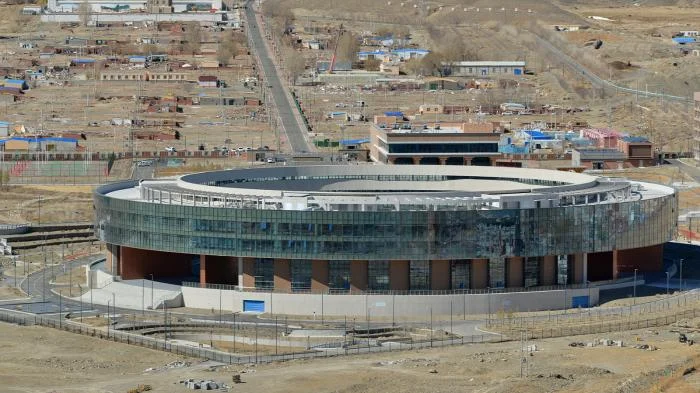

From Xinjiang’s deserts to Shanghai’s coastal waters, China is exploring greener ways to power its growing computing infrastructure.
Not long ago, farming in northwest China’s Xinjiang largely depended on experience. Today, many decisions are guided by data.
Wang Jianguo, a large-scale farmer in Aksu, uses a local agricultural data platform to analyse soil and weather conditions. The system helps him decide when to irrigate fields and apply fertiliser, reducing costs while improving yields.
Behind those decisions lies a growing network of computing infrastructure.
His experience reflects a broader shift taking place across China. As artificial intelligence develops rapidly, demand for computing power is growing. To meet that demand, China is expanding its computing infrastructure while seeking ways to reduce energy consumption and carbon emissions.
From the deserts of Xinjiang to the grasslands of Inner Mongolia and the waters off Shanghai, new projects are linking computing power with renewable energy resources.
Renewable Energy Powers New Computing Hubs
Computing power has become one of the foundations of the AI era. Yet large data centres require vast amounts of electricity, making access to affordable and sustainable energy increasingly important.
Xinjiang is emerging as one of China’s key computing hubs.
The region has built several large-scale renewable energy bases and continues to expand its intelligent computing capacity. Cities including Karamay, Hami and Changji have launched major projects that combine computing infrastructure with abundant wind and solar resources.
Experts say Xinjiang benefits from several natural advantages. It has some of China’s richest renewable energy reserves, relatively low electricity costs and large areas of available land suitable for data centres and computing clusters.
The region is also an important part of China’s “East Data, West Computing” strategy, which directs data-processing workloads from the country’s more developed eastern regions to western areas with stronger energy resources.
Meanwhile, Inner Mongolia has become another major centre for computing power.
According to local authorities, the region’s computing capacity reached 237,000 petaflops in 2025, with intelligent computing accounting for more than 90 per cent of the total. Its combination of renewable energy resources and expanding computing infrastructure has attracted a growing number of AI-related projects.
The technology is also finding practical applications. On the grasslands of Xilingol, herders use AI-powered monitoring systems to track livestock and monitor pasture conditions through mobile apps. In Hohhot, an AI-assisted electrocardiogram system has been introduced in emergency medical services, helping identify potential heart attack risks while patients are being transported to the hospital.
Taking Data Centres Underwater
China’s efforts to develop greener computing infrastructure are also extending offshore.
Recently, an undersea data centre directly powered by offshore wind energy entered operation off Shanghai’s Lingang area.
The project, developed by Hailanyun together with partners including China Telecom and Shenergy Group, is the world’s first commercial facility to combine direct offshore wind power supply with natural seawater cooling. Located 10 to 15 metres below sea level, it occupies only a fraction of the land required by conventional data centres.
The centre is designed to support low-latency services, including AI model training, embodied intelligence, autonomous driving and cross-border e-commerce.
Another key feature is its cooling system. Instead of relying on freshwater, the facility uses naturally cool seawater as a heat sink, improving energy efficiency while reducing cooling-related power consumption. According to the project information, its power usage effectiveness (PUE) is 1.15, which is below China’s mandatory standard of 1.3.
Electricity is supplied directly from a nearby offshore wind farm through submarine photoelectric composite cables, creating an integrated system that links renewable power generation with computing operations.
As demand for AI computing power continues to rise, projects across China are exploring new ways to balance technological growth with energy efficiency. Whether in the deserts of the northwest or beneath coastal waters, renewable energy is playing an increasingly important role in powering the country’s next generation of computing infrastructure.
By Ronnie Yu, additional reporting by Sanliheren, Chinadaily.
If you liked this article, why not read: China Wants AI Computing to Flow Like Electricity.


