
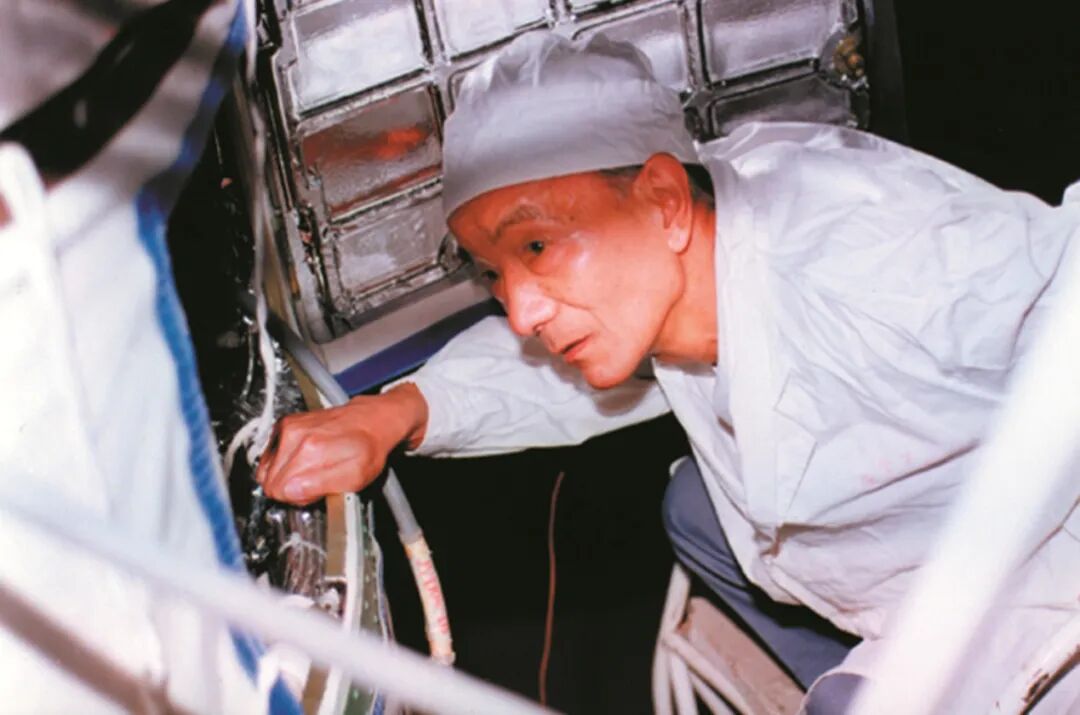

Wang Xiji, a pioneer of China’s space programme, helped develop early sounding rockets, launch vehicles and recoverable satellites. He died at 105.
Wang Xiji, a pioneer of China’s space programme and recipient of the “Two Bombs, One Satellite” Meritorious Service Medal, died in Beijing on August 12 at the age of 105.
As one of the pioneers of China’s early space industry, Wang took part in several landmark projects. He led the development of China’s first sounding rocket. He designed the overall technical plan for the Long March 1 launch vehicle. Wang also served as chief designer of China’s first recoverable satellite.
Together, these milestones trace a path from China’s first steps in rocketry to the development of a broader space programme.
Yet Wang’s own path into aerospace was far from straightforward.
From “Industrial Salvation” to Rocketry
Born in Kunming, southwest China’s Yunnan Province, in 1921, Wang entered the mechanical engineering department of National Southwestern Associated University in 1938.
At the time, he had not planned to work in space technology. In 1948, Wang travelled to the United States to study power and fuel engineering at Virginia Polytechnic Institute. He earned a master’s degree the following year. His original ambition was to return home and help build large power plants.
After the founding of the People’s Republic of China in 1949, however, Wang gave up plans to pursue a doctorate. He returned to China in 1950 and later taught at Dalian University of Technology and Shanghai Jiao Tong University.
Before entering the space sector, Wang was an expert in thermal power engineering. Then, in 1958, at the age of 37, he was transferred to the Shanghai Institute of Mechanical and Electrical Design. His new assignment was to lead the development of sounding rockets.
Wang had never worked with rockets before. The team also had very limited resources. There was no established launch site or specialised equipment. Even basic calculations posed a challenge.
The engineers used hand-operated calculating devices. Several people worked day and night for more than two months to calculate a single trajectory. The stacks of calculation paper rose higher than their desks.
They also found simple solutions to practical problems. With no proper launch facility, they used a rice field on the outskirts of Shanghai for tests. They turned a disused toilet into a testing room and used an abandoned bunker as an engine test stand. A winch lifted the rocket onto the launch stand, while a hand pump helped pressurise the propellant system.
Under these conditions, Wang and his young team kept working. On February 19, 1960, the T-7M sounding rocket successfully lifted off from the outskirts of Shanghai and reached an altitude of about 8 kilometres. China had taken its first step in modern sounding-rocket development.
Wang later described the launch as the first and most important success of his space career.

From Launch Vehicles to Satellites That Could Return
The experience gained from sounding rockets soon became important for China’s satellite programme.
In 1965, China resumed its plans to develop an artificial satellite. Wang took charge of the overall technical planning and design of the launch vehicle. Drawing on experience from sounding rockets and missile technology, he proposed the technical plan for the Long March 1.
The rocket successfully carried Dongfanghong-1, China’s first satellite, into orbit on April 24, 1970. China became the fifth country to develop and launch a satellite independently.
By then, however, Wang had moved on to another unfamiliar field. After helping with the development of the launch vehicle, he turned his attention to a different question: how could a satellite not only reach space, but also return to Earth?
Wang became chief designer of China’s first recoverable satellite. His team developed a return system based on a ballistic re-entry method, with the spacecraft divided into a return capsule and an instrument section.
After years of development and testing, the satellite was successfully launched and recovered in November 1975. China then became the third country in the world to master satellite recovery technology, after the Soviet Union and the United States.
For Wang, changing fields had become a recurring part of his career. Each time, he entered an area that was still taking shape. Each time, he started by working through practical problems.

A Career That Kept Moving Forward
Wang’s work did not end with recoverable satellites.
In the 1980s, he took part in early discussions on China’s crewed space programme. He also contributed to research on small satellites and longer-term space development.
Later, he served as chief designer of the Double Star Programme, a China-Europe joint mission to study Earth’s magnetosphere.
He was elected an academician of the Chinese Academy of Sciences in 1993. In 1999, he received the “Two Bombs, One Satellite” Meritorious Service Medal, one of China’s highest honours for scientists who made major contributions to the country’s early nuclear, missile and satellite programmes.
Even in his later years, Wang remained involved in discussions on space exploration and development. His work also extended to areas such as space infrastructure and the application of new technologies to space programmes.
Looking back on his career, Wang stressed the importance of following scientific laws and seeking truth from facts. He also once described the role he hoped to play in China’s space programme in simple terms: “I am willing to be a paving stone to space.”
The phrase reflected a career built around one task after another. From power engineering to sounding rockets, from launch vehicles to recoverable satellites, Wang repeatedly entered unfamiliar fields and helped establish their foundations.
Additional reporting by CNS, Chinadaily.
If you liked this article, why not read: In My End Is My Beginning: The Life and Legacy of Yang Chen-Ning


