
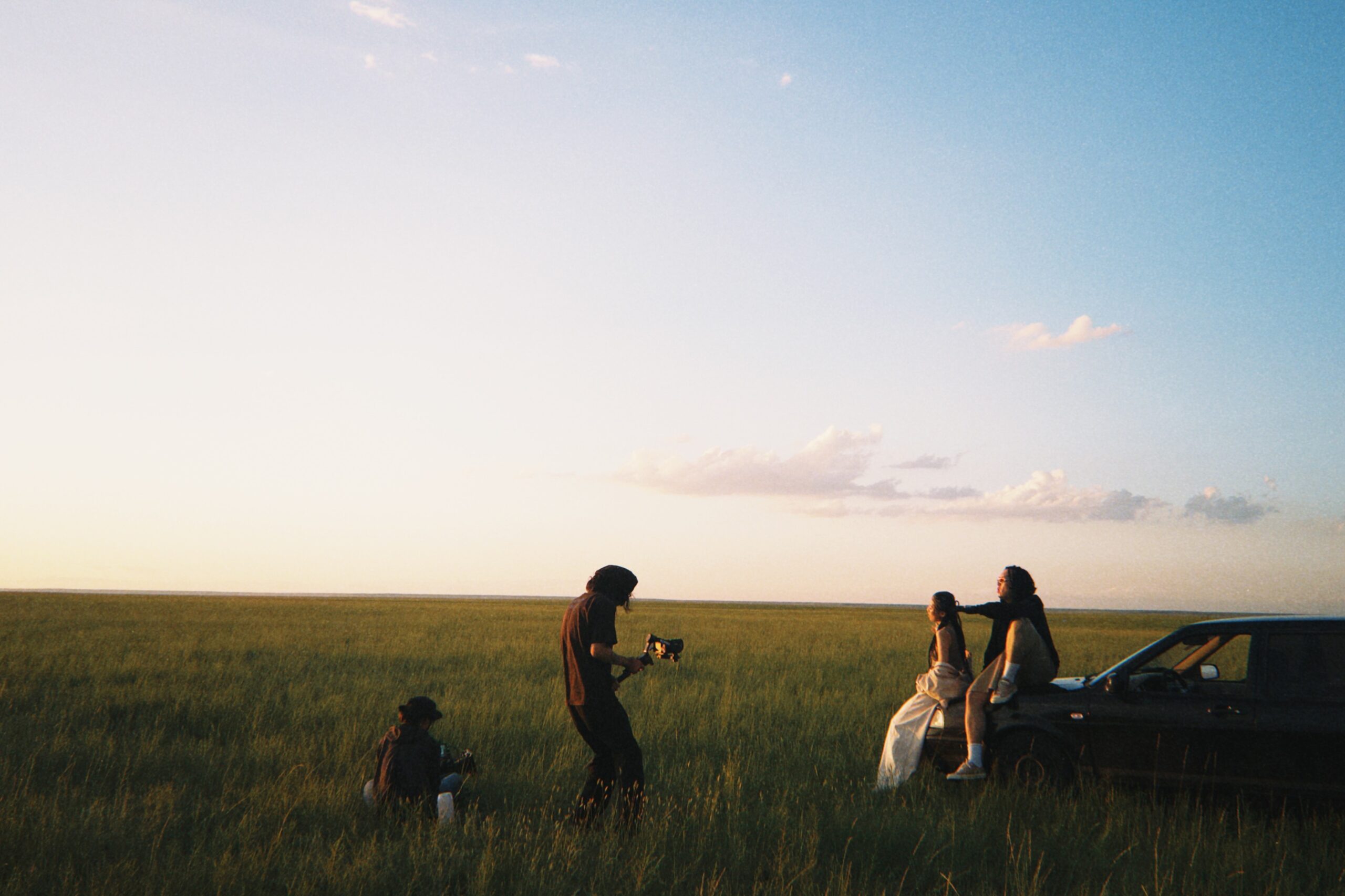

Mongolian music duo Eilseg & Davanim talk about nomadic culture, love, tradition and creativity, and how they carry their roots into the world.
For Eilseg and Davanim, being “nomadic” is not simply about moving from one place to another. It is a way of thinking, creating and connecting with the world.
In early July, the Mongolian music duo brought their Spiritual Nomad double-album special to Blue Note Beijing, one of the stops on their national tour beyond Inner Mongolia.
The venue held around 200 to 300 people. Yet the atmosphere was remarkably quiet. The audience was completely captivated, listening as if swept away to the grasslands and woven into the melodies. From start to finish, they were entirely locked into the music, letting the songs breathe until the room erupted in applause. The audience listened closely throughout the show.

Davanim remembers one audience member in particular: a woman who rode a motorcycle from Tianjin to Beijing for the performance. It was a pouringly rainy day. She told them she wanted to hear them live and see how they sounded on stage.
The encounter stayed with him because it felt genuine.
The concert also gave Eilseg a chance to bring traditional Mongolian aesthetics into the performance. During the second half, she opened with an intro based on the singing style of a traditional Mongolian long song. She wore a formal Khalkha Deel to create a distinctly traditional atmosphere.

The choice was closely connected to the idea behind the tour: Spiritual Nomad.
For Davanim, nomadism also offers a way into a culture that many people may know only vaguely.
“Nomadism can be quite an abstract idea for the wider public,” he says. “People may know that Inner Mongolia has a nomadic heritage, but they may never have thought much about it or tried to understand it.”
That is why the duo wanted Spiritual Nomad to serve as a window.
“We hope people can empty their minds and simply immerse themselves in it,” Davanim says.
Eilseg believes modern people can no longer live a truly nomadic life. Yet the way of thinking can remain. It can live in their music and create a sense of connection with listeners.
Davanim puts it more directly: “Music is bigger than language. Its emotions can travel into everyone’s heart.”
A Folk Song, A Horse and the Distance Between Two People
That idea of movement runs through their music. At times, however, it is the distance itself that matters.
One example is Jonon Hongor, a contemporary reinterpretation of a classic Mongolian folk song. Its Chinese title means My Beloved Horse. On the surface, the song praises a chestnut horse. At the same time, it tells a love story about riding a beloved horse to find someone you love.
For Eilseg, the song has been part of her life since childhood.
“We chose it because we grew up listening to it,” she says. “It can cross time and still move us today.”

The song also made her think about how people express love today.
A message can now cross the world in seconds. A phone call or video chat can instantly connect two people. In the past, however, someone in love might have had to ride a horse across a vast landscape to meet the person they cared about.
“You had to get on your own horse, go to find that person and ride towards her,” Eilseg says. “That journey is very romantic.”
Eilseg sees a subtle irony in modern relationships. Communication has become instant, yet people may not always be as direct with one another. For Davanim, what has been lost is not simply physical distance, but the face-to-face sincerity and effort that once came with crossing it.
“What has been lost is that face-to-face sincerity,” he says. “I feel we are missing the effort of going to find someone. The distance itself, and the process of finding that person, make the feeling more precious.”
That idea shaped their version of Jonon Hongor. The original song has a more melancholic, downbeat mood. The duo’s arrangement brings together its grassland melody with Afro-influenced sounds, softening the weight and creating a more relaxed feeling.
Yet beneath that surface, they wanted to preserve something deeper.
“Once you put aside the surface-level happiness, what remains is the love in your heart,” Davanim says. “That is the two sides of love.”
Carrying Tradition, Preparing to Go
The story behind the Jonon Hongor music video is also a story about friendship.
Eilseg says the project grew naturally out of the people around them. All the actors were friends who joined the project, while the director, Khailun, and cinematographer Enkhdureng were also part of their circle.
The song was recorded in 2023, but it remained relatively unknown for a long time. Davanim says their music had remained relatively niche.
Then, last year, some of their friends came to Inner Mongolia. They had been listening to the song and had ideas of their own. So they decided to make the video together.
The story in the script, Davanim says, was based on things that had actually happened around them.
Much of the video was filmed outside their home. Eilseg remembers that the rainfall had been particularly good that year. Her parents even cooked for everyone during the shoot.
The traditional Mongolian script used in the video adds another layer. For international viewers, it may be their first encounter with the script.
Davanim says its use was not a calculated attempt at cultural promotion.
“We were not doing it deliberately,” he says. “But we feel it is important to express this and not lose our traditional writing and culture.”
For Eilseg, the script is more than a way to present lyrics. Its distinctive forms carry a cultural character and create an unspoken interaction with the audience. Its visual power is also part of the artistic expression.

The same approach shapes their latest single, Tenggeriin Huch, or The Power of Heaven.
Compared with their earlier work, the song reflects a new stage in their journey. For years, Davanim and Eilseg chose not to rush. They kept working, questioning and refining their music. At times, that meant passing up opportunities.
“We always felt that it was not ready yet,” Davanim says. “It was not complete enough. So we told ourselves not to hurry.”
He does not see those missed opportunities as regrets.
“Those opportunities probably did not belong to us.”
Then came Tenggeriin Huch.
“My feeling was, okay, we are ready now,” he says. “It is time to go. It is time to go out and see the world.”
The track also marks their first collaboration with an overseas producer, Man on the Moon, who shares their interest in inner and spiritual themes.
Two new albums are also on the way for a global release: PSYKHON’s Heart•Mind and Eilseg’s self-titled album, EILSEG.
The titles continue a creative journey that began with PSYKHON’s first album, Sunmoon, released in 2017. Even then, the duo was thinking about what makes something good and meaningful. They eventually settled on natural light as an image — something that creates colour in the world and keeps a fire burning inside.
Their thinking has continued to evolve.
“Our spirit is always growing,” Davanim says. “We keep exploring. The physical world is developing, and our minds are developing too. We keep learning and understanding. When we have more knowledge, we carry all of that with us.”
Music as a Way of Living
Davanim and Eilseg are not only musical partners. They are also life partners. They met through music in 2021, when Eilseg’s performance of John Legend’s All of Me caught Davanim’s attention.
Being partners in life and in music, however, comes with its own challenges.
Davanim jokes that he is both Eilseg’s partner and her producer. Once he enters work mode, he becomes strict and demanding. Sometimes, he admits, he has to “calm his wife” after a disagreement.
Eilseg says he can become deeply absorbed in the work and tends to push for perfection. She may feel that a song is finished, while he believes it can still be improved.
But the two have learned how to work with each other.
“We have become much more in sync,” Eilseg says.
Davanim adds with a smile: “She has more and more of her own ideas now.”
For Eilseg, that creative relationship reflects something deeper. She began studying music in junior middle school and gradually came to see music not as a job, but as a way of life.
“I can write lyrics at any time,” she says. “Whenever I have an idea, I can take it to Davanim, and he helps turn it into music.”
She puts it even more simply:
“I feel happy that I can live through music. To experience it. To create it.”
That attitude also shapes how the duo approaches inspiration.
In 2018, Davanim travelled to the grasslands of Xilin Gol with a friend. They planned to stay for two weeks. They ended up staying for three years.
“We thought we were going to find nature,” he says. “But nature enriched us instead. We found ourselves.”

They also found a clearer sense of what they wanted to express and sing about — and, as Mongolian musicians, what they should look for and what they already had.
Today, Davanim still avoids deliberately searching for inspiration.
“I don’t really try to think about it deliberately,” he says. “Making music sincerely is the most important thing.”
Instead, he pays attention to everyday life. He watches people on the street and reads the news. He also spends time with family and friends. These experiences settle inside him and eventually return to his work.
Emotions often become the starting point for a song. His experiences and understanding of the world continue to shape what he creates. When he writes, he often starts with a scene.
Eilseg has developed her own way of holding on to those moments. Whenever she feels moved or notices a change in her emotions, she immediately writes down what she is feeling on her phone.
For example, a sudden expression of affection from her child can bring a feeling she has never experienced before. A piece of music can also trigger an unexpected emotional response. She records those moments before they fade.
“Recording your feelings immediately is a wonderful thing,” she says. “When you read them again later, you can almost feel exactly how you felt at that moment.”
Returning home helps Eilseg recharge. She describes the grasslands as a familiar and quiet refuge, a place where she can clear her mind, feel safe and regain her energy before setting out again.
Somewhere along the way, they keep returning to the same question: Who are we, and what do we want to carry with us?
Photos courtesy of the interviewees.
If you like this article, why not read: Anda Union Brings the Sound of Inner Mongolia to London


