
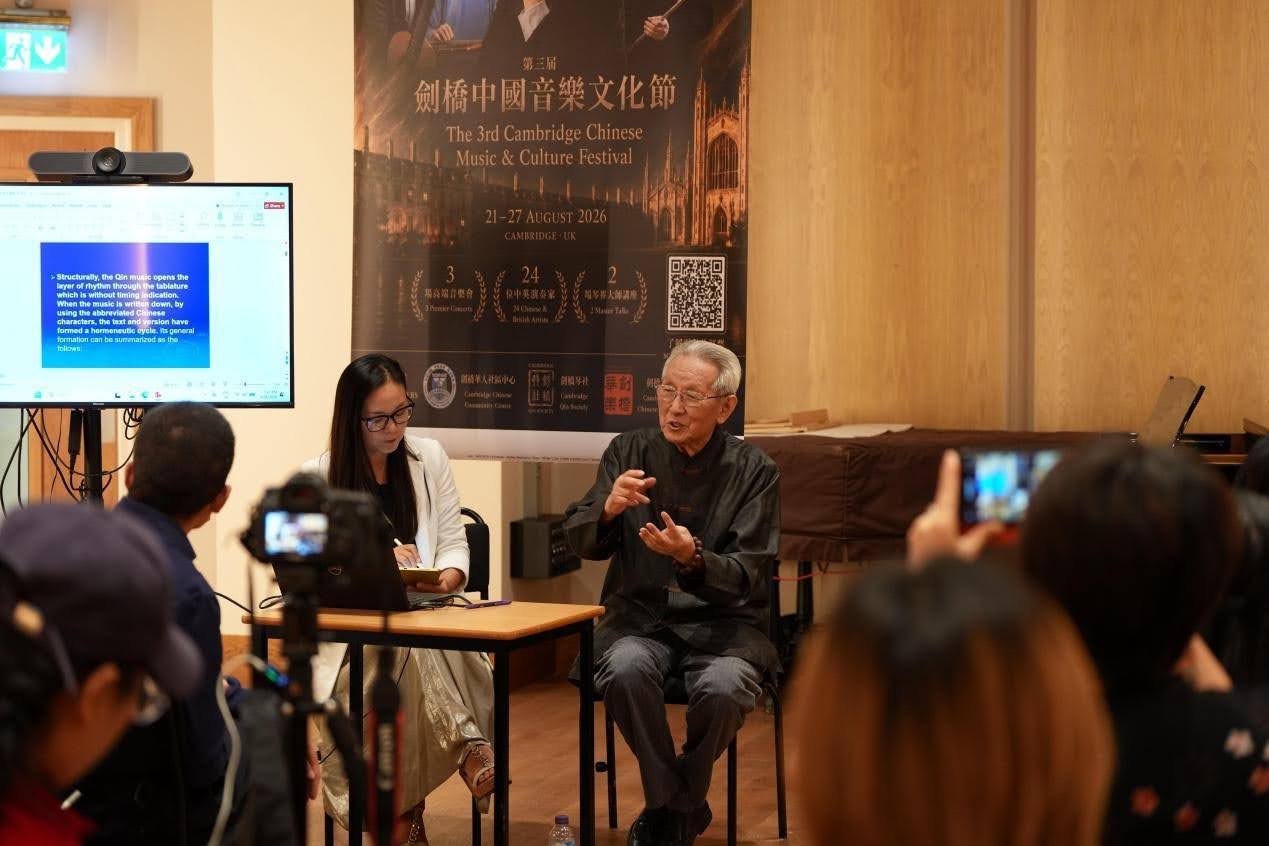

On August 26th, the 3rd Cambridge Chinese Music & Culture Festival held an event at the Royal Academy of Music in London with Wu Wenguang.
The professor at the China Conservatory of Music, honorary president of the China Guqin Association and a distinguished guqin master, gave a lecture and performance titled “Guqin Through the Ages: From Jianzi Notation to Symphonic Music”. The session introduced audiences to the instrument’s history, notation system, performance traditions, and its development in contemporary music.
The event marked Wu’s second lecture during his UK visit, following an earlier session at Trinity College, Cambridge on August 21st. The performances were extra special, as this year also marks the 70th anniversary of Wu’s career in guqin. As part of the festival, a dedicated concert featuring the Yushan Wu School was also held, with several guqin performers and young musicians taking part.

Reading the Guqin Through Its Notation
The lecture opened with a discussion of the guqin’s place within Chinese traditional music, which encompasses folk songs, narrative singing, opera and instrumental music. Wu explained that the guqin sits at the heart of the Chinese literati music tradition, and that over the centuries, a rich cultural system has developed around it, covering the instrument itself, musical theory, notation and repertoire.
Notation – the visual or written system used to represent musical sounds – Wu noted, is a key thread running through the guqin’s history. Early Word Notation (Wenzi Pu) scripts described hand positions and movements in detail; these later evolved into the more concise Jianzi notation. Compared with many other traditional Chinese instruments, the guqin has left behind a relatively substantial body of historical scores and written records, which continue to inform research into ancient Chinese music today.
Wu traced the guqin’s journey from classical performance to contemporary composition. During the lecture, young performers all took to the stage to play traditional guqin pieces, giving audiences a direct sense of the instrument’s tone, rhythm and expressive range. These live performances allowed the audience to experience the development of guqin music from its origin up to the present day as Wu was explaining. In his view, tradition is not the endpoint. The lecture’s title, “From Jianzi Notation to Symphonic Music”, points to the expanding possibilities for the guqin within today’s musical landscape.
Towards the end of the session, Wu’s daughter Wu Ye introduced her newly composed contemporary guqin work, Silk Road of the Sea. From the preservation of classical pieces to the creation of new works, three generations of the Yushan Wu School offered a window into how this lineage has evolved and endured over the past century.

The Meeting of Chinese and Western Musicians
This event was a key part of the 3rd Cambridge Chinese Music & Culture Festival. Shi Yang, founder of the festival and president of the Cambridge Guqin Society, explained that the festival was established with a clear aim: to bring outstanding Chinese musicians to the UK and create opportunities for direct exchange with local Western musicians. “I think it’s a two-way thing, where everyone gains something from it,” she said.
Since its launch in 2024, the festival has continued to invite musicians from China to the UK, with support from institutions including Trinity College, Cambridge. Shi Yang emphasized that the festival’s goal goes beyond presenting Chinese music to British audiences. The aim is to build a platform where Chinese and local musicians can genuinely connect and collaborate.
This year’s programme included multiple concerts, Wu Wenguang’s lecture series, a Chinese music forum, and a Chinese Music Culture Day. Three concerts were held in Cambridge alongside two of Wu’s lectures. The Culture Day, open to the wider community, offered hands-on experiences with instruments such as the guqin, as well as calligraphy and painting activities, providing accessible entry points into Chinese music and culture. The forum brought together 12 speakers covering a range of topics related to Chinese music.
Wu’s first lecture at Cambridge drew a full house of around 100 attendees, including the members of the Chinese community and international music enthusiasts. The fact that a relatively specialist subject drew such a diverse audience was genuinely encouraging.
One audience member told reporter that the guqin performance gave her what she described as “a touch that comes from the soul”, and she was really blown away by the emotions conveyed by the music. For her, it was more than a musical experience; the sound offered a glimpse into the distinct spirit of Chinese traditional music.

Keeping the Communication Going
For Shi Yang, the festival’s deeper significance lies in turning a few days of activity into something longer-lasting.
During this year’s festival, Chinese and British musicians also discussed possibilities for future collaboration. Shi Yang said she hopes to support joint compositions that bring together Chinese and Western musical traditions, and to invite British musicians to visit and perform in China, then bring those new collaborative works back to the UK.
“We need to loop it and have a genuine exchange,”she said. Her vision is for the festival to move beyond individual concerts or lectures, developing into a sustained platform where musicians can build genuine connections and introduce Chinese music to broader international audiences through shared performance and creation.
From Cambridge to London, from classical guqin repertoire to encounters with contemporary musical forms, the third Cambridge Chinese Music Festival gave an ancient art form a hearing in a new setting through its concerts, lectures, forum and cultural experiences, and opened new space for deeper exchange between Chinese and Western musicians.
If you like this article, why not read: A Panorama of Hunan Concert to Tour the UK in September


