
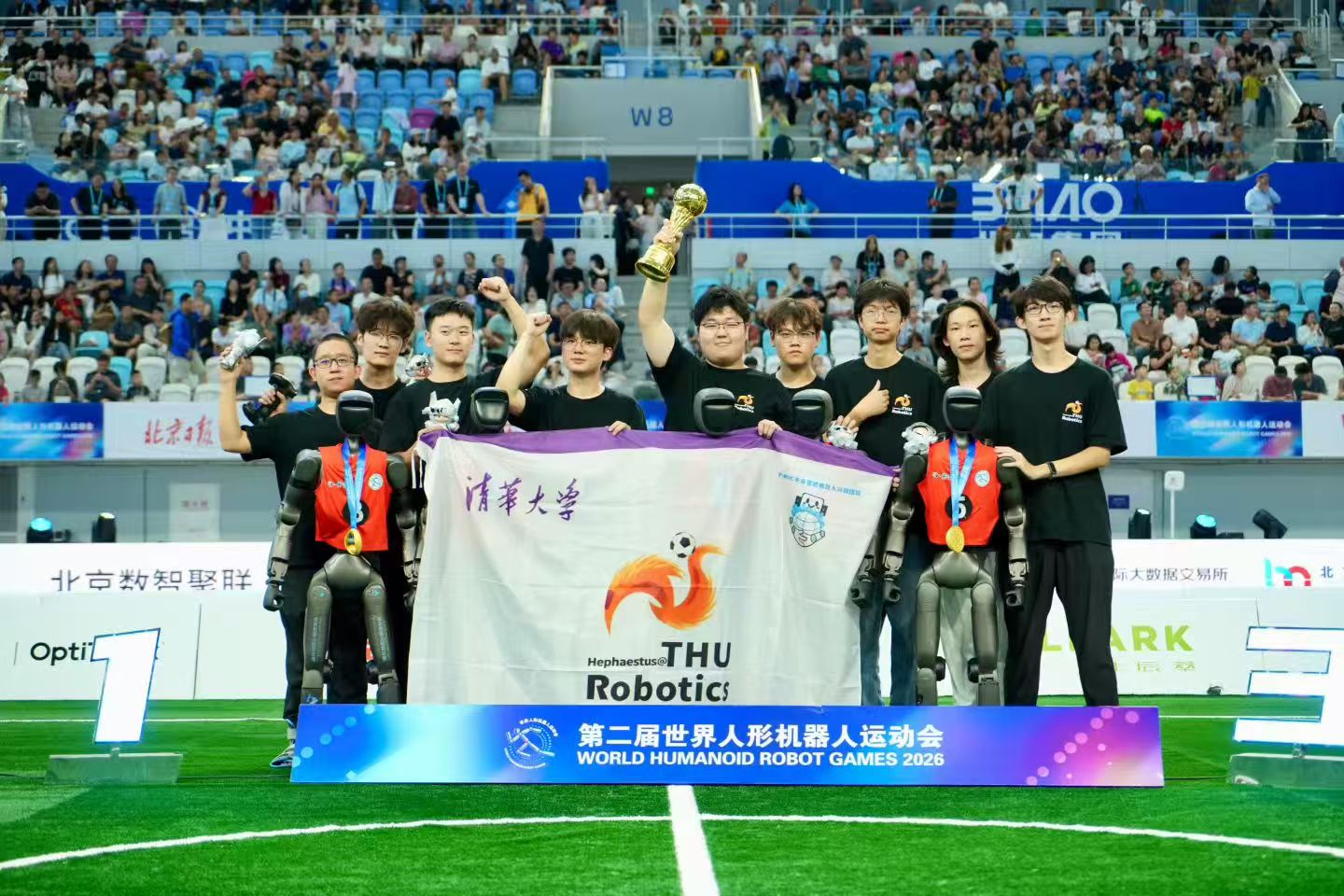

Tsinghua University’s Vulcan Team defends its robot football title after adapting its championship-winning system to new humanoid robots.
Tsinghua’s Vulcan Team had only about a month to adapt its championship-winning system to a new generation of humanoid robots. It still managed to defend its title.
“Five minutes into the match, only one or two of the five robots were still standing.”
That was the reality facing Guo Tong, captain of Tsinghua University’s Vulcan Team, when the team first put its latest humanoid robot, Booster T2, through its paces about a month before the competition.
The team was far from looking like a defending champion.
Yet in the final of the 5v5 Large-Size Group at the second World Humanoid Robot Games, Vulcan Team and its T2 robots defeated SPQR Team to retain the title.
The team also defended its championship in the Large-Size Humanoid Robot Soccer Group at the 2026 RoboCup.
Behind the back-to-back titles was a month of work to adapt a championship-winning system to a new robotic body.
The Robot Changed, but the Champions Stayed
“It hasn’t been easy,” Guo said. “We have basically been working towards this competition for the past month. I’m very pleased, and I’m grateful to our team members and senior teammates for their hard work and support.”
Compared with the previous-generation T1, the T2 is taller and heavier. That also means a fall can be more costly.
More importantly, the algorithms and decision-making strategies that worked well on the T1 could not simply be transferred to the new robot.
“The original strategies could make the robot more likely to fall when transferred to the new body,” Guo said.
So the team began adapting its system for the T2. It trained the robot in simulation and repeatedly adjusted its algorithm parameters. The goal was to make its performance in the virtual environment as close as possible to what it could achieve on the real pitch.
Former captain Luo Changsheng also took part in the transition. He led the T1 team to victory last year. This year, after handing the captaincy to a younger teammate, he focused more on helping the team adapt to the new generation of robots.

The changes were also visible in the way Vulcan Team played.
Rather than constantly moving the ball forward, the team often used passes in the middle and defensive areas to build attacks. When a good chance appeared near the front, the robots were more likely to shoot from distance.
The T2 also showed its ability to keep the ball in play near the touchline.
The playing style was not developed from scratch. Instead, the team built on training from previous generations and adapted it to the T2’s hardware.
“The reason we were able to kick so accurately today is that our senior teammates had already laid the foundation with their kicking gait,” Guo said.
Still, the team had to keep adjusting the system to make full use of that foundation.
Late the night before the final, team members were still checking the robots one by one.
They tested which robot could shoot most accurately from a corner position. They also checked which one performed better from the goal-kick position. The team then selected the best-performing robots and repaired those that were not in good condition.
Those basic checks proved crucial.
“The upper limit was already there,” Guo said. “But everyone worked hard to push beyond it.”
Passing the Torch
For Vulcan Team, technology is not one person’s secret weapon. Instead, it is passed from one generation of students to the next.
“The group of students we trained last year can finally stand on their own this year,” Luo said.
Researcher Zhao Mingguo of Tsinghua University’s Department of Automation founded Vulcan Team in 2004. It was one of the earlier Chinese university teams to compete in the Large-Size Humanoid Robot Soccer Group at RoboCup.
Over more than two decades, students have joined the team and graduated from it. Cheng Hao, president of robotics company Booster Robotics, was also the team’s third captain.
At Vulcan Team, a change in captain does not mean a break in experience.
Instead, senior members continue to work with younger students and pass on technical knowledge and competition experience.
“There is a saying in Tsinghua’s Department of Automation: ‘Pass it on from generation to generation and always strive for excellence,’” Luo said.
“We hope that by passing things from senior students to junior students, we can keep the spirit of Chinese technological innovation alive and continue to develop new talent.”

A Young and Open Robot Football Community
The competition also provides a platform for teams from China and abroad to exchange ideas.
Guo said Vulcan Team stays in contact with university teams from around the world. Teams often arrange friendly matches before or after competitions and exchange small gifts such as team badges.
“Everyone is very friendly,” he said. “They also share some tactical ideas from matches, such as how defenders move sideways to block the ball.”
Meanwhile, more young people are entering the robot football arena.
The World Humanoid Robot Games brought together not only university teams but also teams from vocational colleges and secondary schools. Some took part through partnerships between schools and companies.
Guo sees the trend as encouraging.
University students, after all, once started as secondary school students. Giving younger students an early chance to adjust and work with robots can help them gain practical experience and may encourage them to pursue research in the future.
For Vulcan Team, the robot has changed, and so has its captain.
But the team continues to pass its experience on, one generation at a time.
Additional reporting by Li Yuezhi.
If you liked this article, why not read: ‘Robot Kindergarten’ Steals the Spotlight at HICOOL 2026


