
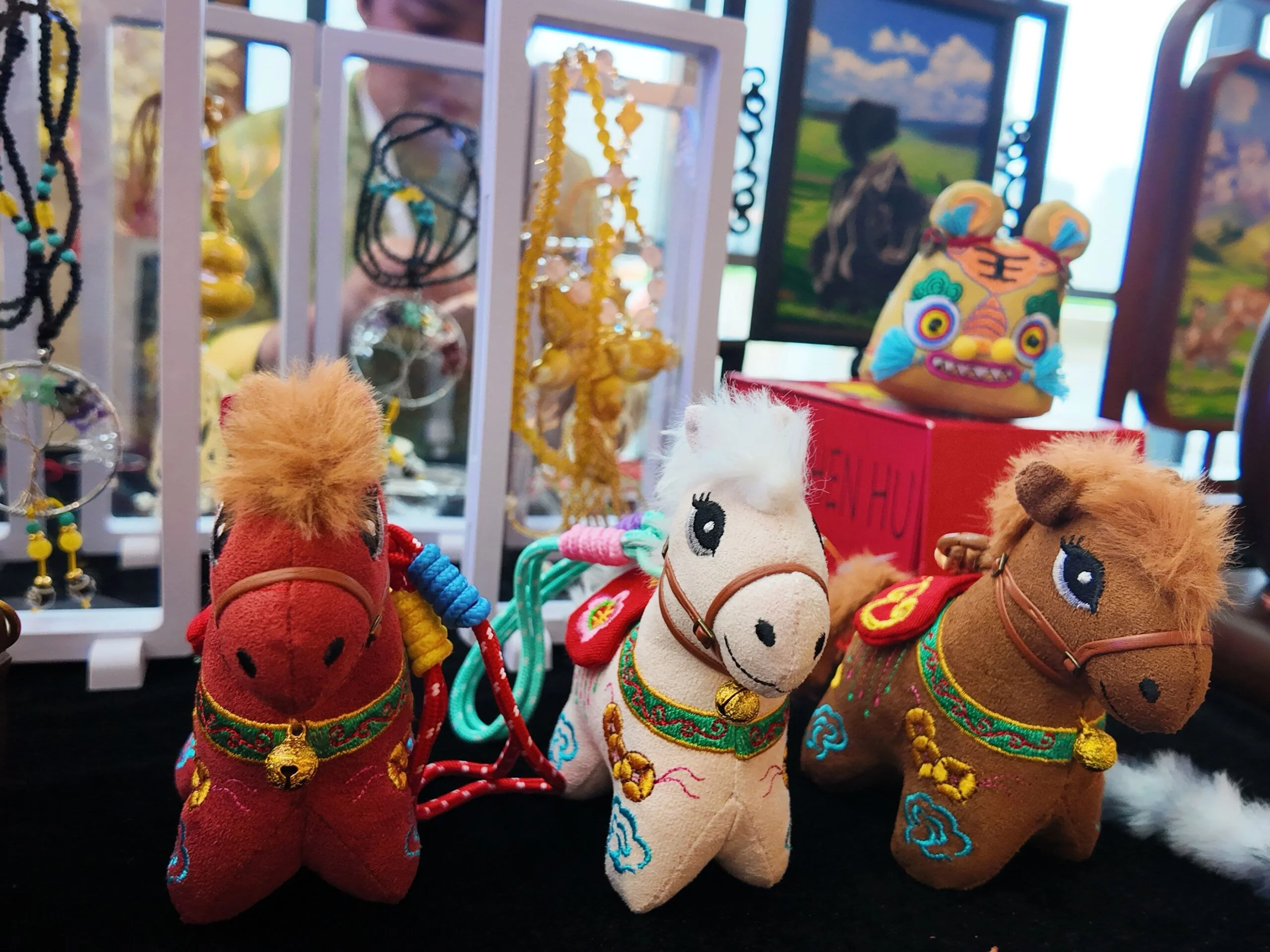

Qinghai’s traditional crafts, from paper-cutting and lantern making to leather embroidery and thangka, are finding new forms in modern life.
A pair of scissors moves across a sheet of red paper. Within moments, a snow leopard takes shape.
“Xining is known as the ‘Snow Leopard Capital’, so I chose to cut one,” said Jiang Youcun.
Jiang demonstrated Hehuang paper-cutting at a cultural event in Xining, capital of northwest China’s Qinghai Province.
The event, part of the Lancang-Mekong Cooperation River-Source Dialogue series, brought guests from six countries to a local fair featuring Qinghai products and traditional crafts.
At the fair, booths displayed Huangyuan row lanterns, Hehuang paper-cutting, Huangzhong dough modelling, Dangg’er leather embroidery and Dzongkha Thangka-inspired cultural products. Nearby, more than a dozen local companies offered yak meat products, barley-based foods and sea buckthorn products.
Together, the displays offered a glimpse of Qinghai’s traditional culture, from handmade crafts to products designed for everyday use.

From Window Decorations to Snow Leopards
Jiang is a municipal-level representative inheritor of Hehuang paper-cutting, an item of intangible cultural heritage. At the event, her scissors moved quickly across red paper. Snow leopards, yaks and Tibetan antelopes emerged one by one.
In the past, the craft was mainly used for traditional festivals such as the Spring Festival. Paper-cut decorations were commonly placed on windows to mark the festive season.
Today, Jiang brings animals and landscapes from the Qinghai Plateau into her designs. The approach gives the traditional craft a stronger local identity.
“In the past, we mainly made window decorations. Now, we can cut Qinghai itself,” Jiang said.
Giving Old Crafts New Uses
The same effort to bring an old craft into modern life can be seen in the Huangyuan row lantern craft.
Zhang Shiquan, a provincial-level representative inheritor of Huangyuan row lantern craft, keeps dozens of carving knives in his toolbox. “Huangyuan row lanterns combine woodworking, carving and painting,” he said.
He then picked up a flat-edged carving knife and gently pushed it across a piece of wood. Small chips fell to the floor.
Huangyuan row lanterns date back to the mid-Qing Dynasty. In 2006, the craft was included in the first batch of national-level intangible cultural heritage items.
Traditionally, Huangyuan row lanterns used wooden frames, carving and painted designs. People displayed them during traditional festivals and lantern fairs.
Today, however, the craft has taken on new forms. Craftspeople have replaced candles with LED lights. Large lanterns that once stretched across streets have become smaller decorative pieces. Huangyuan designs have also appeared on illuminated shop signs.
“An old craft cannot just sit there for people to look at,” Zhang said.

New Materials, New Designs
Meanwhile, craftspeople have also experimented with new materials and designs to keep traditional crafts part of daily life.
At another booth, Zhao Yanfang, a county-level representative inheritor of Dangg’er leather embroidery, picked up a piece of sheepskin and pushed her needle through it.
“If I make a mistake and take out the stitches, the needle leaves holes in the leather. So I have to get it right the first time,” she said.
Zhao combines leather carving with embroidery. She uses sheepskin to create images of yaks, Tibetan antelopes and other animals from the plateau.

Meanwhile, Huangzhong dough modelling has also moved beyond its traditional forms.
Qi Shengcai, a municipal-level representative inheritor of Huangzhong dough modelling, said the craft was originally linked to the custom of making mooncakes for the Mid-Autumn Festival.
Over time, craftspeople combined the techniques used to make mooncakes with structural methods from butter sculpture. The practice gradually developed into a distinctive form of dough modelling.
Today, artists use the same techniques to create new subjects, including snow leopards and other animals from the Qinghai Plateau.
Thangka Finds a New Form
At another booth, several international guests stopped to look at a small thangka.
He Guoming, a senior folk arts and crafts artist in Qinghai and a municipal-level representative inheritor of Dzongkha thangka, explained that the work was designed as a cultural souvenir.
He Guoming, a senior folk arts and crafts artist in Qinghai and a municipal-level representative inheritor of Dzongkha thangka, said the work was intended as a cultural souvenir.
“This is a derivative product of thangka. We extract elements from thangka and turn them into souvenirs,” he said.
In the painting, a figure holds a conch shell filled with water. “It represents environmental protection. We can all play a part,” He said.
From paper-cutting and lantern making to leather embroidery, dough modelling and thangka, Qinghai’s traditional crafts are taking on forms that people can use, carry and see in everyday life.
Additional reporting by Chenhui.
If you liked this article, why not read: Kanbula UNESCO Global Geopark Officially Opens in Qinghai


