
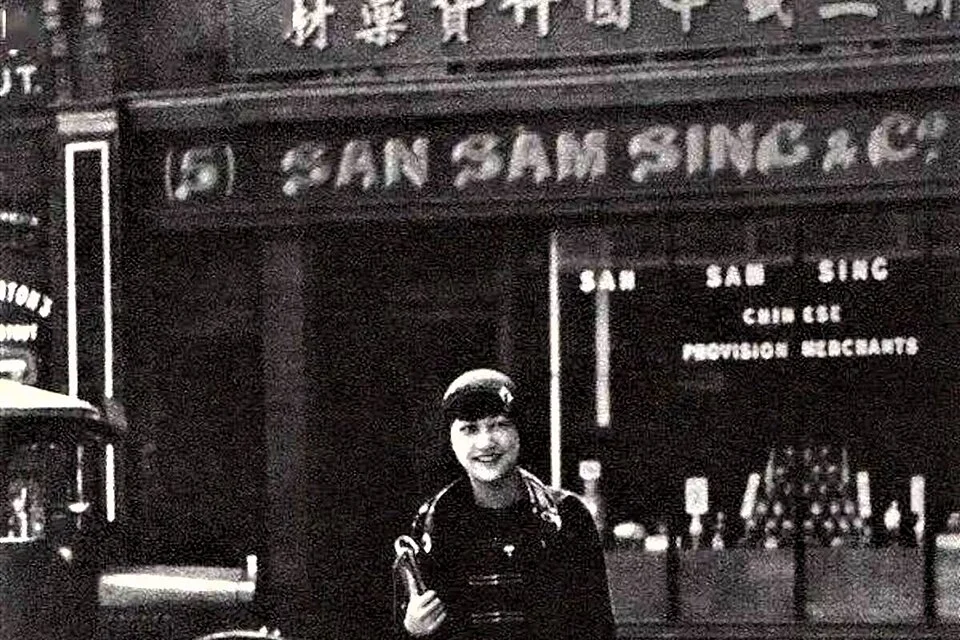

Limehouse Chinatown was London’s first Chinatown, once home to a vibrant Chinese community, before disappearing to time.
Editors note: This article contains racist language in quotes from early 20th century works and members of the community describing their experiences.
Before becoming the glass and steel business hub of Canary Wharf, the docklands were once the destination and starting point for countless ships heading across the world.
Here, while waiting for their ships to depart on month-long voyages around the world, sailors would end up spending time in the adjacent urban areas of Pennyfields and Limehouse. As time passed, a community built up of various sailors from across the world who decided to no longer head to sea and make East London their home.
Among them, a small but tight-knit community of Chinese people was built by the late 19th century.
The racist myth of Limehouse Chinatown
As Limehouse Chinatown became more established, there was a vilification of the area that appeared in exaggerated news stories about Limehouse Chinatown and the people who lived there.
It was presented as a dangerous area, filled with drug dens and gambling. Newspapers carried sensational articles about the area, with debatable accuracy.
Popular culture also presented the myth. Particularly noticeable was The Mystery of Dr. Fu-Manchu series, written from 1913 onwards by Sax Rohmer. A series of racist fiction that shaped the “Yellow Peril” panic. Thomas Burke’s Limehouse Nights, from 1916, was a series of short stories that sensationalised the area. One was titled The Chink and the Child. Three of the short stories went on to be made into Hollywood films.
Even Charles Darwin featured a Limehouse drug den in his book The Mystery of Edwin Drood.
Capitalising on this myth of Limehouse Chinatown, well-known travel agency Thomas Cook even organised ‘tours’ to the area.
This Orientalism and racism present in fiction that shaped people’s perspectives of Limehouse Chinatown spread into everyday life.
Leslie Hoe was born in Poplar in 1919. Recalling his childhood for the Memories of the Genuine Children of Limehouse project, now saved in The London Archive, he describes some of the racism the Chinese community received.
“Chinky Chinese. Ching Ching Chinamen. Chinks.” recalled Leslie when thinking about the names he was called.
“I soon found out you had to fight,” he added.

The reality of Limehouse Chinatown
Compared to the scale of today’s Chinatown and the diverse Chinese community across the UK, the community in Limehouse was small. The official census of 1881 listed just 109 Chinese migrants in London, the majority of whom resided in Limehouse. This number only grew through the rest of the 19th and early 20th century. By 1921, the number of Chinese people living in Limehouse had exceeded 300.
This number was also only the permanent residents living in the area. Many Chinese sailors continued to pass through, spending time on dry land in Limehouse, adding their touch to the area, though not adding to the official statistics.
There were even distinctions within the Chinese community in Limehouse, with Chinese people from Shanghai congregating around Pennyfields, and Cantonese speakers from the south of China mainly lived in Limehouse Causeway.
While small, Limehouse Chinatown was an area that, despite its size, was distinctly Chinese.
Where Leslie Hoe lived, “left and right were streets that were filled with Chinese who were waiting to catch ships.”
“They had left ships that had come to England, and were now waiting to find work on another ship, many often on those returning to China.”
The area was what you might expect from a Chinatown – it was filled with Chinese restaurants and stores selling Chinese dishes and goods from China. There were also launderettes and tailors. Community organisations and schools also started to appear, educating typically mixed children, who were born to Chinese men who settled in the area and the British women they married.

The end of Limehouse Chinatown
However, this community was not to last. Perhaps due to its reputation new Chinese immigrants arriving through the middle of the 20th century started congregating around Soho, with low commercial rents and a popular nightlife they began opening businesses and started to create the Chinatown we now know.
The end of Limehouse Chinatown came in WWII. As part of the docklands, East London suffered heavily during the Blitz, and much of Limehouse Chinatown was destroyed.
Today, Tower Hamlets, where Limehouse is located, has the third-highest Chinese population in the UK. However, there is no distinct Chinatown.
What little remains of Limehouse Chinatown is a dragon statue and a collection of road names like Ming Street. Leaving a forgotten legacy of London’s first Chinatown.
All images from Wikimedia Commons.


