
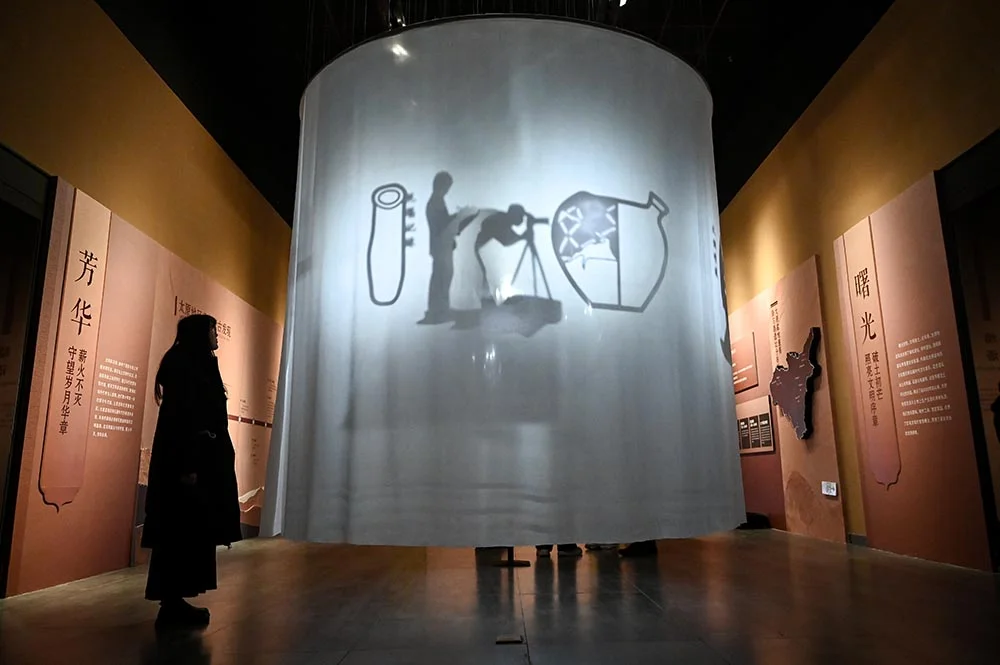

China has released its top six archaeological discoveries of 2025, spanning from the Palaeolithic Age to the Tang Dynasty.
The Institute of Archaeology, with the Chinese Academy of Social Sciences in Beijing, on Feb. 3rd, revealed six sites as notable archaeological achievements in China for 2025.
These archaeological sites follow a continuous historical line, yet each possesses its own characteristics.
The top six discoveries feature ancient ruins spanning from the Palaeolithic Age to the Tang Dynasty (618-907).
Below are the six archaeological discoveries:

1. The Xinmiaozhuang site in Yangyuan county, Hebei province
The Xinmiaozhuang site is preserved in a distinct geographical unit, where six phases of cultural remains dating back to the Late Pleistocene, spanning from approximately 129,000 to 11,700 years ago, have been unearthed. This period is a critical stage in the origin and evolution of modern humans, and the site holds significant value for exploring key issues, including the origins and evolution of modern humans in North China and the transition from the Palaeolithic to the Neolithic.

2. The Peiligang site in Xinzheng, Henan province
Since 2018, archaeological excavations have been carried out at the site for eight consecutive years, yielding significant results. A new batch of tombs, house foundations, pottery kilns, ash pits, many cultural relics, and animal and plant remains have been discovered. Particularly significant is the confirmation of cultural remains from the late Palaeolithic period, the earliest period of human prehistory, spanning from about 2.5 million years ago to roughly 10,000 BC, in the lower layers. The discoveries at the site have preliminarily established the chronology of technological evolution during the late Palaeolithic period.

3. The Zhengjiagou site in Zhangjiakou, Hebei province
The discovery of the Zhengjiagou site indicates that northwestern Hebei may have been a significant area of activity for people of the late Hongshan culture, a key Neolithic culture dating back 6,500 to 4,800 years and spanning across today’s Hebei and Liaoning provinces and the Inner Mongolia autonomous region. This finding not only extends the lower chronological limit of the Hongshan culture but also greatly expands the known range of its people’s activities. It reveals a new trend in the development of the Hongshan culture from the northeast to the southwest and serves as a crucial link in its transition toward the formation of an ancient state.

4. The Husta Bronze Age site in Wenquan county, Xinjiang Uyghur Autonomous Region
Since 2016, archaeologists have been conducting work at the Husta site. Investigations and excavations over the years have revealed that the Husta site is a large settlement covering more than 12 square kilometres. It consists of a core area with a walled settlement and tombs, along with peripheral remains surrounding the core. The main period of the site dates to around 1600 BC, during the late Bronze Age.

5. The Langyatai site in Qingdao, Shandong province
Archaeological excavations have provided concrete evidence for the historical accounts of Emperor Qinshihuang’s eastern tour and the construction of the Langyatai complex. Langyatai is the earliest and largest imperial engineering project of the Qin Dynasty (221-206 BC) discovered to date in eastern China, serving as a political landmark for the Qin and Han (206 BC-AD 220) dynasties to assert their rule.

6. The Badam East cemetery in Turpan, Xinjiang Uyghur Autonomous Region
The Badam East cemetery contains burial remains dating from the Jin (265-420) to the Tang (618-907) dynasties. From 2022 to 2025, archaeologists conducted continuous, proactive excavations at the site. A total of 18 tombs from the Sixteen Kingdoms period (304-439) and nine tombs from the Tang Dynasty were cleared, yielding over 600 artefacts, including two sets of epitaphs. These findings provide crucial physical materials for in-depth research on state governance, cultural integration, and Silk Road exchanges during the Jin and Tang periods.
Written by Sha Liu, additional reporting by China Daily and Global Times.
If you liked this article, why not read: China’s Historic Jin Shi Lu Reunited After Centuries.


