
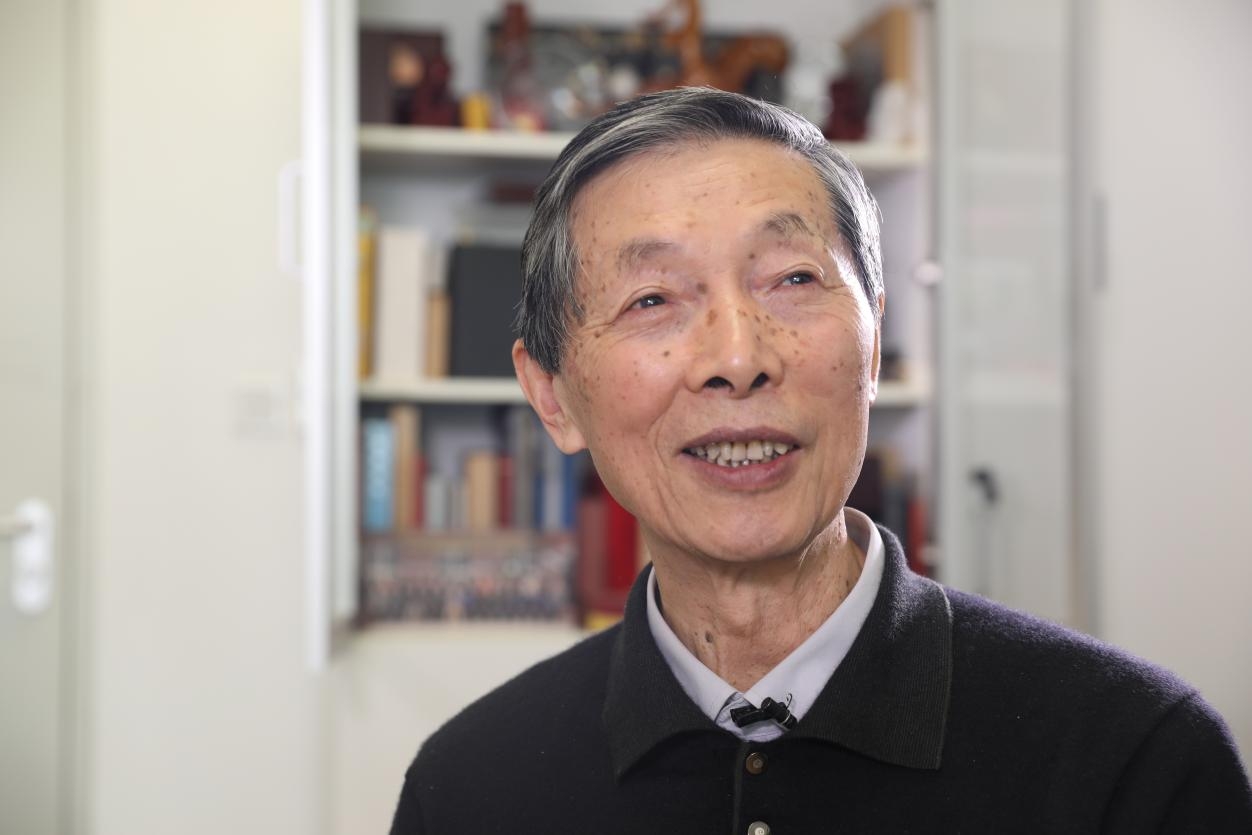

Meet Chen Liquan, the scientist behind China’s lithium battery industry. Discover the three career decisions that shaped his five decades of research and innovation.
When Chen Liquan was growing up in a rural village in southwest China’s Sichuan Province, electricity was scarce. He studied under the light of kerosene lamps, an experience that later shaped his lifelong interest in energy.
On July 8th, the 86-year-old scientist received China’s highest science and technology award for 2025. Over the past five decades, Chen has helped build the country’s lithium battery industry, from early laboratory research to commercial production and next-generation battery technologies.
Looking back, three major decisions changed both his career and the development of China’s battery research.
A Tiny Battery Changed Everything
In 1976, Chen travelled to Germany as a visiting scholar to study crystal growth. During a public open day, he noticed a lithium battery about the size of a button. The small battery caught his attention. It also changed his research direction.
Chen believed batteries could one day transform energy storage and transportation. Soon afterwards, he asked the Institute of Physics under the Chinese Academy of Sciences for permission to switch fields and study solid-state ionics instead.
After finishing his original research five months later, he devoted himself to the new discipline. In 1978, Chen returned to China and began building a research team. The group worked in a former chicken shed that had been converted into a laboratory. After years of research, they established China’s first solid-state ionics laboratory.
In 1988, the team developed China’s first solid-state lithium battery, marking an important step in the country’s battery research.
Turning Research into Industry
Another turning point came in 1991, when Japan’s Sony commercialised the lithium-ion battery. Chen quickly adjusted his research focus. He believed China also needed to develop lithium-ion batteries.
His team faced a series of challenges. Some key raw materials were unavailable in China, and there was no production line or suitable equipment. The researchers synthesised materials themselves and assembled the equipment.
As a result, they built a pilot production line in 1998 that could produce 200,000 cylindrical lithium-ion batteries each year. The project solved several scientific and engineering problems related to large-scale production.
Years later, Chen continued working with industry.
In 2009, he met Zhang Yujie, former chairman of CATL. The two agreed to work toward strengthening China’s lithium battery industry. Chen later became chairman of CATL’s Academic Committee and helped train technical talent for the company.
China’s industry, universities and research institutes continued to work together. By 2014, China ranked first globally in both lithium battery production capacity and output.
Looking Beyond Lithium-ion
Even after those achievements, Chen was already thinking about the next challenge.
He believed liquid lithium-ion batteries faced limits in energy density. Safety concerns also remained, while lithium resources were not unlimited. Therefore, he returned to the field where he had started decades earlier: solid-state batteries.
Chen argued that China should develop solid-state batteries while also advancing sodium-ion batteries.
In 2016, Chen and his colleagues proposed an in-situ solidification technology route. The approach addressed a key challenge involving solid interfaces. The same year, they founded Beijing WeLion New Energy Technology Co., Ltd. to promote the commercialisation of solid-state batteries.
At 86, Chen still works on battery research. Nearly 50 years after a tiny lithium battery first caught his attention, he remains in the laboratory.
Additional reporting by CNS.
If you liked this article, why not read: A Bulgarian Scholar’s Lifelong Journey into Chinese Literature


