
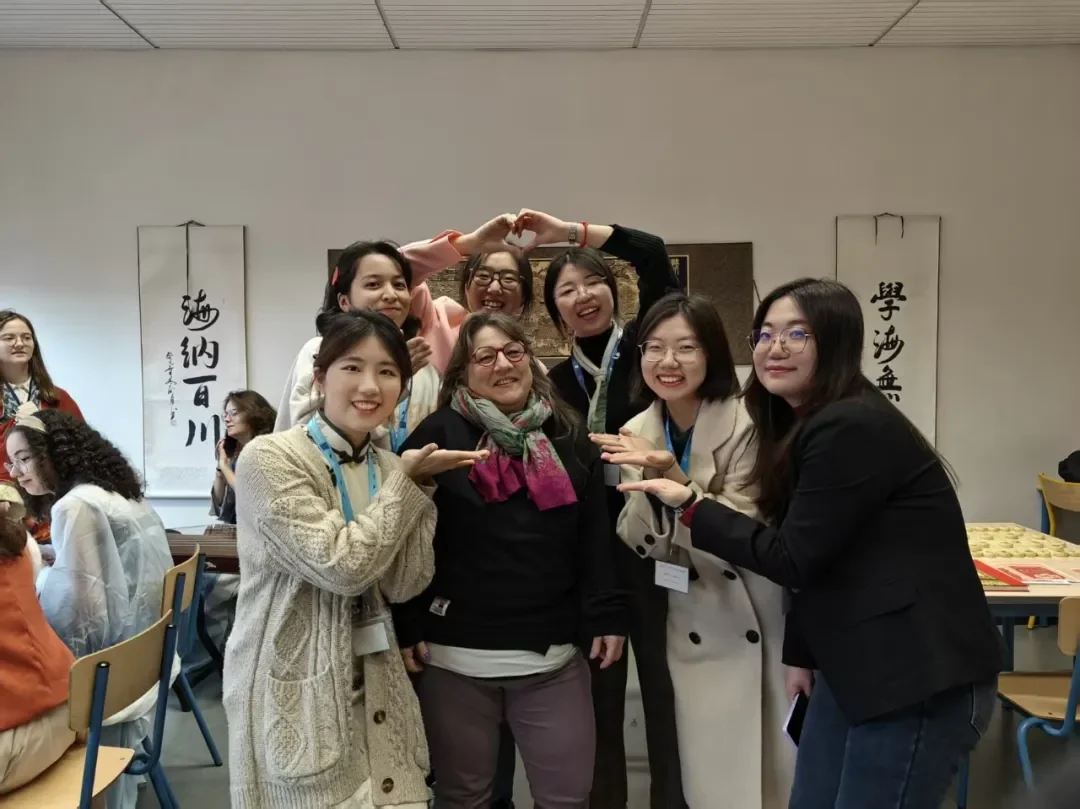

Agnès Belotel-Grenié has spent over 40 years translating Chinese history and literature, helping French readers understand modern China.
French sinologist Agnès Belotel-Grenié’s desk is always piled high with books.
Histoire concise de la civilisation chinoise, Grands Printemps et Automnes, Recueil de nouvelles de Han Dong, Économie chinoise, Rapport sur le développement de l’enseignement international du chinois— these Chinese works spanning literature, history, economics and education form her continuously evolving reading list on China, updated over more than four decades. To date, Agnès has translated and edited over fifty China-related publications, covering nearly every facet of China that French readers seek to understand.
She reads China, and through translation introduces a country that is constantly changing and increasingly connected with the world to French readers.

Sinology Helps Cultures Understand One Another
Today, Agnès works as a lecturer in Chinese at La Rochelle University, alongside her roles as a translator and sinology researcher.
When translating Chinese texts, she devotes extensive time to research, tracing the origins of concepts and understanding their historical context. For her, the greatest challenge has never been expression in French, but the Chinese language itself.
“So many words seem simple on the surface, yet they are the hardest to translate.”
She cites examples: the Chinese Dream, the Belt and Road Initiative. These terms are familiar to all Chinese people, yet rendering them into another language goes far beyond consulting a dictionary. Behind these terms lie thousands of years of Chinese history, as well as the realities of China’s development today.
Agnès recalls a seminar years ago, where participants debated the appropriate French phrasing for such concepts for hours.
“Translation is not merely finding an equivalent word; it requires conveying the full cultural backdrop carried by the term.”
This underpins her understanding of sinology. Sinology is not simply about studying China. It helps different cultures truly understand one another.
Forty Years, an Ever-Expanding Reading List on China
Looking through Agnès’s translations reveals an interesting pattern. Her scope has consistently broadened alongside China’s development.
Her output includes historical works such as Histoire concise de la civilisation chinoise and Grands Printemps et Automnes, contemporary literature including Recueil de nouvelles de Han Dong, and topical publications such as Rapport sur le développement de l’enseignement international du chinois. In recent years, she has joined French translation projects for theoretical volumes including Économie chinoise and Clés du développement vers une grande puissance moderne.
Her translations stretch across history, literature, art, economics and education. In Agnès’s view, this evolution is no accident. “China keeps developing, and French readers’ curiosity about China evolves alongside it.”
Decades ago, French readers focused largely on traditional Chinese culture. Later, interest shifted to Chinese literature and society. Today, they aim to grasp China’s development path, China’s path to modernisation, its economy and governance philosophy.
Her professional journey advances in tandem with China’s transformation.
“The subjects I translate have changed, yet my core objective remains unchanged: to offer French readers a picture of China that is authentic, multifaceted and continually evolving.”
A Shared Passion for Chinese Studies
Agnès’s journey in sinology has never been a solitary pursuit.
For many years, she and her husband have both pursued research on China. They co-author textbooks and academic papers, and frequently deliberate over translation challenges.
At times, discussion over a single term can keep them talking for hours. Their aim is not to craft the most elegant French equivalent, but to persistently ask: what meaning does the Chinese text truly intend to convey?
Such debates yield no definitive answers. Many Chinese concepts are rooted in the historical experience and cultural heritage of the Chinese people.
The Chinese character jia (home) signifies not only a household, but a whole framework of ethical relations. Tianxia (all under heaven) is both a spatial notion and a political cultural concept. “Unless I fully grasp these ideas myself, I cannot hope to make them intelligible to French readers.”
For Agnès, a translator’s foremost responsibility is not to showcase linguistic prowess, but to enable an author’s ideas to travel intact across cultural boundaries.
Literary Translation Seeks Spirit; Theoretical Translation Demands Precision
Years translating diverse genres have shaped her professional stance.
She is often asked about the divide between literary translation and the translation of political and theoretical texts.
Her response: literary translation is almost a form of creative writing. Translators must preserve the author’s style, rhythm and emotional tone, and may adjust phrasing to replicate the original reading experience.
Translating theory and policy documents follows entirely different principles.
In Agnès’s opinion, every term carries a fixed definition, every concept has clear boundaries. Translators must not add, omit, or restructure content according to personal interpretation.
“Literary translation may seek to capture the spirit; theoretical translation must prioritise accuracy above all.”
While the standards differ, one principle holds constant for both kinds of work: fidelity. Fidelity to the author, to the language, and above all, to sincere exchange between different cultures.
In 2024, Agnès received the Outstanding Foreign Translation Experts Award. Over more than four decades, she has translated China’s past, and continues to translate the China of today. To her, sinology creates space for understanding between two languages, bringing civilisations closer through exchange.
At the end of the interview, she showed the journalist the two necklaces resting against her chest. One features a Taiji Yin-Yang pendant; the other bears the Chinese character Fu, meaning blessing. Both were gifts from her son. They embody traditional Chinese culture, as well as her family’s affection.
She smiled and said she wears them every day.
Perhaps this mirrors her decades-long career: helping one culture gradually become understood by another, bringing people from disparate linguistic backgrounds closer through mutual understanding.
By Ziwei Li.
If you liked this article, why not read: Italian Sinologist: Matteo Ricci Built a Cultural Bridge with His Stories of China


