
China’s LineShine supercomputer has ranked first on the latest TOP500 list, becoming the world’s first system to exceed 2 exaflops in sustained performance.
Where is the fastest supercomputer in the world? China.
China’s domestically developed LineShine supercomputer has ranked first on the latest TOP500 list, marking the country’s return to the top of the global supercomputing rankings for the first time since 2017.
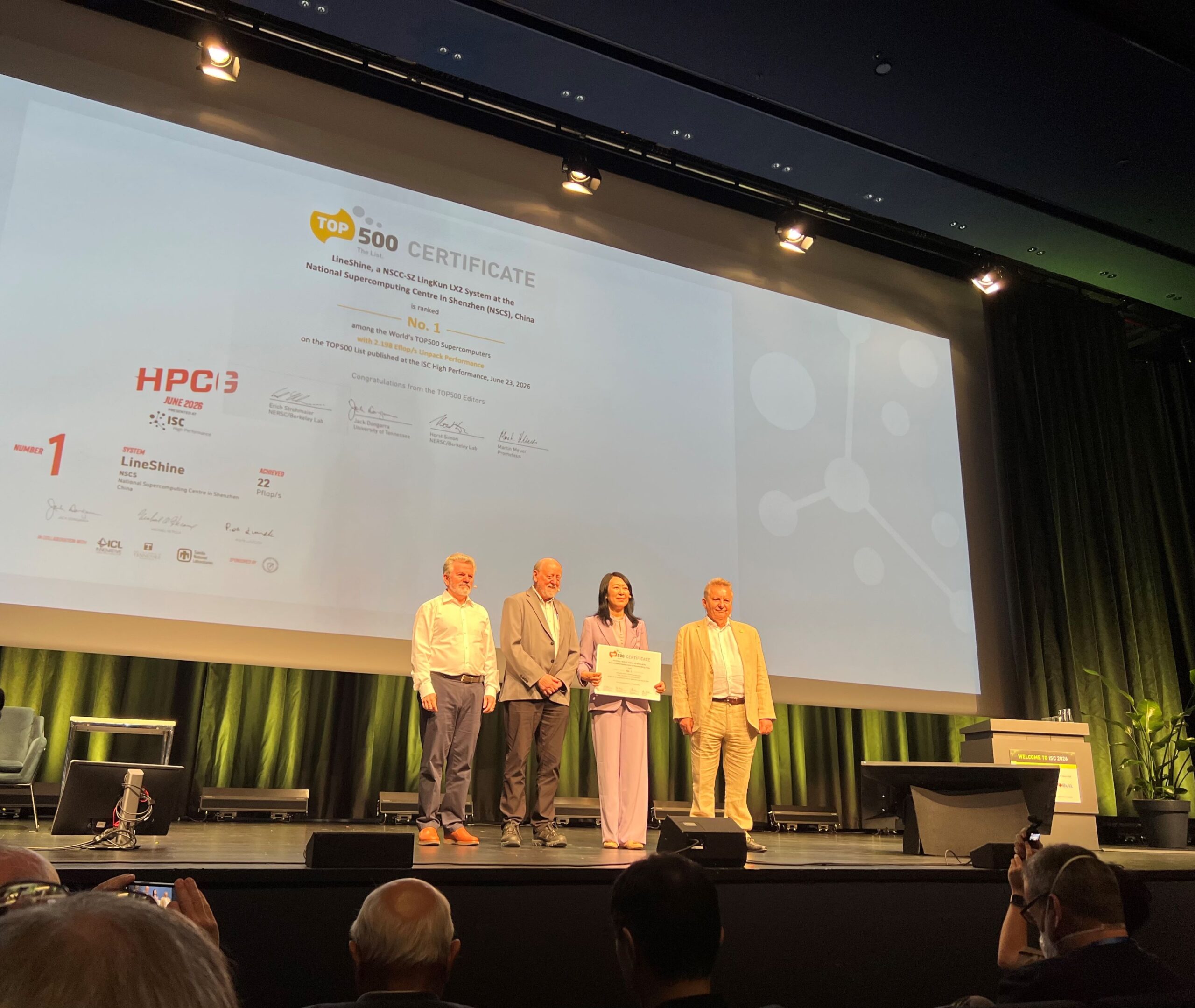
The 67th TOP500 list was released on June 23rd during the 41st International Supercomputing Conference (ISC 2026) in Hamburg, Germany.
LineShine, which is deployed at the National Supercomputing Centre in Shenzhen, achieved a sustained double-precision performance of 2.19 exaflops. According to conference organisers, it is the first supercomputer in the world to exceed 2 exaflops in sustained performance.
The system debuted at No. 1 on the list, replacing the United States’ El Capitan supercomputer.
LineShine recorded 2.198 exaflops, meaning it can perform more than two quintillion calculations per second.
CPU-Based Design
Unlike many leading high-performance computers that rely heavily on graphics processing units (GPUs), LineShine operates entirely on central processing units (CPUs).
In addition, the system uses a fully CPU-based design and requires about 42.2 megawatts of electricity to operate.
At the conference, Lu Yutong, chief designer of the LineShine system and director of the National Supercomputing Centre in Shenzhen, said the machine adopts a full-CPU architecture with built-in AI acceleration units. She said the design aims to support both traditional supercomputing tasks and AI-related workloads.
Meanwhile, Lu described the system as an effort to improve coordination between scientific computing and intelligent computing applications.
According to the Centre, the system has supported applications in areas including climate and ocean research, engineering simulation, materials science, drug discovery, brain science and AI computing since its deployment.
Return to the Top
The result marks China’s first appearance at the top of the TOP500 list since Sunway TaihuLight held the leading position in 2017.
Founded in 1993, the TOP500 project publishes lists of the world’s most powerful computer systems twice each year. Today, it is regarded as one of the most influential benchmarks in high-performance computing.
According to the latest list, El Capitan, located at Lawrence Livermore National Laboratory in California, ranks second. Frontier and Aurora, both in the United States, occupy third and fourth places, while Germany’s Jupiter system ranks fifth.
In addition, the five systems are currently the only publicly verified exascale supercomputers in the world.
International Gathering
Founded in 1986, ISC is one of the major annual events for the global high-performance computing industry.
This year’s conference carries the theme “Connecting the Dots” and runs for five days. Around 188 supercomputing suppliers and research institutions are taking part in the event.
According to The Guardian, the United Kingdom has 11 systems on the latest TOP500 list. Isambard-AI at the University of Bristol is the country’s highest-ranked machine at No. 11.
Chinese companies, including Lenovo, Huawei and Sugon, are among the exhibitors presenting products and research at this year’s conference.
Additional reporting by CNS, Global Times, HKCNA.
If you liked this article, why not read: China Starts Clinical Trial for New 128-Channel Fully Implantable Brain-Computer Interface