

Young Chinese people are turning to British anthropologist Alan Macfarlane for answers about anxiety, work, relationships and the future.
What do you think about death? When asked how he views death, Alan Macfarlane said he hopes to end up as a very handsome sea slug.
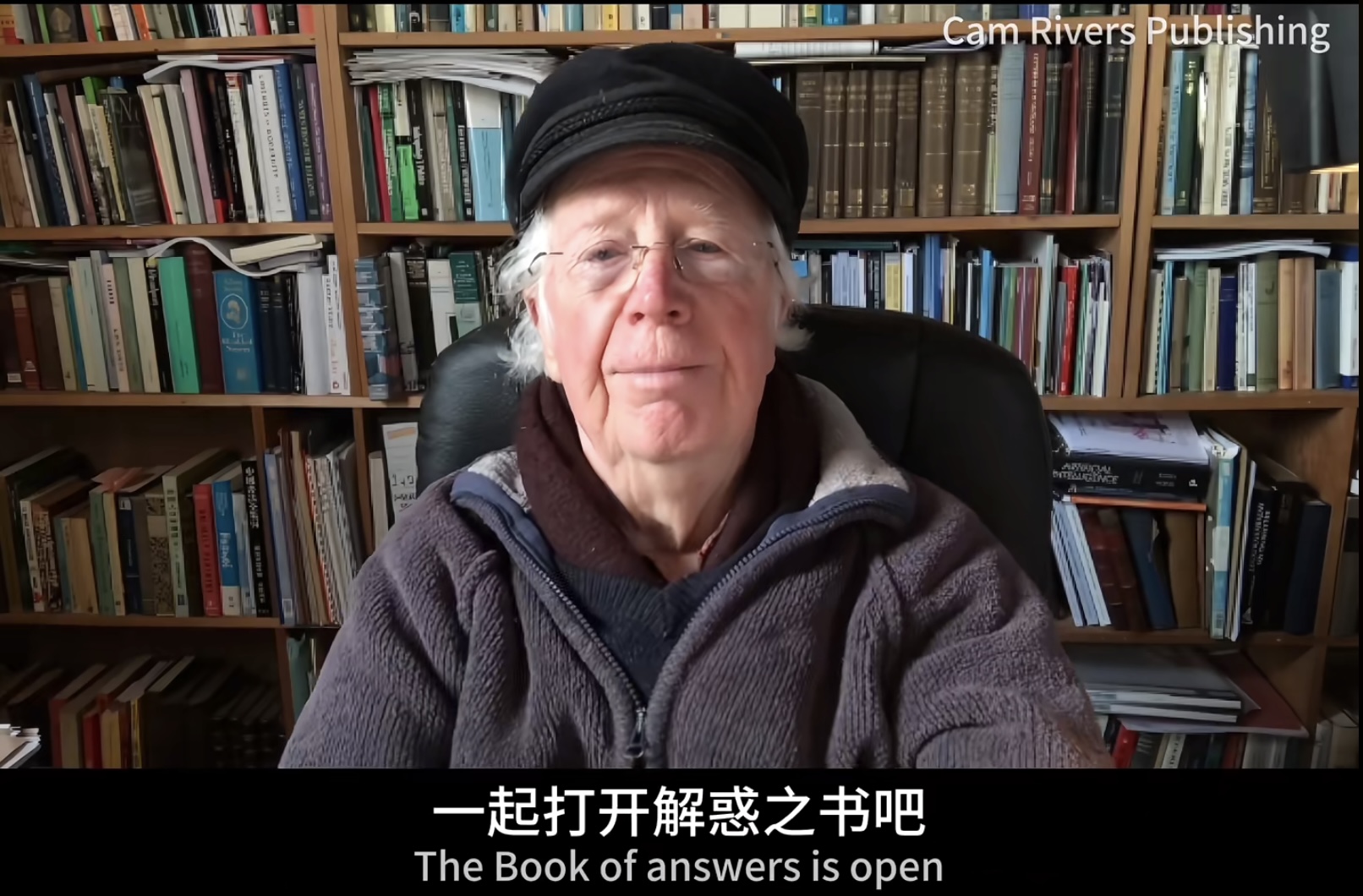
Now 84 years old, with silver hair, Macfarlane speaks slowly, carrying a typical British academic sense of humour. In videos, he is often seen sitting in his study, with an entire wall of books behind him. This scene has become very familiar to Chinese netizens.
Over the past year, the British scholar—an emeritus fellow of King’s College, Cambridge, and Fellow of the British Academy—has gained over two million followers on Chinese social media Xiaohongshu, or RedNote.
When faced with questions such as “How should we face death?”, “Why do I always feel empty?” “Does work still have meaning?” and “Will AI take my job?”, he always responds calmly and candidly.
Therefore, more and more young people are drawn to leave their thoughts in the comment section. Many call him a “life mentor”, while others dub his account an “online confessional”.
Beneath all these varied questions lies one shared emotion: anxiety amid uncertainty.
Why Are So Many Young People Looking Back?
This year, Macfarlane answered questions about nostalgia twice on Xiaohongshu.
Faced with the questions, he first made a joke. “Nostalgia is not what it used to be.”
In his view, the nostalgic mood among many young Chinese people today is far from accidental. Between roughly 2002 and 2015, China experienced a period of extraordinary growth. The economy expanded rapidly, and opportunities seemed endless. Many people believed that studying hard and getting into a good university would naturally lead to a better life.
In recent years, however, the picture has changed. Economic growth has slowed, the pandemic disrupted lives, and the rapid rise of artificial intelligence (AI) has made many once-certain assumptions feel less secure. The life wisdom accumulated by older generations no longer fully applies. New confusion and friction have emerged between young people and their parents, as well as between men and women.
Macfarlane said that when all these uncertainties arrive simultaneously, people naturally start looking back.
To him, nostalgia is more than an emotion; it is also a form of psychological reassurance. If happiness and hope existed in the past, then perhaps they can be found again in the future.
He also believes that this tendency toward collective nostalgia reflects different Chinese and Western views of history. Many modern Western societies have often embraced narratives of progress. Chinese civilisation, by contrast, has traditionally placed greater emphasis on preserving connections with the past, drawing lessons and reference points from history.
In his view, China is a civilisation that places enormous value on historical memory.
Yet Macfarlane does not see nostalgia as a sign of pessimism. Through his conversations with young Chinese people, he found that today’s challenges are not unique to China. Nor is the popular idea of “lying flat” a uniquely Chinese response.
In the West, there is a group known as NEETs—young people who are not in employment, education, or training. He believes “lying flat” bears some resemblance to this phenomenon. Rather than giving up, it is often a deliberate pause. People are simply stopping temporarily so that they can set off again.
And when viewed through a longer historical lens, the current difficulties seem less exceptional. He mentioned the Industrial Revolution, when most people lived terribly hard lives, but people pulled through and built better societies. So he believes that young Chinese people will also get through this.

Why Young Chinese People in Particular?
In one of his videos, Macfarlane answers the question with a simple image: bamboo. When a storm hits, bamboo doesn’t fight the wind. It bends, absorbs the force, and then springs back once the storm has passed.
He explained that there was no need to stand stiffly when confronted with something overwhelmingly powerful. Sometimes the wiser strategy is to lie low for a while and get back up when the time is right.
To him, that ability to bend without breaking is one of the defining strengths of young Chinese people.
What he has encountered online has reinforced that belief.
Over the past year, Macfarlane has shared many personal reflections on life, ageing, loss, and uncertainty. In Western online spaces, that kind of openness may attract ridicule, hostility, or bad-faith attacks. Yet on Chinese social media, he has not been attacked.
In his comment section, some users write about conflicts with their parents; others share their struggles with unemployment. Some discuss relationships, while others seek advice about major life decisions. A stranger in Dalian might comfort someone in Chengdu. Another user might offer encouragement by sharing a similar experience.
People are willing to share their experiences and support one another. In his opinion, this is no longer just a simple comment section; it has almost become a small community where people support each other.
In his long-term experience of managing social media accounts, he rarely saw similar scenes. He noted that Western culture emphasises competition, while Chinese culture emphasises harmony.
As he keeps responding to people’s questions, Macfarlane has pondered another question: why do so many young Chinese people trust him?
He believes the Confucian tradition is part of the explanation. For centuries, Chinese society has placed great respect on parents, teachers, and elders. At the same time, as a foreign scholar from Cambridge, he naturally carries a sense of distance and authority.
Young Chinese People Seen as Friends
Why would a distinguished anthropologist spend so much time answering questions that seem non-academic?
To Macfarlane, the question itself rests on an artificial divide.
He says academic work and personal life are not separate. Scholars, like novelists, draw on their experiences, memories, and observations of life when they think and write.
That belief is rooted in his own upbringing.
Macfarlane’s mother, a writer, exerted an enormous influence on him. She wrote candidly about her feelings and emotions, never concealing her inner truth deliberately.
Anthropology itself, he argues, is deeply personal.
Macfarlane often speaks about participant observation. Anthropologists do not stand outside society looking in. They immerse themselves in the lives of others and learn by sharing their experiences.
For this reason, he never adopts a condescending stance when fielding questions from young Chinese people. He imagines them as people walking alongside him, like friends. In this way, he sees the genuine anxieties of many young Chinese people.
In his view, behind these issues lies the same timeless concern: when the world is changing rapidly, how do we understand ourselves and our place within it?
What Can Anthropology offer Young People?
Macfarlane noted that anthropology first teaches humility. Once people genuinely understand another culture, they can realise that their own way of living is not the only way.
Second, it teaches tolerance. People who live differently from us are not necessarily wrong. They are just following different but reasonable ways of life.
Most importantly, anthropology gives a broader sense of time.
Viewed against the long sweep of human history, today’s upheavals are hardly unprecedented. Wars, pandemics, industrial revolutions, and now the rise of artificial intelligence—humanity has lived through them all and continued to build better societies.
History never moves forward without turbulence. Macfarlane, the elderly Cambridge scholar, has become an unlikely companion to countless young people navigating an uncertain age. The role he plays is not simply that of a listener or a sounding board. It is something deeper: an invitation to reflect, to understand, and to keep moving forward.
Written by Sha Liu, additional reporting by Ziwei Lee.
If you liked this article, why not read: “You Can Rent Everything”, A New Fashion among Young Chinese


