

Historic revolutionary sites across China, from Shanghai to Yan’an, are attracting new generations of visitors seeking to understand the country’s past and present.
China’s revolutionary landmarks are welcoming a different kind of visitor today.
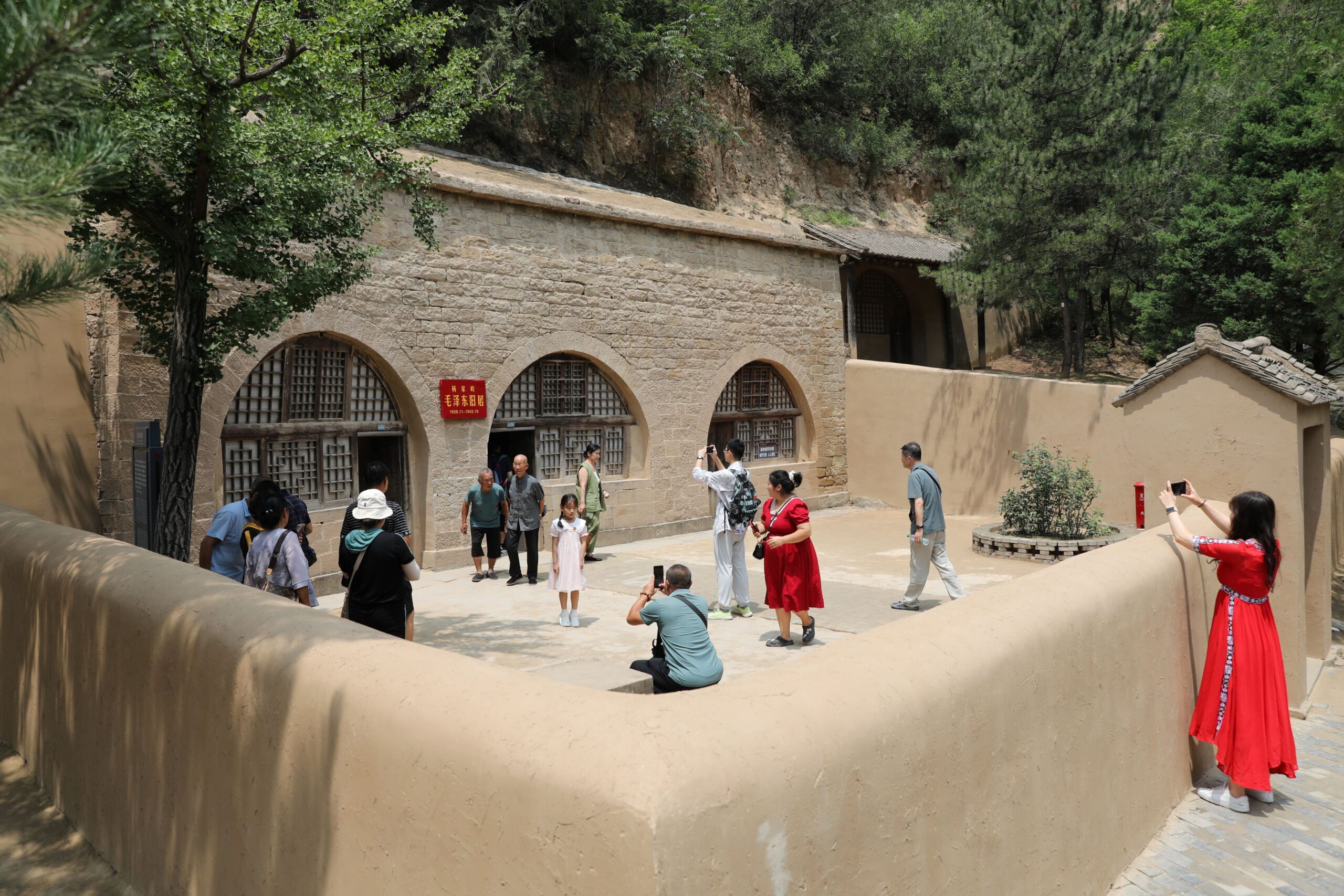
British Ambassador to China Peter Wilson trying on handmade cloth shoes in Yan’an. Young visitors exploring the famous Red Boat through augmented reality in Jiaxing. International tourists photographing a century-old Shikumen house in Shanghai.
These scenes may seem unrelated. Yet together, they reflect a broader trend. Across China, places that witnessed pivotal moments in the country’s modern history are attracting growing numbers of visitors. Some arrive out of curiosity. Others hope to better understand China’s remarkable transformation. Many simply want to stand where history happened.
Interest in Historic Revolutionary Sites in China is Growing
One of the busiest stops is a two-story Shikumen building on Xingye Road in downtown Shanghai.
In July 1921, representatives of China’s early communist organisations gathered inside the modest brick-and-wood house for the First National Congress of the Communist Party of China (CPC). After the meeting was interrupted, delegates moved to nearby Jiaxing, where they completed the final session aboard a boat on Nanhu Lake.
More than a century later, the Shanghai site has become one of China’s best-known historic landmarks. Every day, visitors pause outside the restored Shikumen building, many taking photos before stepping inside.

Interest is growing well beyond China.
According to the Memorial of the First National Congress of the CPC, the museum welcomed about 3.23 million visitors in 2025, including nearly 100,000 overseas visitors from dozens of countries and regions. Museum officials say international visitors are becoming younger and more diverse, including students, scholars, businesspeople and independent travellers.
Yang Yu, head of the publicity and education department of the memorial, said overseas visitors are particularly interested in China’s rapid development over the past two decades and the improvements in people’s daily lives. During guided tours, museum staff connect historical exhibits with China’s more recent development, helping visitors understand today’s China through its history.
For Dutch visitor Henk, who has travelled regularly between China and the Netherlands for more than 20 years, the visit offered a deeper understanding of the country’s development and the ideas that have shaped it. Thai visitor Papa made the museum her first stop in Shanghai, taking photos and recording videos to share with family and friends back home.
To meet growing international demand, the museum has expanded its multilingual services. Exhibition panels now include English translations throughout the galleries. Visitors can also use audio guides in seven languages, while professional English- and Japanese-speaking guides are available for scheduled tours.

Yet for many people, the building itself tells another story.
The Shikumen style blends traditional Chinese residential design with Western architectural elements, reflecting Shanghai’s history as a city where different cultures met and influenced one another. Just beyond the museum, cafés, boutiques and busy shopping streets now stand alongside historic lanes, creating a landscape where old neighbourhoods continue to evolve rather than disappear.
The story that began in Shanghai continues about 100 kilometres away in Jiaxing, Zhejiang Province.
After delegates left Shanghai in 1921, the final session of the First National Congress took place aboard a wooden boat on Nanhu Lake. Although the original boat was destroyed during the War of Resistance Against Japanese Aggression, a faithful replica built in 1959 has since become another destination for visitors seeking to better understand this chapter of modern Chinese history.
Inside the Nanhu Revolutionary Memorial Hall, visitors can step into a full-scale replica of the Red Boat while holographic projections recreate the historic meeting. An augmented reality treasure hunt encourages visitors to interact with the exhibits and collect a digital “boarding pass,” turning a museum visit into a more immersive experience.
The museum now welcomes more than three million visitors each year. Overseas attendance has also continued to grow. In 2025 alone, it welcomed more than 10,000 international visitors, including politicians, scholars, students and tourists.
For Italian visitor Vladimiro Giacchè, the visit illustrated how “great things begin with small beginnings.”

Visitors to Revolutionary Sites in China are Changing
The growing interest is not limited to Shanghai or Jiaxing.
In Beijing, another historic landmark is drawing a new generation of visitors. The Red Building of Peking University, a key site of the New Culture Movement and the early spread of Marxism in China, has welcomed about 1.8 million visitors since reopening in 2021. More than 60 per cent are under the age of 35, according to the museum.
At Beijing Xiangshan Revolutionary Memorial Hall, visitors can join themed city walks retracing the CPC’s historic journey to Beijing, create cultural souvenirs inspired by the museum’s collections, or explore exhibitions enhanced by artificial intelligence, holograms and three-dimensional digital displays. Rather than replacing historical artefacts, these technologies help visitors better understand the people, places and events behind them.
For Zhang Siyu, a university student who joined one of the themed walks, the experience felt very different from reading a textbook. “It was more immersive,” she said. “It helped me better understand the history.”

Visitors are becoming more diverse, too.
In June, British Ambassador to China Peter Wilson visited Yan’an, one of the country’s best-known revolutionary sites. During the trip, he toured museums and historic locations, talked with residents in fluent Chinese, sampled local agricultural products and bought handmade souvenirs, including a pair of cloth shoes, a small gardening hoe and a bag of apricots.
“For me, wherever I work, it is very important to understand that country’s history in depth, as well as how that country views its own history,” Wilson said during the visit.
His visit reflects a broader trend. Across China, many historic sites have introduced multilingual services, digital technology and interactive exhibitions to make visits more accessible. At the same time, surrounding historic neighbourhoods continue to evolve, with Shikumen lanes in Shanghai now sitting alongside cafés and creative spaces. Museums have become part of everyday urban life rather than destinations visited only on special occasions.
For many visitors, these places are no longer simply memorials to the past. They offer a way to understand how China’s modern story began, and how it continues to shape the country people see today.
Written by Chen Wang, additional reporting by Xinhua, CGTN, CNS.
If you like this article, why not read: Rain, Lanterns and Dialogue: Inside Starmer’s Shanghai Stop


