
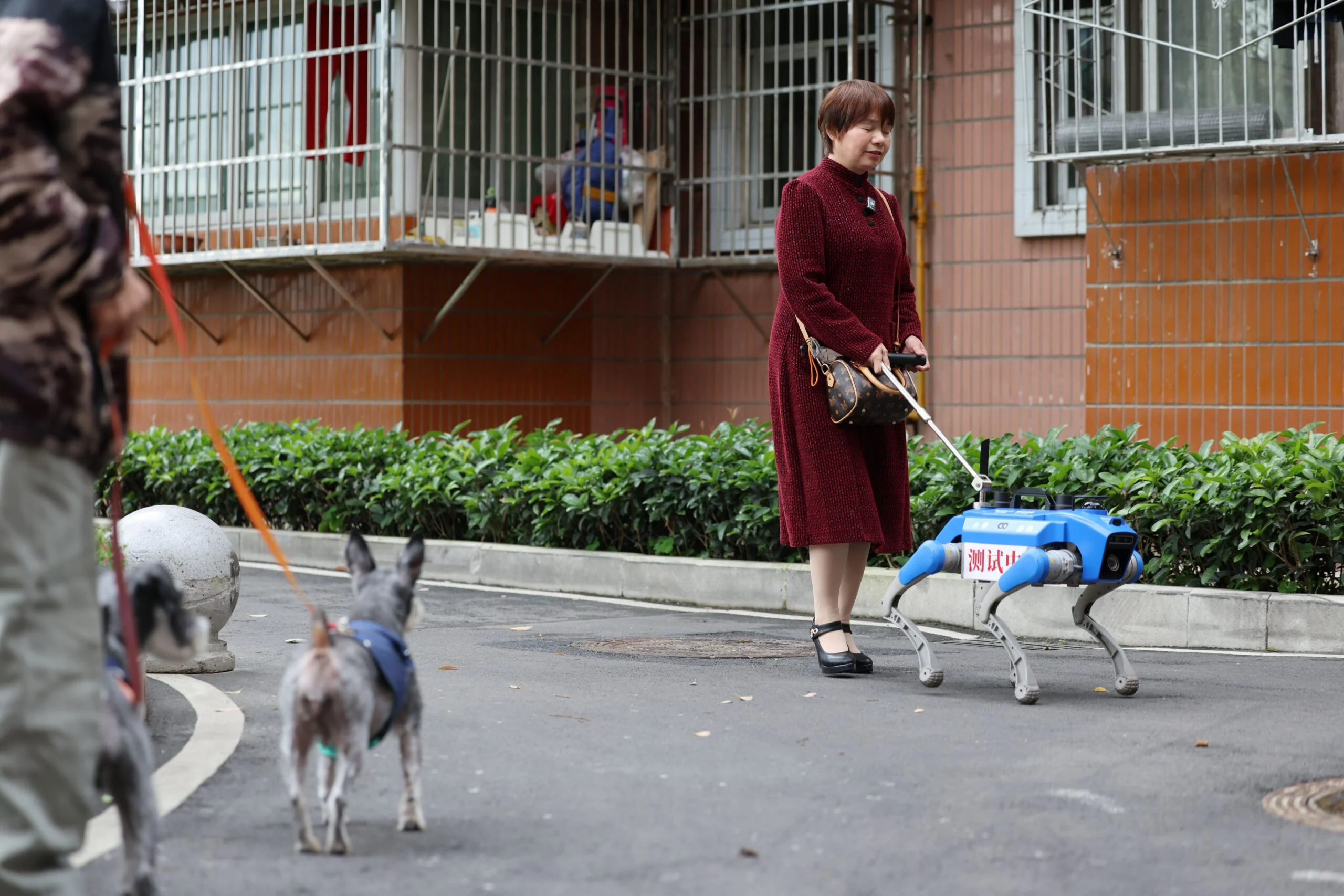

China is testing robot guide dogs to support people with visual impairment, aiming to improve mobility and independent travel through assistive robotics.
A new generation of robot guide dogs is being tested in China to support mobility for people with visual impairments.
At a humanoid robot half-marathon in Beijing, a university student with visual impairment completed the race with the help of a four-legged robot guide dog named “Tutu.”
The student, Wang Zihao, has only 0.01 vision in both eyes. During the race, the robot guided him through crowded areas, narrow passages, and changing terrain, helping him reach the finish line.
“I have never used a real guide dog before,” Wang said. “Guide dogs are very rare. For visually impaired people, going outside alone is very difficult. Family members cannot always stay with us. We really need a smart companion like this.”
Limited Access to Guide Dogs and Growing Demand
China has about 17.31 million people with visual impairments, according to the China Association of the Blind. However, only around 400 guide dogs are currently in service nationwide.
This gap limits independent mobility in daily life. Many people with visual impairments rely on family support or limit outdoor travel due to safety concerns.
As a result, researchers and companies are developing robotic systems to explore alternative forms of mobility support.
Robot guide dogs like “Tutu” use perception, navigation, and motion control technologies to assist users in real time.
Testing in Real-World Environments
During the 2026 Beijing E-Town Half Marathon and Humanoid Robot Half-Marathon, the robot detected obstacles, adjusted its route, and guided the user through crowded and narrow sections. It also helped maintain direction and identify checkpoints along the course.
Developers say the system combines perception, decision-making, and motion control, allowing it to operate in dynamic environments.
Beyond the race, similar systems are being tested in cities such as Chengdu. These trials include everyday scenarios such as commuting, shopping, hospital visits, and public transport transfers.
The system supports stair climbing, slope navigation, uneven surfaces, and voice-based interaction for route guidance.
Experts say these trials mark a transition from controlled testing to broader real-world use, although the technology remains under development.
Technical and Regulatory Challenges
Despite progress, several challenges remain before wider deployment.
Real-world environments such as subway stations, supermarkets, and hospitals are more complex than test conditions. Noise, crowds, and unpredictable movement continue to affect performance.
Cost is also a major factor. Key components such as LiDAR sensors and computing chips remain expensive. Experts estimate that broader adoption will require costs to fall to around 10,000 yuan (approximately £1,100) per unit.
Regulation is another issue. Clear rules are needed to define how robotic guide dogs can operate in public spaces and transport systems.
Traditional guide dogs require long training cycles and remain in limited supply. Robotic guide dogs offer an alternative approach, with no fatigue, no illness, and software-based updates.
However, researchers stress that safety, reliability, and real-world stability must improve before large-scale use becomes possible.
Additional reporting by People’s Daily, CNS.
If you liked this article, why not read: Chinese Robot Breaks Human Half-Marathon Record


