
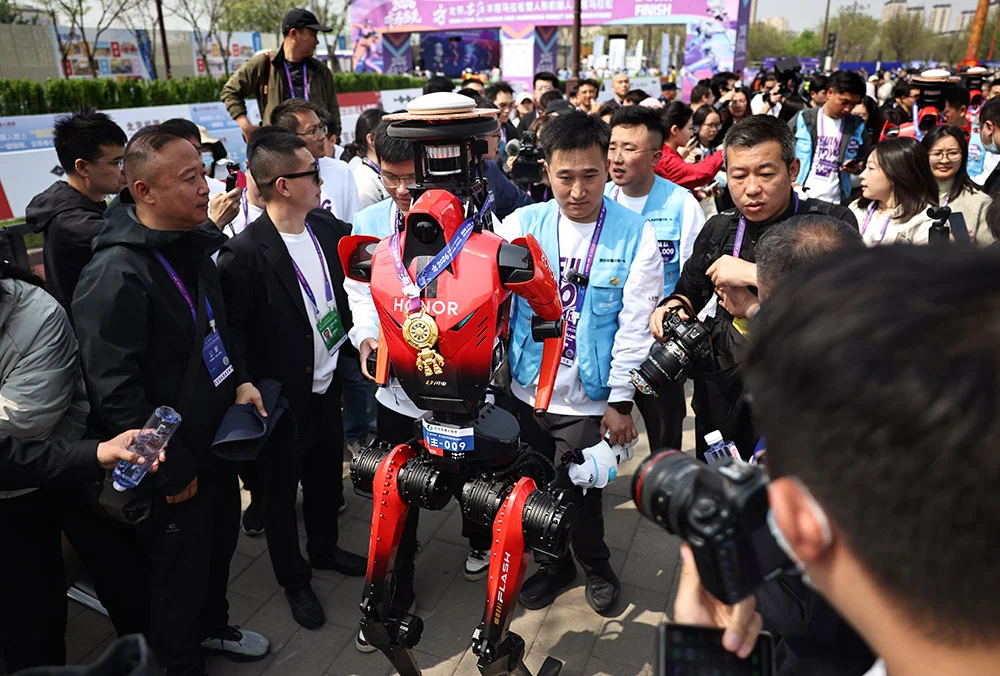

Chinese humanoid robot has broken the human half-marathon record at a robot marathon competition in Beijing E-Town.
A history-making event took place on the morning of April 19th in Beijing. Humanoid robots set a new record at the 2026 Beijing E-Town Half Marathon and Humanoid Robot Half Marathon.
This competition attracted over a hundred humanoid robot teams. Over 100 humanoid robot teams and 12,000 human runners took part in this event.
“Lightning” Shines
Among them, the robot “Lightning” from the Great Sage Equaling Heaven team finished the race and set a new record. “Lightning” completed 21.0975 kilometres with a net time of 50 minutes and 26 seconds, breaking the current human half-marathon world record of 57 minutes and 20 seconds.

According to Du Xiaodi, a test and development engineer of Honour, “Lightning” was designed with long legs like excellent human athletes, and equipped with a high-efficiency liquid cooling system to dissipate heat during running.
Yao Bin, captain of the Thunder Lightning Team, which took second place, said that their robot completed the race after one battery swap with autonomous navigation. When encountering a collision, the robot can restore a stable running posture instantly via its internal dynamic balance algorithm and resume running.
Remarkable Progress
The performance progress of robots this year has been remarkable. A large number of participating teams outperformed last year’s champion.
The competition was divided into the autonomous navigation group and the remote control group, with mixed timing and unified ranking.
Cai Jizheng, Director of the Beijing Economic-Technological Development Area’s robotics bureau, said that this year’s track featured more complex terrains, including over 10 types of road conditions such as flat ground, slopes, curves and narrow passages, along with nearly 90-degree bends.
The race set new all-time records in terms of participant scale, geographical coverage and robot technology categories.
Zhao Mingguo, researcher from the Department of Automation at Tsinghua University, said that this year’s results show that robots have made rapid progress in the stability of “cerebellum” control and battery swapping endurance. Their “brain” technologies, including autonomous motion control and outdoor operation, are maturing rapidly.
Besides racing and completion events, this year’s event also includes individual technical awards to evaluate comprehensive abilities, including endurance, humanoid gait and technological innovation.
Beyond the Track
Off the track, robots also served as volunteer supply staff, handing water and towels to human runners.
Zhang Yujia, Marketing Director of Xinghaitu Technology, said that event services require higher levels of perception and decision-making capabilities of embodied intelligence technology. The company has secured thousands of commercial orders in scenarios including handling, grasping and packaging. They will launch mass production on a 10,000-unit scale this year.
The robot dogs from companies such as Benmo Technology are also serving the competition.
Challenging Future
Liang Liang, Deputy Secretary-General of the Chinese Institute of Electronics, noted that the goal of this year’s robot half-marathon is to promote research, production and application through competitions, so as to verify technological innovation and industrial development.
Lin Zhongyan, marketing executive of Benmo Technology from Taiwan, has studied and worked in the mainland for years. He said that the speed of robots has increased, and errors have decreased. He looked forward to strengthened cross-Strait cooperation in hardware, software and other industrial sectors.
“After breaking the human record this year, future robot half-marathon events will be more challenging and entertaining,” said Julio Rogelio Guadarrama Olvera, Chief Strategy Officer for Technological Foresight of the German Salvage Project Team. Robots compete in long-distance running, driving many companies to develop more advanced drivers and controllers. Such technological breakthroughs will serve more scenarios, such as industrial inspection, emergency rescue, and health services.
Written by Sha Liu, additional reporting by CNS.
If you liked this article, why not read: Robots Hit the Ground Running in Beijing’s Half-Marathon


