
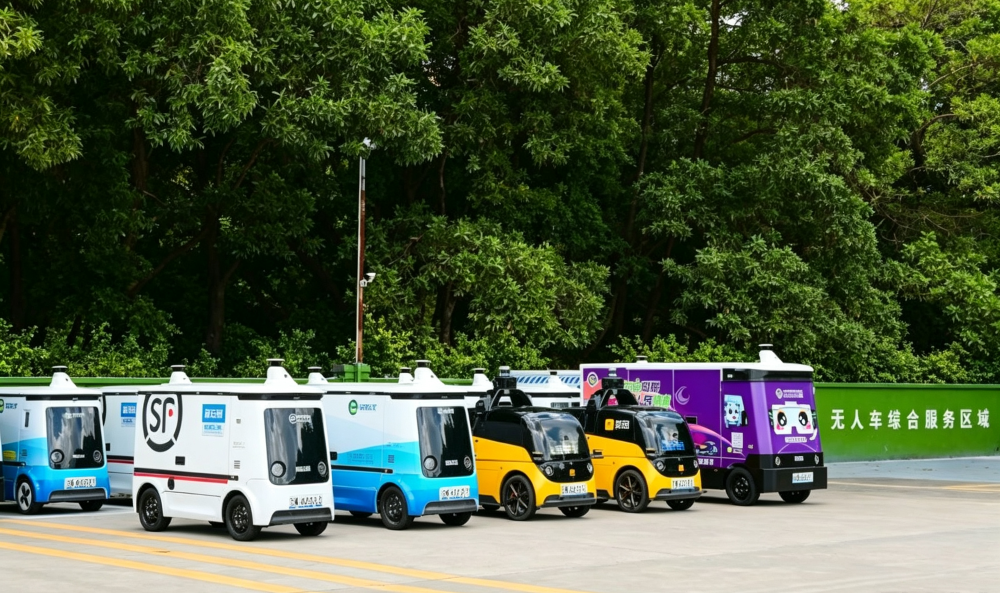

China’s delivery robots are expanding from city streets to rural roads, reshaping last-mile logistics through autonomous vehicles and drones.
Open a ride-hailing app in Foshan, Guangdong Province, tap “Delivery” and select an autonomous vehicle. Within minutes, an autonomous delivery vehicle can arrive to pick up the goods.
This is no longer just a technology demonstration. Autonomous delivery vehicles are gradually entering everyday logistics in China, serving businesses, courier networks and, increasingly, rural communities.
To understand how this is happening, follow the journey of a delivery robot — from the factory floor to city streets and, eventually, village roads.
From the Factory Floor to the Road
More than 1,000 kilometres from Foshan, the journey begins at a smart manufacturing plant in Anyang, Henan Province.
Inside the plant operated by Neolix, robotic arms handle components while automated systems calibrate autonomous driving equipment. One L4 autonomous delivery vehicle can roll off the production line every 45 minutes.
Before hitting the road, however, each vehicle must pass a series of demanding tests. A spray system simulates heavy rain while LiDAR checks obstacles up to 200 metres away. On a test track with a 15-degree slope, the vehicle must adjust its power output and climb steadily.
Neolix says its X6 model uses 12 high-definition cameras and can operate in different weather and lighting conditions. Its autonomous driving system does not rely on high-definition maps, allowing the vehicle to navigate without the detailed maps traditionally used by autonomous vehicles.
The company reached a milestone in September 2025, when its 10,000th autonomous delivery vehicle rolled off the production line in Tonglu, Zhejiang Province.
The wider industry is also expanding. By the end of 2025, China had more than 35,000 autonomous logistics vehicles in operation, according to industry data. L4 autonomous vehicles were operating in more than 300 cities and had handled more than 100 million deliveries across more than 100 application scenarios.
The scale suggests that autonomous delivery is moving beyond technology trials and towards wider commercial use.

From Fixed Routes to On-Demand Delivery
The changes are already visible on city streets.
At a YTO Express outlet in Foshan, delivery worker Liu loads parcels into an autonomous vehicle before tapping a button on his phone to send it on its way.
The vehicle travels about three kilometres to a Cainiao service station. It handles traffic lights, a speed bump and a narrow lane along the way, then slows down and pulls over when needed.
Before the vehicle was introduced, delivery workers used electric three-wheelers to make the same trip. The short-distance transfer took up a large part of their working day.
After a year of operation, the outlet says its overall last-mile delivery costs have fallen by 30 per cent. Workers also spend about 40 per cent less time on repetitive trips.
Major courier companies are expanding their use of autonomous vehicles as well. SF Express has deployed about 3,000 such vehicles across more than 130 cities, while ZTO Express operates more than 3,560 vehicles in 268 cities, according to company figures.
However, autonomous delivery is no longer limited to fixed courier routes.
In Shunde, Foshan, an electric vehicle retailer can request an autonomous vehicle through a mini programme when it needs to move stock between stores.
Store manager Wu Chao-yang says he placed more than 80 orders in half a month. He estimates that his logistics costs have fallen by 60 per cent.
The service is known as Robot-as-a-Service, or RaaS. Instead of buying or leasing a vehicle, customers order transport when they need it and pay according to the service provided.
In simple terms, fixed-route delivery works like a bus. RaaS works more like a ride-hailing service. This model could make autonomous vehicles more accessible to small businesses that do not need their own delivery fleet.

Taking the Last Mile into Rural Areas
The role of autonomous vehicles becomes even more significant in rural areas.
For many villages, the last mile is also the most difficult one. Roads can be long and winding, populations are scattered, and delivery volumes may not be high enough to justify frequent manual services.
In Jiahe County, Hunan Province, autonomous delivery vehicles now transport parcels and fresh produce from the county distribution centre to township stations and village service points.
The county introduced its first autonomous delivery vehicle in 2025. It now has 10 vehicles, each with a maximum payload of 1.3 tonnes and a range of more than 200 kilometres. The vehicles serve all townships in the county.
For residents, the change is simple but practical.
Previously, some villagers had to travel to township stations to collect parcels. For older people, the trip could be difficult, especially during bad weather or busy farming periods.
Now, parcels can travel further into villages.
“I’m getting older, and travelling back and forth to the township is difficult,” said He Xiu-nü, a resident of Huangfeng Village in Tantang Township. She said fresh food ordered online could sometimes lose its freshness before she had time to collect it.
Jiahe is not an isolated case.
In Xinzhou District of Wuhan, Hubei Province, the local postal service began trialling nine autonomous delivery vehicles on nine township routes in July. Eight of them serve rural areas.
The vehicles travel at a maximum speed of 25 kilometres per hour and use LiDAR, millimetre-wave radar and panoramic cameras to monitor their surroundings. Operators can also take control remotely in the event of an abnormal situation.
In Fang County, also in Hubei, authorities are using conventional vehicles, autonomous vehicles, drones and passenger-and-freight transport services to connect remote villages with the wider delivery network.
The approach addresses one of the biggest challenges in rural logistics: keeping delivery services affordable when distances are long, and shipment volumes are relatively low.

From Pilot Projects to a Wider Network
These local examples form part of a broader push to automate China’s postal and delivery sector.
A Chinese postal official said on August 20th that more than 16,000 autonomous delivery vehicles had been deployed in multiple parts of China as part of pilot programmes. More than 400 drones were also being used for last-mile delivery.
Meanwhile, postal and courier companies are introducing automated sorting, AI-based security screening and intelligent route planning.
These technologies aim not only to reduce labour costs, but also to improve efficiency and extend services to areas that are harder to reach.
The rural rollout is already showing results. By the end of July, 17 pilot counties had added 2,244 villages to the network covered by the “express delivery to villages” programme, reaching 94 per cent of the target. Business volume in the participating areas had increased by 217 per cent compared with the period before the pilot programmes.
At the same time, autonomous vehicles are finding new roles in supermarkets, building materials, fresh food distribution and other sectors. Some operators are also testing overnight replenishment, allowing vehicles to deliver goods to stores before they open.
From a factory in central China to a courier outlet in a southern city, and from a busy urban road to a remote village, delivery robots are gradually taking on more roles in China’s logistics network.
Additional reporting by cnr.cn, rmzxw.com.cn, CNS.
If you liked this article, why not read: How Drone Delivery is Transforming Tourism


