
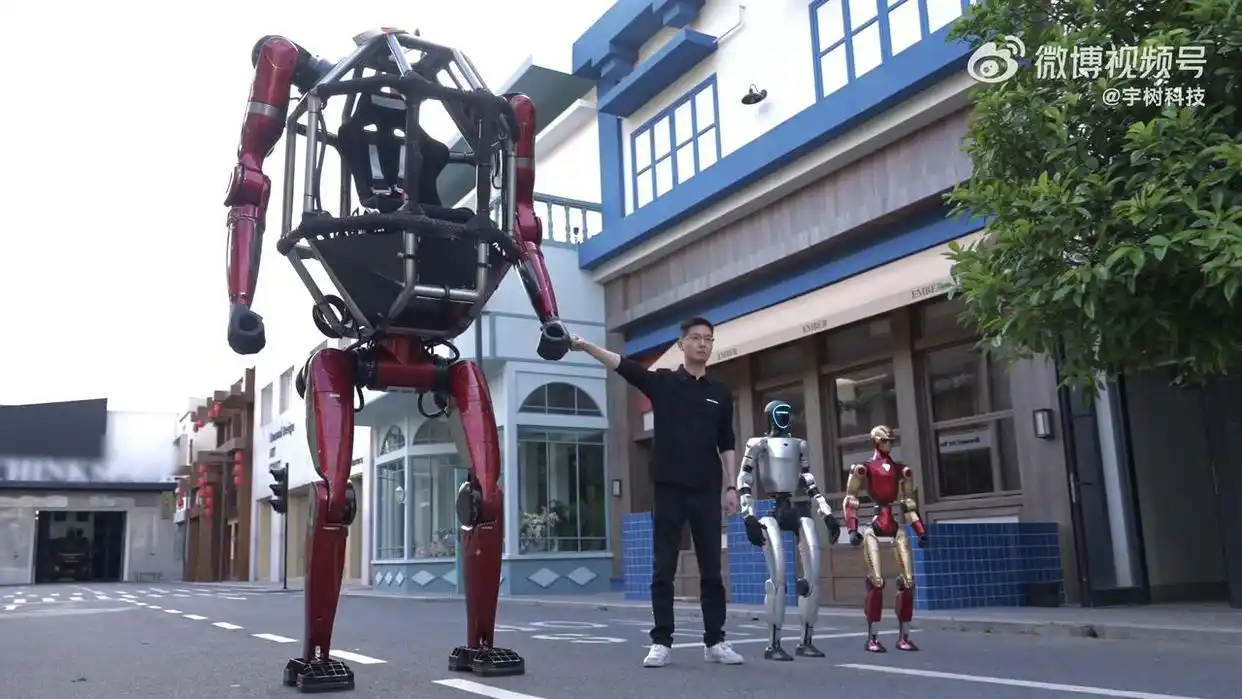

Chinese robotics company Unitree unveiled GD01, a human-carrying transforming robot that can switch between bipedal and four-legged movement modes.
Chinese robotics company Unitree has unveiled what it says is the world’s first mass-produced rideable transforming mech robot. The launch has drawn online attention and prompted discussion about embodied AI and new forms of mobility.
The company released the mech, named GD01, on May 12th. Priced from 3.9 million yuan (about £430,000), the robot can carry a human operator and switch between bipedal and four-legged movement modes, HKCNA reported.
Shortly after the launch video was released, related topics trended on the Chinese social media platform Weibo.
Demonstration Video Shows Human-Controlled Movement
In the launch video, Unitree founder Wang Xingxing climbs into the robot’s cockpit and controls its movements in real time. The machine walks steadily while carrying a person, strikes a brick wall, and then folds into a four-legged form within seconds. Many viewers compared the scenes to science-fiction films such as Pacific Rim.
Unlike traditional humanoid robots, GD01 creates a stronger sense of “human-machine integration.” Instead of simply watching a robot move, people can imagine themselves operating one.
As a result, the mech quickly became a symbol of how fast China’s robotics industry is evolving. Founded in 2016, Unitree develops robots for research, industrial, and commercial use. The company has reported strong revenue growth in recent years as China’s robotics sector expands.
Industry Discusses Applications and Regulation
Industry observers said the robot demonstrates advances in dynamic balance control, real-time human-machine coordination, and switching between bipedal and four-legged movement modes.
They said future applications could include emergency rescue, hazardous industrial operations, transport in difficult terrain, and entertainment uses.
Some social media users also raised questions about regulation, including whether rideable robots would require license plates or how they might fit into existing traffic rules.
Unitree has not announced a public ordering process. The company also said humanoid robotics technology remains at an early stage globally and advised potential buyers to understand the technology’s current limitations before purchasing.
If you liked this article, why not read: Unitree Robotics Opens Its First Physical Store in Beijing


