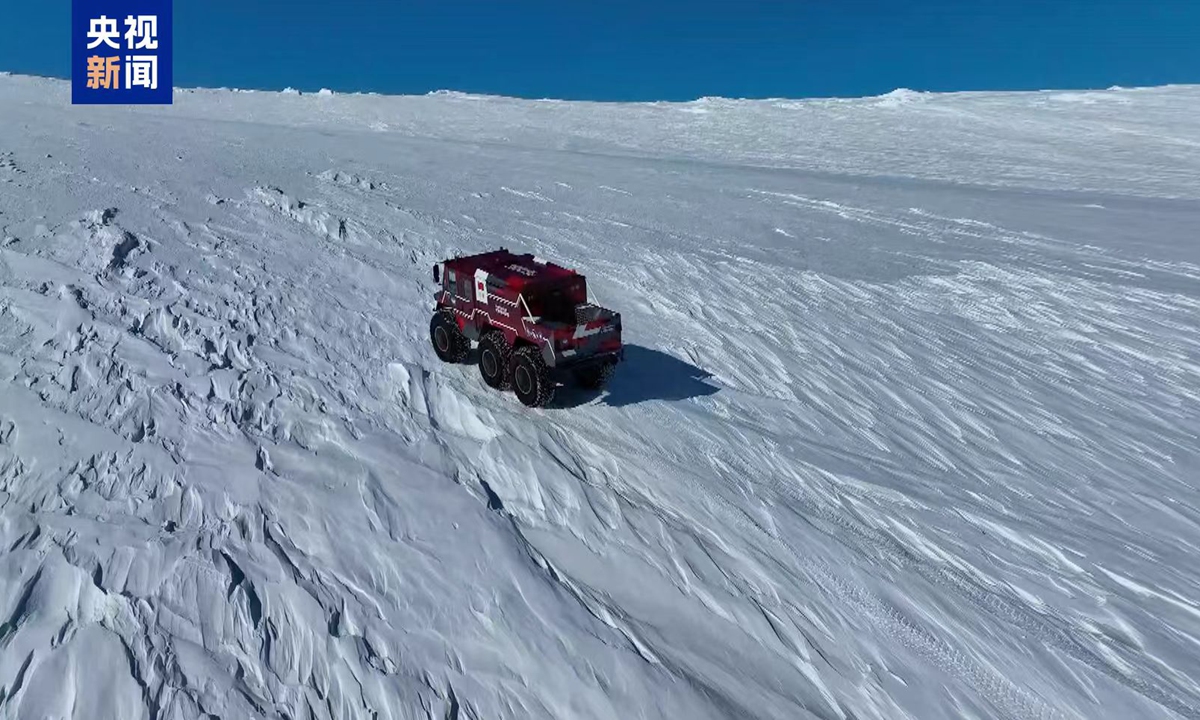

China’s domestically developed Snow Leopard 6×6 wheeled vehicle has completed a 10,000 km test in Antarctica, marking a breakthrough in inland polar mobility.
China’s domestically developed Snow Leopard 6×6 wheeled vehicle has completed more than 10,000 kilometres of testing and validation in the Antarctic interior, according to the 42nd Chinese Antarctic Expedition on February 10th. The program closes a long-standing gap in China’s capability to deploy wheeled vehicles for inland polar operations.
Performance on Snow and Ice
Over a 75-day mission window, engineers subjected the full-time six-wheel-drive platform to systematic trials across five terrain categories: sea ice, gravel, soft snow, hard snow and solid ice. The team evaluated core performance metrics, including terrain passability, dynamic stability and operational safety.
Field data indicate a marked improvement in mobility compared with tracked vehicles commonly used in polar expeditions. The Snow Leopard 6×6 wheeled vehicle reached average speeds of 28 km/h on soft snow, 42 km/h on hard snow, and a stable top speed of 65 km/h on solid ice during Antarctic testing. By contrast, tracked vehicles operating on soft and hard snow typically average no more than 20 kilometres per hour.
Mission Tasks and Strategic Significance
The vehicle undertook four operational task profiles during the expedition: rapid intra-station transport, inter-station transit, mission manoeuvre deployment and emergency support response. It completed all assigned tasks under inland Antarctic conditions.
For an extended period, China’s inland Antarctic operations have relied primarily on imported tracked vehicles. These systems provide high traction but operate at lower speeds and involve elevated fuel consumption and maintenance costs. The successful validation of the Snow Leopard introduces a domestically developed alternative for rapid personnel transport, scientific logistics support and emergency response in the polar interior.
The test campaign marks a transition from a predominantly tracked, heavy-load and low-speed operational model toward a combined wheeled-and-tracked deployment framework. This approach aims to enhance mobility, logistical efficiency and payload capacity in future Antarctic missions.
If you like this article, why not read: Growing Numbers of Chinese Travellers Explore Antarctica