
More than twenty years ago, the man who has just won this year’s Nobel Prize in Literature travelled to China in search of a spiritual utopia inspired by its classical civilisation. Here is his story.
A Journey in Search of Classical China
In May 2002, a Hungarian man named ‘Stein’ boarded a minibus from Nanjing to Jiuhuashan, setting out on a spiritual quest for ‘classical China.’
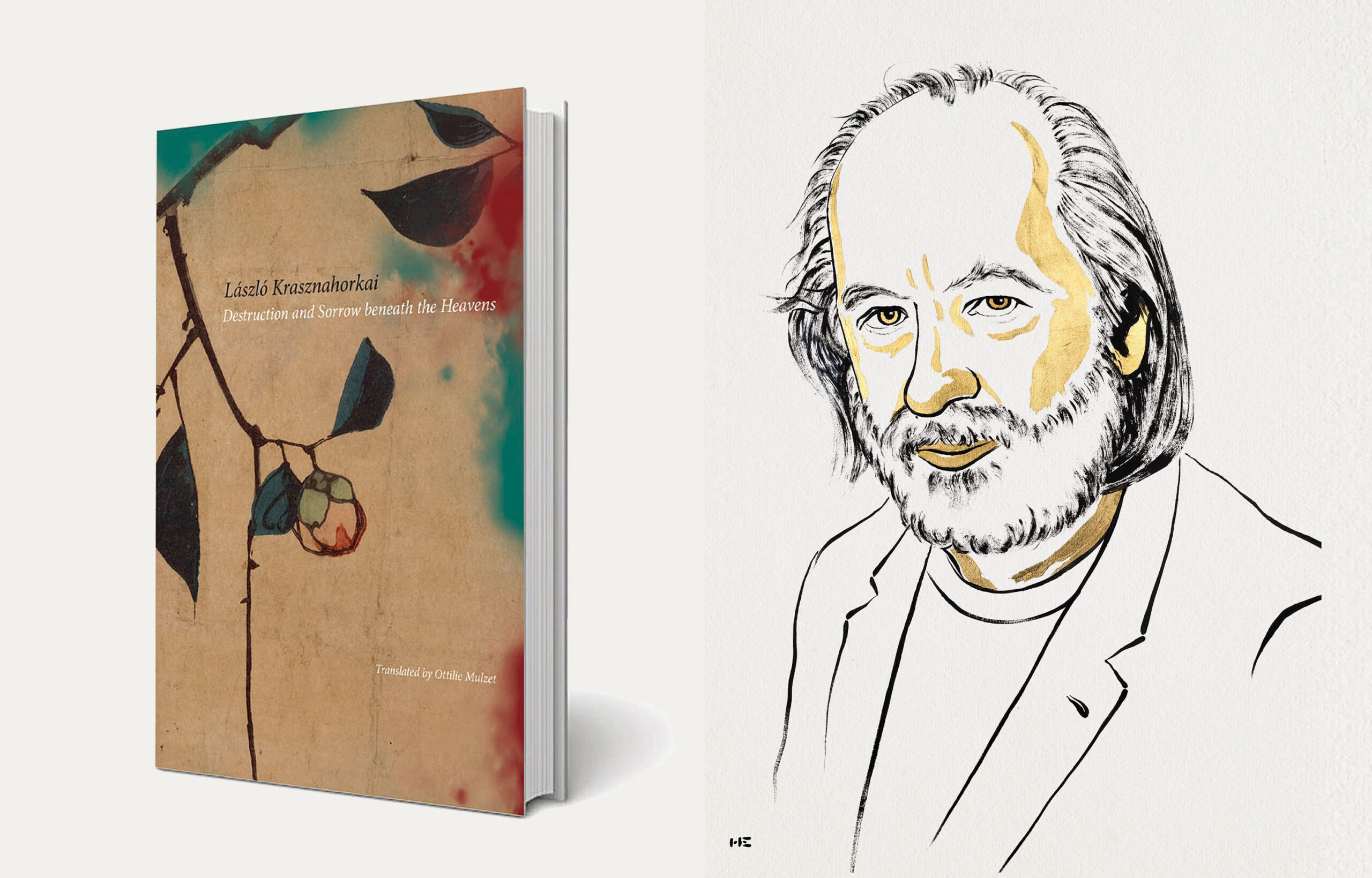
‘Stein’ was, in fact, the alter ego adopted by the Hungarian author László Krasznahorkai in his semi-documentary novel Destruction and Sorrow Beneath the Heavens, based on his own travels in China.
On 9 October 2025, the Swedish Academy announced that Krasznahorkai won the Nobel Prize in Literature. Chinese media widely highlighted his admiration for Chinese culture, especially his love of the Tang dynasty poet Li Bai.

The official Nobel Prize website prominently displays the English edition of Destruction and Sorrow Beneath the Heavens in the ‘group portrait’ of Krasznahorkai’s works. Yet when I began reading the book, expecting an ode to China from a writer ‘enchanted by Chinese culture,’ what I encountered instead was a pervasive tone of loss and disenchantment.
Blending fact and fiction, the book presents ‘Stein’s’ journey as both a record of Krasznahorkai’s own experiences in China and an introspective meditation on how he — and, by extension, the West — perceives and often misreads the country.
‘Stein’ regards ancient China with a near-religious reverence. To him, in ancient China, what we call ‘culture’ was not a separate domain but an integral part of daily life: poetry, philosophy, music, painting, and calligraphy were all expressions of life’s essence, inseparable from existence itself.
Carrying this idealised vision, ‘Stein’ travelled deep into the cultural heartlands south of the Yangtze River. He visited Buddhist temples, ancient architecture, and museums in cities such as Nanjing, Yangzhou, Zhenjiang, Shanghai, Hangzhou, Shaoxing, Taizhou, and Ningbo.
Disillusionment and the Persistence of Tradition
In 2002, China was undergoing rapid market reform. Urban redevelopment and tourism were expanding fast, and many heritage sites were being restored. Meanwhile, transport and accommodation infrastructure remained rudimentary. The public’s enthusiasm for foreign cultures was growing rapidly. Yet all this shattered the utopian image in ‘Stein’s’ mind. He saw the roughness and restlessness of a society in transition as proof of a ‘collapse of civilisation’.
His writing seethes with discontent. He laments the poor conditions of hotels, resents the minibus drivers touting for passengers, and despises pop music blaring in the streets. He condemns the commercialisation of temples and the reconstruction of ‘ancient’ buildings — even disapproving of monks using cell phones.
This hostility softened slightly one evening when he arrived in Zhouzhuang, a little village near Shanghai. To his delight, he found a tranquil village that seemed to exist only in his imagination: locals washed clothes down in the canal and sat idly in front of the houses as if time had stood still for this village. Yet the following morning, the illusion was shattered as the town was engulfed by tourist crowds.

‘Stein’ longed to find in China a civilisation untouched by time — a relic of simplicity and silence. He dreamed of a world that could fulfil his romanticised Oriental vision. In doing so, he ignored the realities of modern Chinese life and people’s pursuit of economic progress. He lamented that the Chinese, like modern Europeans, had embraced what he called a ‘second-rate mass culture’ that accompanied both the modern market economy and the so-called elite culture.
With the help of a local interpreter, ‘Stein’ conversed with a range of Chinese cultural figures — abbots, Kunqu theatre directors, writers, scholars, and designers. To his pessimism, they responded with patient explanations: traditional culture had not vanished, they said, but survived in new forms.
A young university instructor named Yao Luren told him that many still drank traditional Chinese tea and read classical books. A fashion designer named Wang Xiaolin said that clothes inspired by traditional Chinese elements were increasingly popular. The abbot of Guoqing Si (Guoqing Temple on Mount Tiantai) explained:
‘There is an expression, suiyuan, which means something like “according to predestination” or “according to fate”. During the Sui dynasty, Buddhists lived according to the suiyuan of their time. Today they live according to the suiyuan of ours. The form is different, but the essence is unchanged.’
‘You, sir, have only been here a few days, and you only see the surface.’ Yao concluded.
Yet ‘Stein’ remained obstinately bound by his own logic. In every conversation, he drew a firm line between ‘tradition’ and ‘modernity’, insisting that once buildings were reconstructed or ways of life departed from the ancient model, tradition had ceased to exist.

In Ningbo’s Tianyi Ge, the renowned private library from the Ming dynasty, the director, Gong Liefei, explained that the staff had moved the ancient books to modern concrete buildings. The new environment allowed them to control humidity and dryness more precisely and to prevent insect damage.
‘Stein’ was not persuaded. He protested that Tianyi Ge itself wasn’t the same thing. Unless all 13,000 books were returned to their original bookcases, he insisted, it could not truly be called a ‘library’.
Reconciliation and the Enduring Spirit of Chinese Culture
After his disillusionment, ‘Stein’ began seeking reconciliation with himself. Speaking with the poet Tang Xiaodu, he reflected that his journey had been a happy one after all. He had not found what he was looking for, yet in the end there was something: the realisation that the same sky clouded above him had once clouded above Li Bai — above all of Chinese classical poetry, and all of Chinese tradition — and that simple knowledge filled him with quiet happiness.
Following Tang’s advice, his final destination was Suzhou. It was there that ‘Stein’ seemed, at last, to find the answer he had been searching for — the embodiment of the civilisation he had long idealised. In the Zhuozheng Yuan, a garden built in 1509, he felt a rare peace. Despite the groups of tourists, he declared that the garden remains ‘intact,’ an ‘indestructible form.’ For even if a particular garden were to be destroyed, he reasoned, the spirit of the Garden itself endures.

The plants that compose it — chrysanthemums, hydrangeas, wisteria, lotus, bamboo, plum, paulownia, pine, and apricot — still grow upon the earth. Workers can still quarry the stones that give the garden its structure. Architects and scholars can still consult the plans of the pavilions and the books that describe their construction. If someone faithfully follows these traditional prescriptions, they can rebuild the original. Thus, through the persistence of materials, knowledge, and form, ‘Stein’ discerned the possibility of a living tradition, one that could never truly disappear.
Reading the book in full, I felt that ‘Stein’s disappointment revealed less about China than about his own aversion to the modern condition. China, in his imagination, became a site of redemption; when reality failed to match the myth, he felt betrayed.
Notably, more than two decades later, enthusiasm for traditional culture in China is stronger than ever. As with the Suzhou gardens, people are reviving many once-forgotten cultural traditions. Ancient aesthetics are back in vogue; young people wear Hanfu, and traditional crafts flourish on short-video platforms. Were ‘Stein’ to return to China today and witness how the ‘modern tastes’ he once deplored are being overtaken by ‘traditional sensibilities,’ one wonders — would his vision of China, at long last, be fulfilled?

Written by Estelle Tang
If you liked this article, why not read: László Krasznahorkai: Newly Nobel Literature Winner Who Looks to the East