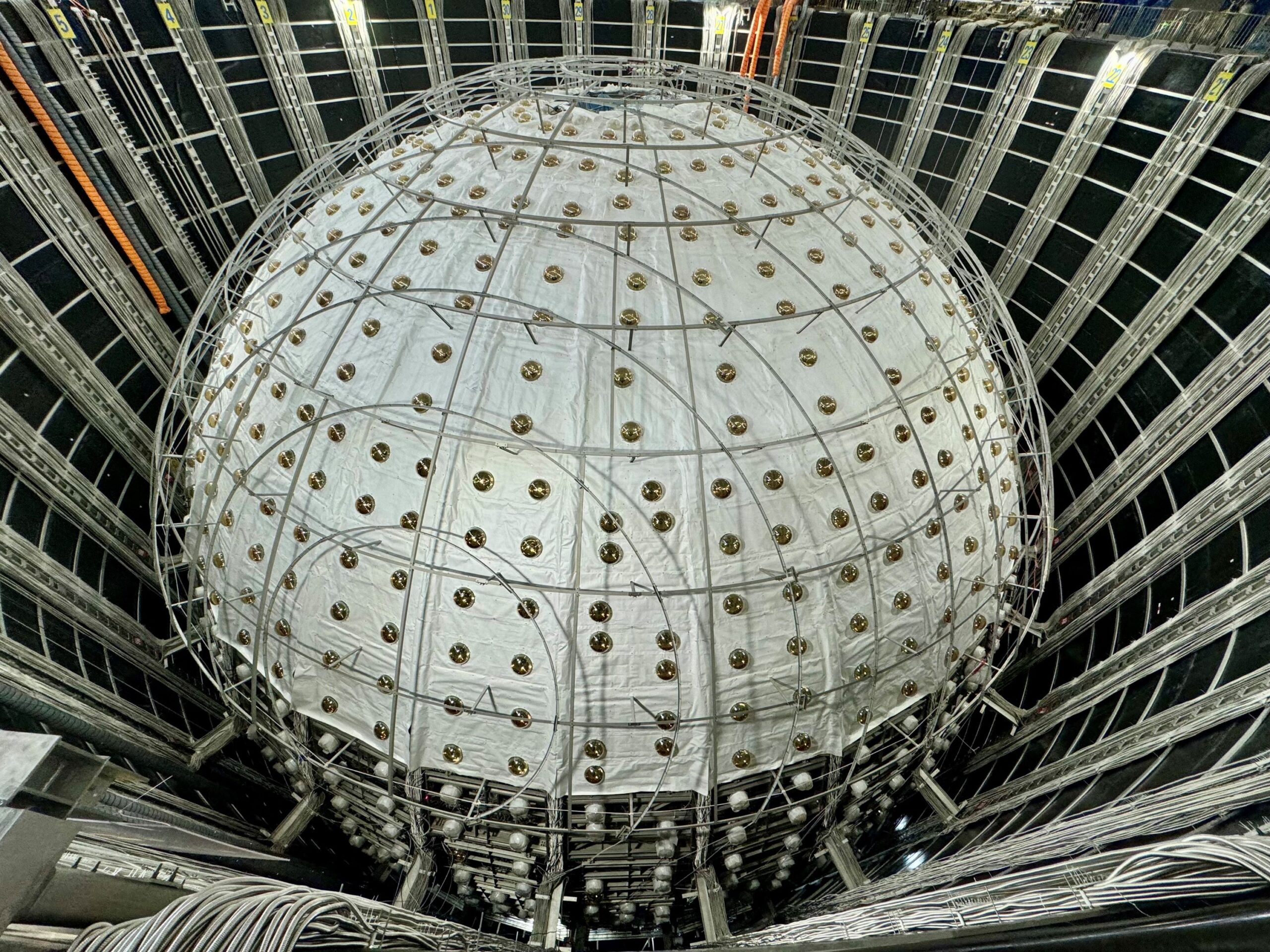

China’s Jiangmen Underground Neutrino Observatory (JUNO) has begun data collection, exploring neutrinos from reactors, the Sun, supernovae, and the Earth.
The Institute of High Energy Physics (IHEP) of the Chinese Academy of Sciences announced on August 26 that the Jiangmen Underground Neutrino Observatory (JUNO) has completed filling 20,000 tons of liquid scintillator and officially started collecting data. JUNO is the world’s first next-generation large-scale neutrino experiment.

A World-First in Neutrino Research
“This is the first time an ultra-large-scale, ultra-high-precision neutrino-dedicated large scientific facility has entered operation. JUNO will help us answer fundamental questions about matter and the universe,” said Wang Yifang, spokesperson for the JUNO collaboration.
JUNO sits 700 meters underground near Jiangmen in Guangdong Province. It can detect neutrinos produced 53 kilometres away by the Taishan and Yangjiang nuclear power plants and measure their energy spectrum with unprecedented precision.
After more than ten years of preparation and construction, trial run data show that the detector meets or exceeds all key performance goals. This enables scientists to address one of the major questions in particle physics for the next decade: the ordering of neutrino masses.

Global Collaboration Makes It Possible
JUNO involves around 700 researchers from 74 institutions across 17 countries and regions. Gioacchino Ranucci, JUNO deputy spokesperson and professor at the University of Milan and the Italian National Institute for Nuclear Physics, said, “International cooperation has been crucial. Together, we pushed liquid scintillator technology to its limits, making JUNO’s ambitious goals possible.”

Exploring the Unknown Universe
In addition, JUNO will study neutrinos from the Sun, supernovae, the atmosphere, and the Earth. It opens a new window to explore unknown physics.
The core detector holds 20,000 tons of liquid scintillator. A 41.1-meter-wide stainless-steel lattice sphere supports it at the centre of a 44-meter-deep underground water pool.
Additional reporting by CCTV and CNS.
If you liked this article, why not read: China’s AliCPT-1 Captures Images of the Moon and Jupiter