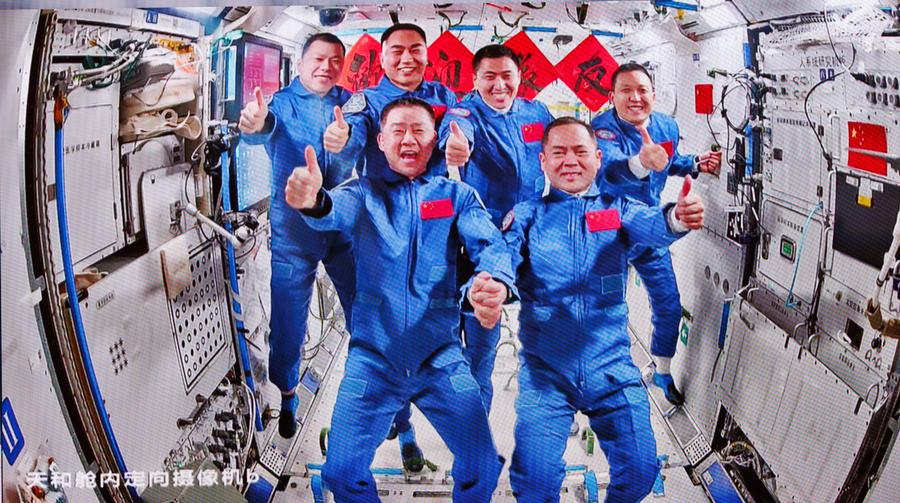

China’s Shenzhou-20 crewed spacecraft has delayed its return mission to Earth due to a suspected impact from tiny space debris.
The return of China’s Shenzhou-20 crewed spacecraft, originally scheduled for November 5th, has been postponed due to a suspected impact from tiny space debris, the China Manned Space Agency (CMSA) announced.
The decision to delay the return aims to ensure the astronauts’ safety and mission success, the agency said. The impact analysis and risk assessment are under way.
The Shenzhou-20 crew has been on board the Chinese space station for more than six months since their arrival on April 25th.
A Chinese expert explained the potential dangers, main sources, and countermeasures related to such debris.
Pang Zhihao, a senior space expert, said that discarded spacecraft and related components are the most direct sources of space debris, accounting for more than 40 percent. These include decommissioned satellites, rocket remnants and fragments from disintegrated spacecraft.
He added that another major source is operational waste generated during space missions. Though small in size, these fragments are vast in number. They include functional discardable such as bolts released during satellite separation, rocket fairings, or tools dropped by astronauts. Others also include Micro-particles from peeling surface coatings, tiny solar panel fragments, and engine combustion residue.
Pang noted that collisions and explosions between spacecraft have become a crucial factor behind the increase in orbital debris. Historical incidents of satellite-to-debris or satellite-to-satellite collisions have triggered chain reactions, with each impact generating new fragments that can strike other spacecraft – creating a “debris avalanche” that exponentially increases orbital density.
Written by Sha Liu, additional reporting by Xinhua, China Daily and Global Times.
If you liked this article, why not read: China Unveils Shenzhou-21 Crew of Space Station Mission